Retailers spend most of their budget and energy on the in-store experience. It only makes sense – upwards of 95 percent of revenue is generated inside the brick-and-mortar stores. However:
- The path to purchase often begins online. Seventy-three percent to eighty-three percent of U.S. consumers research online before buying in-store, according to a PricewaterhouseCoopers survey.
- Shoppers leave stores to buy online. Per a Harris Interactive poll, 43 percent of adults report that they’ve visited a brick-and-mortar store to examine a product before purchasing it elsewhere.
- Customer expectations of online/in-store integration out-pace the state of the industry. See the Forrester Research North American Technographics Retail Online Survey.
- Cross-channel satisfaction leads to revenue and loyalty. Per ForeSee’s 2012 E-Retail Satisfaction Index (U.S. Holiday Edition), satisfied site visitors are:
- 65 percent more committed to the brand overall
- 71 percent more likely to purchase from the retailer online
- 58 percent more likely to purchase offline
- 69 percent more likely to recommend the retailer
- 67 percent more likely to purchase from the retailer next time
Further complicating or enhancing the equation, depending on your perspective, is the influence of mobile. No one has summed up the impact better than Gibu Thomas, senior vice president of mobile and digital at Walmart, who was just named Mobile Retailer of the Year by Mobile Commerce Daily.
“Almost every facet of our lives has been transformed by a smartphone, but when you walk into a store…your shopping experience is still very much what it was 10 or 20 years ago,” said Thomas. “The possibility of mobile bringing the Web to the store is incredibly disruptive. Ecommerce brought the store to the Web and mobile brings the Web to the store. Our biggest opportunity in mobile is to drive offline-influenced retail sales with these capabilities, making it easier for our customers to shop with us,” he said.
Mobile sets the stage to integrate and create synergy among experiences on- and offline. As Vibes opines in its Mobile Consumer Survey, “A major factor driving consumers to research a product from their mobile phone while still in-store is simply to feel better about their purchase.” Here are four ways to do just that.
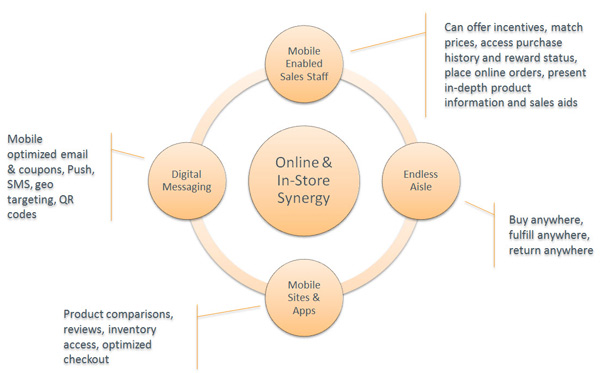
- Put mobile tools in the hands of store associates. A mobile-enabled sales staff should be able to offer incentives, access purchase history and reward status, place online orders, and present in-depth product information and sales aids.
- Create the endless aisle. Customers want to be able to buy anywhere and return anywhere. Creating access to all store and online inventory will move more product. The in-store pick-up or return is an opportunity to win customer loyalty. Associates should be encouraged – and incented – to make all experiences positive.
- Enable self-serve. Let customers research – and buy – on their own, on their phones. Provide the information that moves them closer to purchase: product comparisons, ratings and reviews, and availability. Many consumers, particularly younger ones, do not want to talk to an associate at the consideration stage. For those who move beyond and want to purchase, don’t skimp on optimizing the checkout process. Conducting extensive usability, testing and tweaking e-commerce and m-commerce functionality doesn’t win awards, but it does win sales and customers.
- Deliver effective digital messaging. Opportunities to gain competitive advantage abound here. Update your email templates to render well on mobile devices, which account for 30 to 50 percent of opens. Take advantage of push and SMS (not or, and!) to deliver sales and service information:
- Pickup notifications
- Order status
- Delivery/installation/service status
- eReceipts
- Account balances
- Returns received/processed
- Offer codes
- Coupons
- Traffic drivers
- Text-to-get and geo-targeted push for in-store offers
- Sale, event, and product announcements
- Credit card and reward program sign-up
- Product information, reviews, and videos
- Sweepstakes entry
- Email opt-in
As Gibu Thomas noted, bringing the web to the store is incredibly disruptive. Make it disrupt your customer experience in the best possible way.
Leave a Reply
You must be logged in to post a comment.