Marketing Goes Live.
“Advertising is no longer a broadcast sent into the world and measured weeks later. Through agentic AI and connected data layers, it becomes a living nervous system: sensing, deciding, and acting across the entire business in real time.”

Most DTC brands and retailers operate with a fundamental structural flaw. Their marketing and advertising operation runs in one silo. Their inventory, logistics, pricing and operations run in another. They are connected only by human meetings, weekly reports, and the institutional lag of spreadsheets.

Sources: McKinsey Global Retail Survey 2024 · Gartner CMO Spend Report 2024 · Fospha Benchmark Data 2025
“The question isn’t whether your marketing data is good. It’s whether your marketing data can talk to the rest of your business, and whether anything listens when it does.”
The Model Context Protocol (MCP) is an open standard developed by Anthropic that allows AI agents to connect to, query, and act on external data systems in real time. Think of it as USB-C for AI: a universal connector that lets an intelligent agent reach into your CRM, your warehouse management system, your ad platforms, and your attribution layer simultaneously.
THE MCP STACK FOR A CONNECTED BRAND:

Before MCP. Each data system is a separate island. A human analyst must extract, transform, and synthesise data across tools. Decisions happen after the moment has passed. Creative, budget and inventory decisions are made independently.
After MCP. An AI agent reads attribution data, checks live inventory, queries margin data, and writes updated ad copy or budget recommendations — in a single workflow. The loop closes in minutes, not days. Decisions are profitable by design.
MCP doesn’t just let AI read data. It lets AI act on it. An MCP-connected agent can query your attribution layer, check live stock levels in your WMS, pull margin data from your ERP, and write updated budget recommendations. Completed inside a single workflow, in minutes.
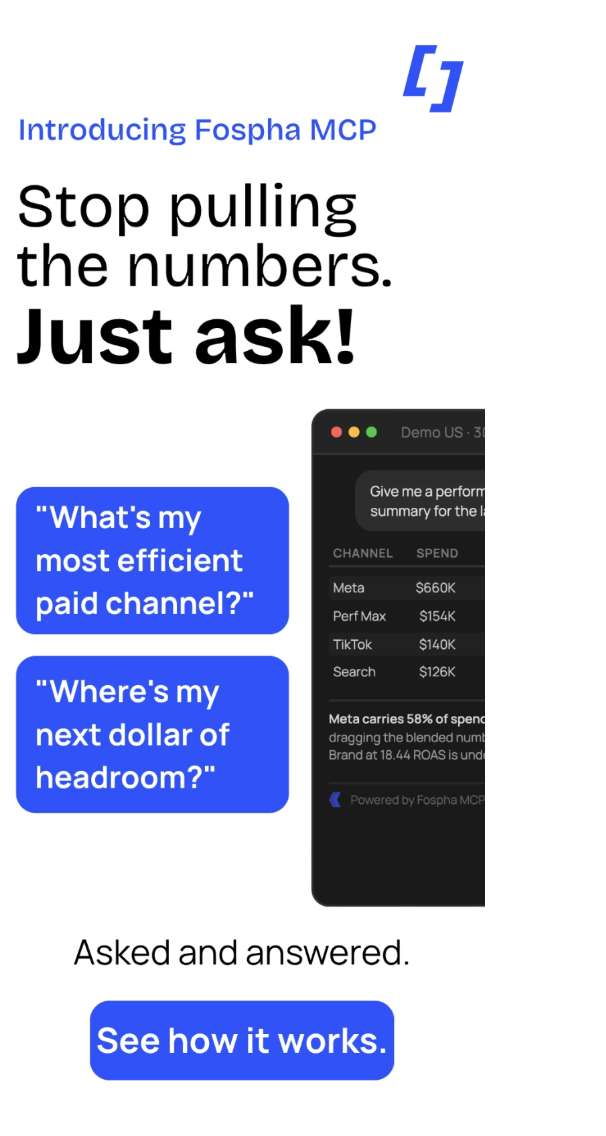
Fospha’s MCP exposes verified, privacy-safe attribution data, true channel contribution, incrementality, and saturation signals directly to AI agents. Rather than a monthly report that lands after decisions are made, Fospha becomes a real-time data layer any AI orchestrator can query: “What is my TikTok’s incremental ROAS this week? Where is paid social saturating?” The answers feed directly into automated actions.
Agentic AI doesn’t just surface insights, it closes the loop. When marketing truth data is connected to inventory, cost, and operational signals through MCP, the advertising activity becomes the nervous system of the business. It reads the state of the company and acts accordingly.
This is not automation of the old kind. This isn’t a scheduled report or a rule-based trigger. This is an AI agent that reasons across multiple live data sources, determines the optimal action, executes it, and logs the decision with its full rationale for human review.

Sources: Forrester Future of Marketing Operations 2025 · Fospha Internal Benchmark Data · BCG Retail AI Study 2024
Connecting attribution truth to inventory and cost data means the AI agent understands not just what is driving revenue, but what is driving profitable revenue. The distinction is worth hundreds of basis points in contribution margin.

Illustrative scenario based on aggregated Fospha client data · Actual results will vary by brand, category and media mix
Fospha Role
Fospha’s channel-level contribution and incrementality data is exposed via MCP. It tells the agent not just where revenue is coming from, but at what true cost and with what efficiency headroom. Combined with live COGS and inventory data, this allows the AI to optimise for contribution profit, not just top-line ROAS.
The connected brand doesn’t just react to data — it reads the signal before the customer leaves. Agentic AI operating across marketing, CRM, and operations data means personalisation at a scale no human team can match, delivered in the window when it matters.

Sources: Fospha Platform Data · Klaviyo DTC Benchmarks 2025 · Gartner Customer Experience Report 2024
“The closest brands to their customers aren’t the ones with the biggest CRM teams. They’re the ones whose data systems can read a signal and respond before the customer even notices the experience degraded.”
Speed is the compounding advantage. Brands that close the loop between marketing signal and operational response in hours rather than weeks accumulate a structural edge that becomes insurmountable over time. Not because they make better decisions — but because they make more of them, faster, with feedback built in.

This isn’t automation for automation’s sake. Speed in the right places, particularly where the window of opportunity is measured in hours represents direct revenue protection. A brand that responds to a viral product moment in 4 hours captures economics that one responding in 4 days simply cannot recover.
Not every brand is at the same starting point. The path to the Connected Brand architecture depends on where your organization sits today — and which foundation needs laying first.

If you’re in Latent Power. Connect your attribution layer first. Deploy Fospha to get verified channel attribution. Then layer MCP connectors to inventory, pricing, and CRM. The agent has something true to act on before you automate.
If you’re in Flying Blind. Attribution before automation. No amount of agentic sophistication compensates for bad marketing truth data. Fix your measurement foundation. Fospha’s cookieless attribution model is the starting point.
“The question every DTC brand needs to answer is: are we in Latent Power, where the data is good but the connection isn’t built? Or are we in Flying Blind, where we haven’t even got the foundation right?”
Framework adapted from BCG Digital Maturity Model 2024 ·
The first movers are already building. The window to close the gap without losing structural advantage is 12 to 18 months. After that, the compounding effect of accumulated decision intelligence will make catch-up extremely costly.

The brands that understand this in 2026 will be structurally unreachable by 2027. Not because they have better creative, better targeting, or better technology. But because they have built an operating model where every advertising decision is informed by the full truth of the business: margin, inventory, customer cohort, channel efficiency, and where the loop between insight and action is measured in minutes, not weeks.
This is what the Model Context Protocol makes possible. Not AI for AI’s sake. Not automation for automation’s sake. A connected architecture where marketing truth: verified, privacy-safe, always-on can flow into every decision that touches the customer.

Marketing Truth as a Live Data Feed
Fospha’s MCP exposes verified, privacy-safe attribution data, true channel contribution, incrementality, and saturation signals – directly to AI agents. Rather than a monthly report, Fospha becomes a real-time data layer any AI orchestrator can query. The infrastructure for the Connected Brand already exists.
Leave a Reply
You must be logged in to post a comment.