The Man Who Refused the Money - A Conversation with Brent Ridge, MD, Founder at Beekman 1802
Most founder stories from 2008 begin with a pitch deck. Brent Ridge, MD begins with a layoff and a goat. He was thirty years old, working as Director of Healthy Living for Martha Stewart, when the recession took the career he thought he was building. His partner lost his job the same week. They had a farm in Sharon Springs they couldn’t afford, ninety goats they hadn’t planned to keep, and no way back to the city they had just been ejected from. The conventional move, then as now, was to find an investor who would believe in the story and write a cheque against the promise of a turnaround. Ridge made the opposite move. He decided he would never take that cheque.
The decision sounds like founder folklore until you look at what it actually cost him. Beekman 1802 did not pay its founders a salary for the first ten years. Ridge and Josh Kilmer-Purcell grew their own food because they couldn’t afford to buy it. They paid neighbours in barter and goodwill because they couldn’t afford labour. The brand that is now stocked in every Ulta in America was built by two men making soap in a barn while reaching into a hen house for that night’s dinner. The discipline of refusing outside capital was not a strategy. It was a vow taken in anger at the banking industry, and then honoured for a decade past the point at which any rational founder would have broken it.
The mechanism underneath this is not frugality. It is sovereignty. When you take someone else’s money, you take their timeline. The investor’s clock starts running the day the wire clears, and from that day forward, every decision is filtered through a question that is not yours: how does this look at exit. Ridge understood, earlier than most founders ever do, that the question itself corrodes the thing being built. You cannot design a hundred-year company while answering to a five-year fund. The two timelines do not reconcile. One of them wins, and in almost every case it is not the founder’s.
Ridge has said it plainly:
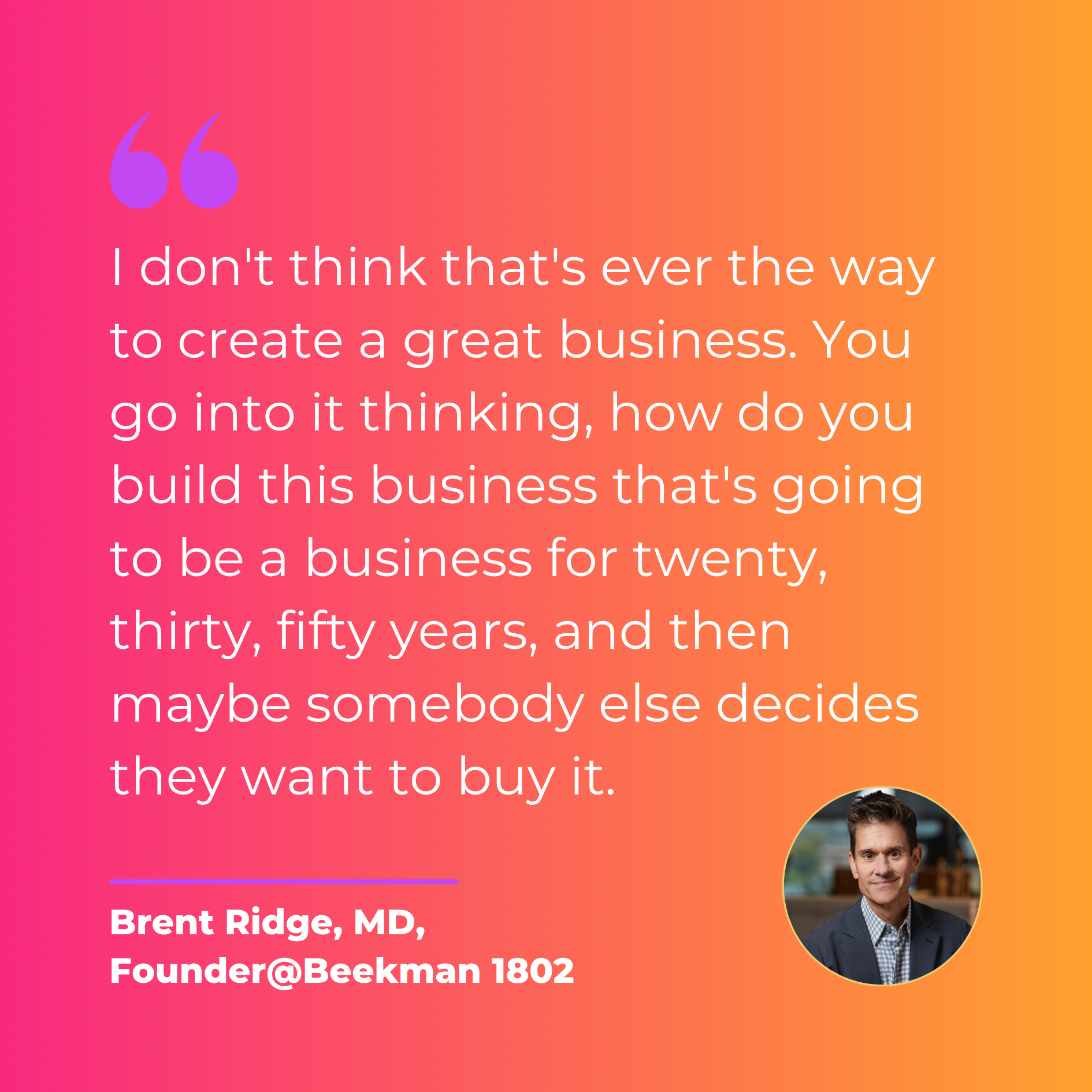
“I don’t think that’s ever the way to create a great business. You go into it thinking, how do you build this business that’s going to be a business for twenty, thirty, fifty years, and then maybe somebody else decides they want to buy it.”

The distinction matters because the vehicle built for the buyer is optimised for the multiple, and the multiple is optimised for the spreadsheet, and somewhere in that chain the actual product, the actual customer, and the actual reason any of it began get stripped out for parts. A great business is what happens when the founder builds something they would still want to be running in thirty years, and someone else decides they want to buy it anyway. The order of those two events is everything.
What is striking about Beekman 1802 is that the philosophy did not stay philosophical. It compounded into a structural advantage. Because Ridge could not afford acquisition marketing, he had to build a brand that customers would carry for him. Because he could not afford celebrity endorsement, he had to make the founders themselves the credible voice. Because he could not afford to be impatient, he had to wait for the goat milk story to become the microbiome story, which took a decade of patient scientific groundwork that no funded competitor would have had the runway to do. Eurazeo eventually bought into the company in 2021, which is the kind of outcome that retroactively justifies any path, but the path was not chosen for the outcome.
There is a quieter point inside this. The hardship Ridge endured was not chosen. The recession imposed it. But once it arrived, he refused the obvious exit from it, and in refusing he turned an external pressure into an internal practice. Ten years of growing your own food because you have to becomes, by year eleven, a way of operating that no funded competitor can replicate. This is the pattern I have spent the last two years writing about in Hard: that voluntary friction, sustained past the point of comfort, builds capacities that ease cannot. Ridge’s version was involuntary at the start and voluntary by the middle. Most founders do not get the recession. They have to choose the friction themselves.
The lesson is not that founders should refuse capital. Some businesses cannot exist without it.
The lesson is that capital, once accepted, sets the metabolism of the company, and the metabolism cannot be reversed.
Ridge built Beekman on what he calls a community of neighbours. He still uses the word neighbours to describe his customers. The Kindness Crew, the four thousand affiliates screened on a “Kindness Quotient,” is not a marketing programme that was bolted on after product-market fit. It is the natural extension of paying neighbours to box soap because there was no other way to get the soap boxed. The brand’s defensibility today, the layer that makes a category leader like L’Oréal hesitate to commodify the microbiome story, was built when two broke men had no choice but to do everything by hand and in person. The constraints made the moat.
For a founder reading this in 2026, with a deck open in one tab and a list of warm investor introductions in another, the question is not whether to take the meeting. The question is whether you have first built something that would still be worth building if no one ever wrote the cheque. Ridge spent a decade answering that question with his hands, his land, and his neighbours, and the answer is now stocked on a thousand shelves.
The companies that last are built by founders who could have walked away from the money and didn’t need to.
Leave a Reply
You must be logged in to post a comment.