ETAM and Vuori: Global Growth Runs Through Local Trust
Event Coverage Sponsored by

Three out of four brands fail when they try to take a proven concept into a new market. That is not a niche statistic. It is the backdrop against which ETAM and Vuori built their international operations, and it framed a session at Shoptalk Europe 2026 that argued the real barrier to global growth was never strategy. It was execution.
Gaurav Pant, Chief Insights Officer at Incisiv, opened the panel with research spanning close to a decade of expansion attempts across global brands. His framework rested on three questions: what a brand refuses to change, whether it understands its customer through lived experience, and whether its people on the ground can deliver what head office designed. Pant argued that brands fail for one of three reasons: hubris, in believing their success travels automatically; complexity, in underestimating operational differences between markets; or under-preparation, in not building the local team needed to execute.
He then brought Jose Gomez of ETAM and Ashley Kechter of Vuori on stage to test that framework against two very different businesses. ETAM is a French lingerie group with five brands present in 60 markets. Vuori is a California-founded performance wear brand with a growing footprint in China, Korea and the UK.
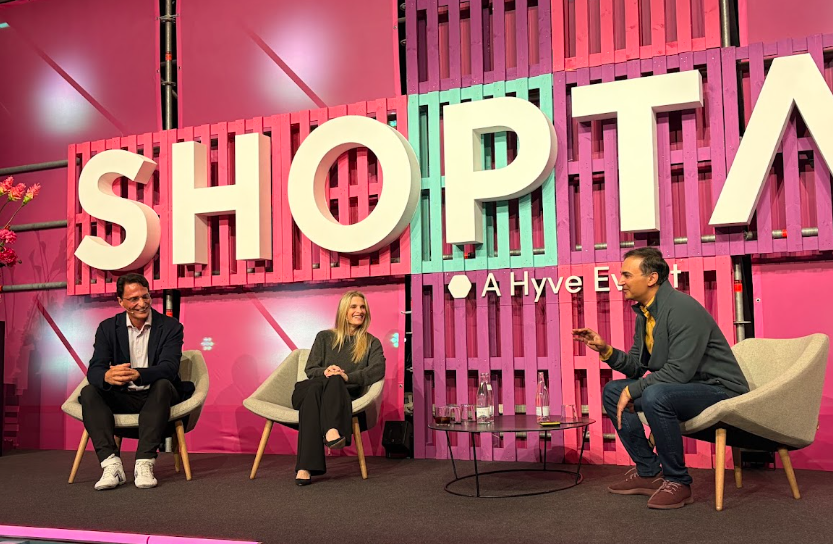
Gomez was direct about what has changed for international expansion over the past decade. Where growth once hinged on finding physical infrastructure in new markets, the challenge today is capability, not real estate. He also flagged a shift that matters commercially: the advantage a Western brand once carried simply by entering an emerging market has thinned considerably. “When you go to a market, you go to homework and you study and you study the competition, and you study a little less the customer, because maybe you’re less present, so you know less that customer is.” Gomez argued that ought to be reversed, with far more attention paid to the customer and local talent than to competitor benchmarking.
Kechter described a deliberately narrower approach at Vuori: building density within a market before spreading thin across several. “Our strategy… has been around building density of stores within a market before we go too thin across multiple markets, so we honed in on China, we’ve honed in on Korea, and we’ve started our expansion there with many doors, so we could test and learn from that before we start to spread ourselves across markets.”
Both speakers rejected the idea that a five-year plan, however polished, is the thing that travels. Gomez was explicit that a plan has to survive contact with shocks, not predict them. What does travel, in his framing, is a short list of things the brand will never trade away. Asked what he would tell teams to focus on immediately, he named three: product integrity, brand integrity and shopper trust, adding that brands should build capability before they build store count.
Kechter’s version of the same idea centred on trust in the local team. Her advice mirrored Gomez’s in spirit.
“Trust your customer and the local truths that you hear from them. Second, empower your leaders, both corporate wide and within the teams that are on the ground. And then the third is protecting your brand DNA.”
Both panellists were clear that data has changed the speed of decision making without changing where the real signal comes from. Kechter pointed to social sentiment and customer insight tools as giving Vuori a depth of market understanding earlier-stage international brands lacked a decade ago. But she was equally firm that the store remains the place where the relationship is actually built. “Our stores, in our experience, and the experience you get when you’re working with our sales associates, is much more relationship based, and so our customers come in and they know who they’re working with, they often have the same conversation with the same person.”
Neither speaker dismissed AI, and neither oversold it. Gomez was specific about where he sees genuine value versus hype. “I think the reality is productivity. Okay, definitely reality. We see it, we have more information, we can make decisions faster.” He was equally direct about the limit. “AI cannot replace experience or emotion. And today, if you have stores without experience or without emotion, you have stores without soul, and stores without soul, they become transactional. So, if your store is exclusively transactional, it will be easily replaced by a website.”
Kechter’s read was consistent with that, describing AI’s role at Vuori as helping customers navigate product choice, including work on a conversational shopping experience, while insisting it supports rather than substitutes for the in-store relationship her team has built deliberately.
The session’s throughline was that international growth fails less often from a flawed thesis than from a team that cannot execute it under pressure. For marketers weighing expansion, the practical takeaway is to define the two or three things the brand will never compromise before writing a market entry plan, since that list will outlast any five-year forecast. Data can tell a team what is happening faster than ever. Whether the brand is worth choosing still gets decided by a person, in a store, having a conversation nobody automated.
Leave a Reply
You must be logged in to post a comment.