Consistency Matters in Social Customer Care: Three Things to Help Get it Right
Social capital can help brands build trust and encourage customer loyalty, as long as marketers are consistent in social media strategy.
Social capital can help brands build trust and encourage customer loyalty, as long as marketers are consistent in social media strategy.
Consistency is gold on the social web. A fantastic restaurant with a tendency for “off nights” is less likely to succeed over the long-term than a decent restaurant that is always on the mark. Why? Because the willingness to offer recommendations — those conversations that power conversions to sales — is rooted in consistency via social capital. Make great recommendations and your fans, friends and followers will reward you. But inconsistency makes recommendations less likely, even after a stellar experience.
The company I work for, Lithium, acquired Klout partly in recognition of the importance of understanding social capital and its contribution to trust. Along with actual performance your consistency is a factor in building your brand reputation. Yet, even among like-sized and similarly positioned firms the quality and timeliness of social responses varies. Consider this study from Socialbakers of social channel response across industry verticals. 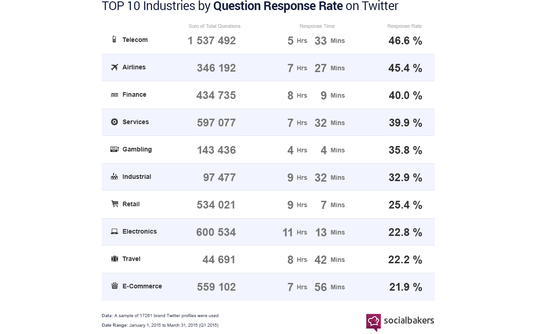
Striking is the disparity between industries — Telecom and Airlines respond to roughly twice the share of incoming posts as Retail and Electronics, but the former respond on average in six hours while the latter are average closer to 10.
The chart tracks with reality, too. I’ve recounted in the past my very favorable experiences with United and T-Mobile, both of which provided timely, consistent responses. KLM is legendary. If you’ve seen my recent posts regarding Pioneer you’ll know I’ve waited for eight weeks for a warranty repair, with no response at all to posts on Twitter or Facebook. I did receive a private message, directing me to Pioneer’s warranty department; I called and was promised an authorization for repair but have yet to receive it. Great product. Lousy follow-up. Poor consistency.
So, who do you think I’m likely to recommend? United: check. T-Mobile: check. Pioneer? The irony is that great products and services are available in all of the industries noted; Pioneer is certainly considered a top brand. But on the social web, it scores a “neutral” and more likely a negative.
So what do you about this? How can you build a first-rate social customer team? Here are three things you can do that will help increase the likelihood of your own customers becoming brand advocates on the social web:
1) Implement a social response team and process-driven workflow so you can measurably improve response capability while observing fiscal responsibility. Just because Brand A is responding in 10 minutes doesn’t mean you need to. Build a response plan that connects your business objectives and measure your results. Working with the National Bank of Kuwait, our professional services team helped do exactly that, and in turn the social team at the bank (disclosure: NBK uses both Lithium and Socialbakers software) was able to meet its established business goals. #boom.
2) Benchmark your performance by visiting the Socialbakers study linked above and seeing how your brand stacks up, use your own favorite benchmarking tool or ask someone to help you with a benchmarking exercise, a service we routinely provide for our customers (many of whom appear favorably in the Socialbakers study). The point is this: it matters less how you benchmark than that you do benchmark. Connect your social response strategy to your business objectives, all in the context of your competitive set. Maybe Pioneer has it right; maybe losing me to Sony or Alpine makes business sense for them. There is power in quantitative knowledge, and benchmarking is a key discipline in gaining and harnessing that power.
3) Consider the costs of customer acquisition in your governing equations for ROI. Social Care ROI is generally driven by a realized cost savings when a customer’s issues are addressed in social rather than telephone agents. But there is more: when you lose a customer over poor service there is a cost to re-acquire or to acquire-from-new. That can be quantified as well. If you haven’t, consider mapping your customers onto a loyalty loop.
In summary, one problem, ensuring response consistency, can be tackled through three best practices: strategic planning, benchmarking, and inclusion of acquisition costs in ROI. Add these disciplines to your social technology planning and measurement program and join the best-of-class.
Leave a Reply
You must be logged in to post a comment.