Spotify trades users commercials for branded moment video ads
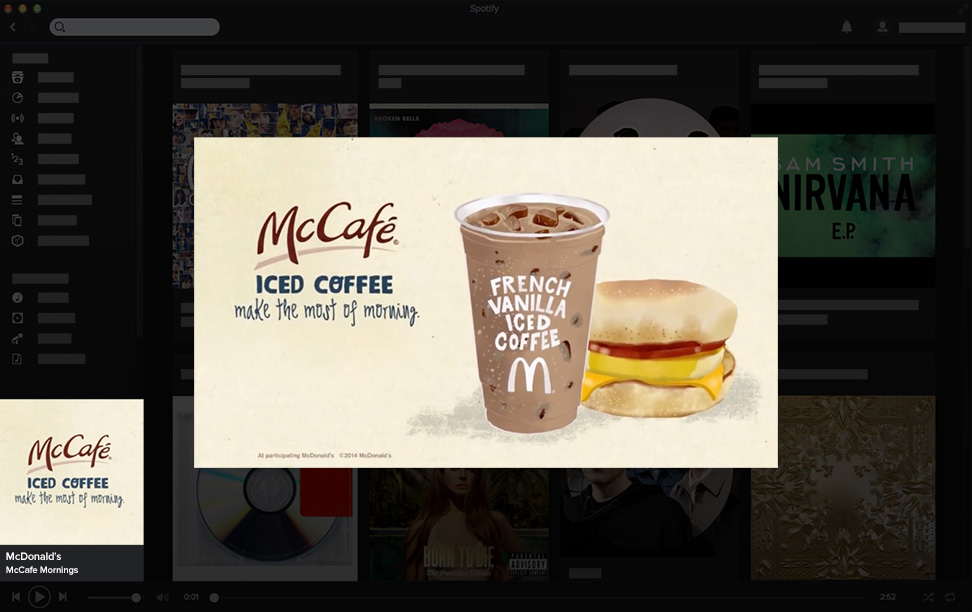
Spotify, the popular digital music service, is getting into the video ad game with a new ad offering called “branded moments.”
Currently, Spotify has 70m free users who it delivers audio commercials to, much like terrestrial radio. Branded moments give those users an alternative: if they watch a branded moment ad, which appears when they first open a playlist, they’ll receive 30 minutes of commercial-free listening.
The branded moments are mobile-centric vertical video ads, and they can be targeted to six categories: chill time, workout, party, dinner, focus and sleep.
According to Danielle Lee, Spotify’s VP of global partnership solutions, “A branded moment is more about reaching users in a specific context. Based on the playlists that they’re activating, we know the moments they are in.”
Bose, for instance, is targeting chill time playlists with a branded moment promoting its headphones. Mike Mangione, Bose’s director of consumer marketing, likes the branded moment concept because it’s less disruptive to the user experience. He told AdAge:
We’re focused on wrapping ourselves around the experience, in the moment. We’re moving away from interruptive ads and actually trying to understand what the user is trying to accomplish.
While users who watch a branded moment ad don’t have to worry about commercials interrupting their listening, display ads do appear periodically during the commercial-free 30 minute period. Spotify sees these display ads as a way for advertisers using branded moments to reinforce their messages after the initial video is delivered.
Spotify is just one of many media companies launching offerings that allow them to monetize their users in new ways while giving users the ability to alter, reduce or eliminate the advertising they are subjected to.
The Atlantic, for instance, is rolling out a new subscription offering that costs $3.99/month or $39.99/year and allows its users to consume The Atlantic’s online content free of ads. The offering will be promoted to users with ad blocking enabled, who will be asked to subscribe or whitelist The Atlantic’s site in their ad blocking software.
According to Kim Lau, the publisher’s business development chief, The Atlantic is losing “multiple millions of dollars” of revenue to ad blockers, an unacceptable situation that had to be addressed.
While Spotify with its audio commercials doesn’t face the same ad blocking challenges that other media companies do, its decision to allow users to trade video ads for commercial-free listening highlights the fact that media companies of all kinds are trying to figure out how to maximize revenue while minimizing user angst over ads.
Leave a Reply
You must be logged in to post a comment.