A report by The Internet Advertising Bureau UK and UK Online Measurement Company has revealed that the average Brit spends two hours 51 minutes per day actively using the internet at home and work (during the first six months of 2015). Internet time is split one hour 16 minutes (45 per cent) on PCs/laptops, one hour nine minutes on smartphones (40 per cent) and 26 minutes on tablets (15 per cent).
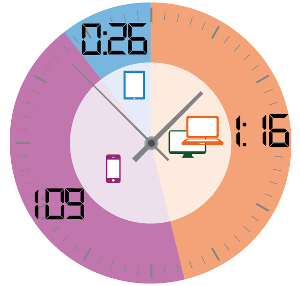
“There’s a lot of confusion when it comes to the various sources claiming to measure how long people spend on different media,” said the IAB’s Chief Strategy Officer, Tim Elkington. “So, we wanted to put a stake in the ground for internet time to remove this misconception and help advertisers understand how much time they realistically have to play with to reach people online. It equates to about 1 in every 6 waking minutes¹.”
The data comes from a combination of meters measuring the behaviour of 73,000 people (a panel) plus thousands of sites and apps being tagged (site analytics).
The resulting figures purely measure “active attention”, that is, only the time people are actively using the internet to do something. Elkington explains: “If I’m surfing the internet on my PC but then start using a word document, the internet time is stopped even though the web page is still open. A similar approach is applied on mobile when internet activity is interrupted due to calls or texting.”
Social media overtakes entertainment in share of online time
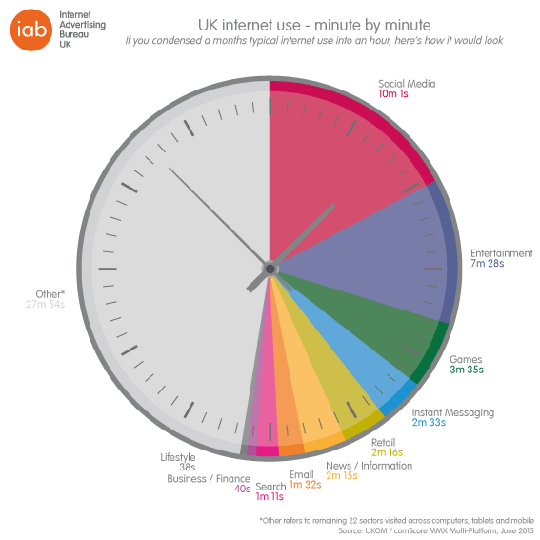
The data reveals that 16.7 per cent of all UK internet time (one in every 6 minutes) across computers, tablets and smartphones is spent on social media – up from 12 per cent two years ago. Social media has overtaken entertainment, whose share nearly halved from 22.1 per cent to 12.4 per cent.
Games follows next at 6 per cent share – double that of two years ago (3 percent). Together, these activities account for over one third of Britons’ time online.
Share of time differs dramatically by device
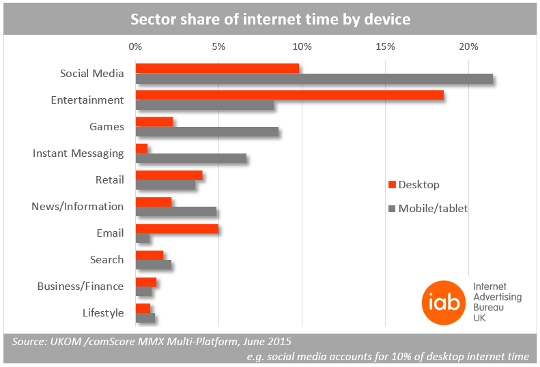
Social media accounts for over double the share of mobile/tablet internet time (21.4 per cent) than it does of desktop internet time (9.8 per cent). Games (8.6 per cent vs 2.3 per cent), Instant Messaging (6.7 per cent vs 0.8 per cent) and News (4.8 per cent vs 2.2 per cent) also take up a much larger proportion of mobile internet time than desktop time.
In contrast, entertainment accounts for over double the share of desktop internet time (18.5 per cent) than it does on mobile/tablet (8.3 per cent); for email, it’s over six times the share (5.0 per cent vs 0.8 per cent).
“When trying to reach consumers, advertisers can’t afford to think of time online as a homogenous entity,” said UKOM’s General Manager Scott Fleming. “Mobile internet time is more heavily skewed towards social networking and games whilst desktop is more loaded towards email and entertainment such as film and multimedia. “The most effective digital ad strategies recognise and take into account how behaviour and mind-set differ dramatically by device.”
Leave a Reply
You must be logged in to post a comment.