Three Best Practices for Customer Engagement
Relationships with customers is now worth twice as much as your measured brand value, as brand value has fallen by almost half in the past decade while the latter has doubled.
Relationships with customers is now worth twice as much as your measured brand value, as brand value has fallen by almost half in the past decade while the latter has doubled.
If a picture is worth a thousand words, what’s below is worth five hundred billion. Why? Because $500 billion was roughly the global advertising spend in 2013.
Looking at the graph, it’s obvious that an increasing share of that is wasted.
Building a strong business is no longer about declaring the brand to be this or that in a TV spot or magazine ad: it’s about proving it every day, in every single transaction, with every customer.
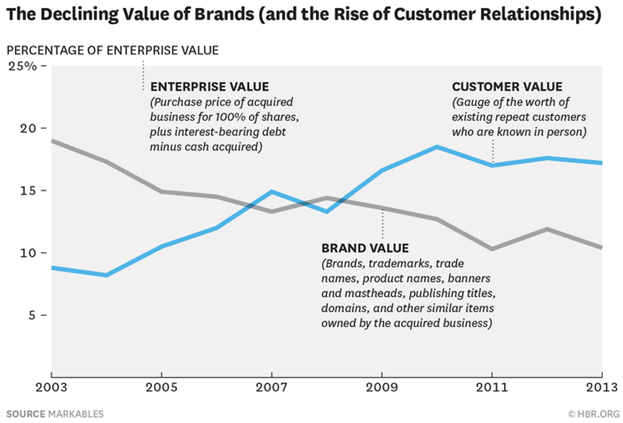
Taken from a thought-leadership article appearing in the Harvard Business Review the story accompanying the graph makes clear this new reality: if you’re thinking in terms of ROI and measurement of actual values (and you should be) then the article will appeal to you. It makes the case that on your balance sheet your relationship with individual customers is now worth twice as much as your measured brand value. Brand value, as a share of balance sheet assets, has fallen by almost half in the past ten years while customer value has doubled.
So what should you do? Quit your ad campaigns? Unlikely: awareness is still part of acquisition. But instead of focusing primarily on advertising – which most brands do – focus on customer retention and loyalty. Not loyalty as in “here’s 50 points toward a beach umbrella (with our logo on it…) that you can earn in a few years”, but rather loyalty as in “I will repeatedly buy from you and tell my friends about you if they ask.” What’s the easiest way to ensure that? Get to know your customers as individuals and engage with them as such: learn about what they like, and consistently deliver that. Here’s how.
When a customer calls, you have a standard for response. When a customer walks in to your store, same thing. But what about a post on Twitter? In a study conducted by Maritz, the majority of brands failed to respond at all while separately, of those that did, the majority had response targets of 2 hours, 4 hours, or even longer. That used to be OK; in contemporary connected markets, it’s not.
Best of class response times for high-tech consumer, telecom, media and entertainment, and financial services is now on the order of thirty minutes, with some response time targets as fast as 90 seconds. 90 seconds. The fact is customers are more likely to buy when you respond: a New York University proved it, as if you needed a study to know that.
It’s an all-too-common practice that Marketing and PR still own customer response. But consider: just because the social media channels have “media” in the name doesn’t mean your social response needs to be limited to “Wow, we’re so sorry. Please email us”. For brands with basic social customer, the bar has been raised there too: it’s no longer sufficient to define responses in a script and force agents with limited process knowledge to fend-off customers with advanced questions they really can’t answer.
To be sure, agents can answer-in an excellent, efficient manner-questions like “Why does my statement show a $12 charge when I was expecting a credit?” It’s better from a business perspective to spend $3 on social rather than $30 on a call to address questions like that. But what happens when your customers asks “In considering our renewal, which blade server best fits my needs?” You need to engage subject matter experts across your organization: can your social response team do that?
Finally, share the love. When your customers experience satisfactory resolution to specific issues, and in particular those using social channels, those conversations should be shared. Not just on Twitter where your employees probably can’t see them but internally, on monitor walls and real-time desktop dashboards. Build employee excitement around collaboration social channel participation.
When employees see customer’s questions their first thought is “I didn’t realize that so many of our customers had that problem!” The result is better products and services. The second thought? “I could help answer that…I know what to do to fix it.” There is simply no better way to get expert assistance for agents who often do not know the answer than to appeal to the experts within your own organization.
So there you have it. Customer value is at an all-time high: it looks less and less a winning strategy to pour money into Superbowl ads. Instead, empower your organization to engage and get to know your customers. Build relationships through timely responses that encourage loyalty and brand advocacy.
Leave a Reply
You must be logged in to post a comment.