Why Your CFO Doesn't Trust Your Marketing Numbers
A Q&A with McCall Milligan, Head of Data Science at Fospha, on building the trust layer that makes measurement actually useful
Every marketer has been there. You walk into a budget review with data showing a channel is working. Your CFO pulls up Google Analytics. The numbers contradict yours, and the conversation stalls.
That upper-funnel campaign you know is driving results? It stays underfunded for another quarter.
The frustrating part is that neither tool is necessarily wrong. GA measures one thing. Full-funnel measurement captures something else entirely. But when no one in the room can explain why the numbers differ, trust evaporates. And without trust, nothing moves.
This is the problem Fospha set out to solve with Model Spotlight, a transparency layer built into their measurement platform. We sat down with McCall Milligan, Fospha’s Head of Data Science, to understand why measurement transparency has become a strategic imperative, and why it matters more than ever as brands race toward AI-powered automation.
ClickZ: Tell us about your role at Fospha.
Milligan: I’m the Head of Data Science at Fospha, so my team is responsible for the model quality that provides measurement values for the dashboards.
ClickZ: For any marketing leader who’s ever opened two dashboards and seen two completely different stories, why does that happen? What’s actually going on under the hood when GA says one thing and another measurement tool says something else?
Milligan: It happens because they’re quite different models. If you’re looking at the GA model, it’s a really useful starting place. You can get information really quickly, it’s good for that. But then comparing to what we’ve got in Fospha, it’s more of a holistic view.
The last-click numbers in GA aren’t actually representative of what’s going on with impressions or a bunch of other information. So if you’re looking at the difference between something like last click and what you see in Fospha, the number differences are really because of all of the different processes and modelling and measurement that we put in behind the scenes to make sure that you’re getting a holistic view rather than just what happens at the last click.
ClickZ: When measurement feels like a “black box,” what’s the real cost of that?
Milligan: One of the worst things that happens if you don’t have complete trust in what’s going on, or you see a black box, is that you can’t really correctly justify your decisions. Which means that when you’re looking to make a case for changing really anything budget-wise to finance, it becomes an absolute pain because it’s impossible to justify what the model is actually giving you.
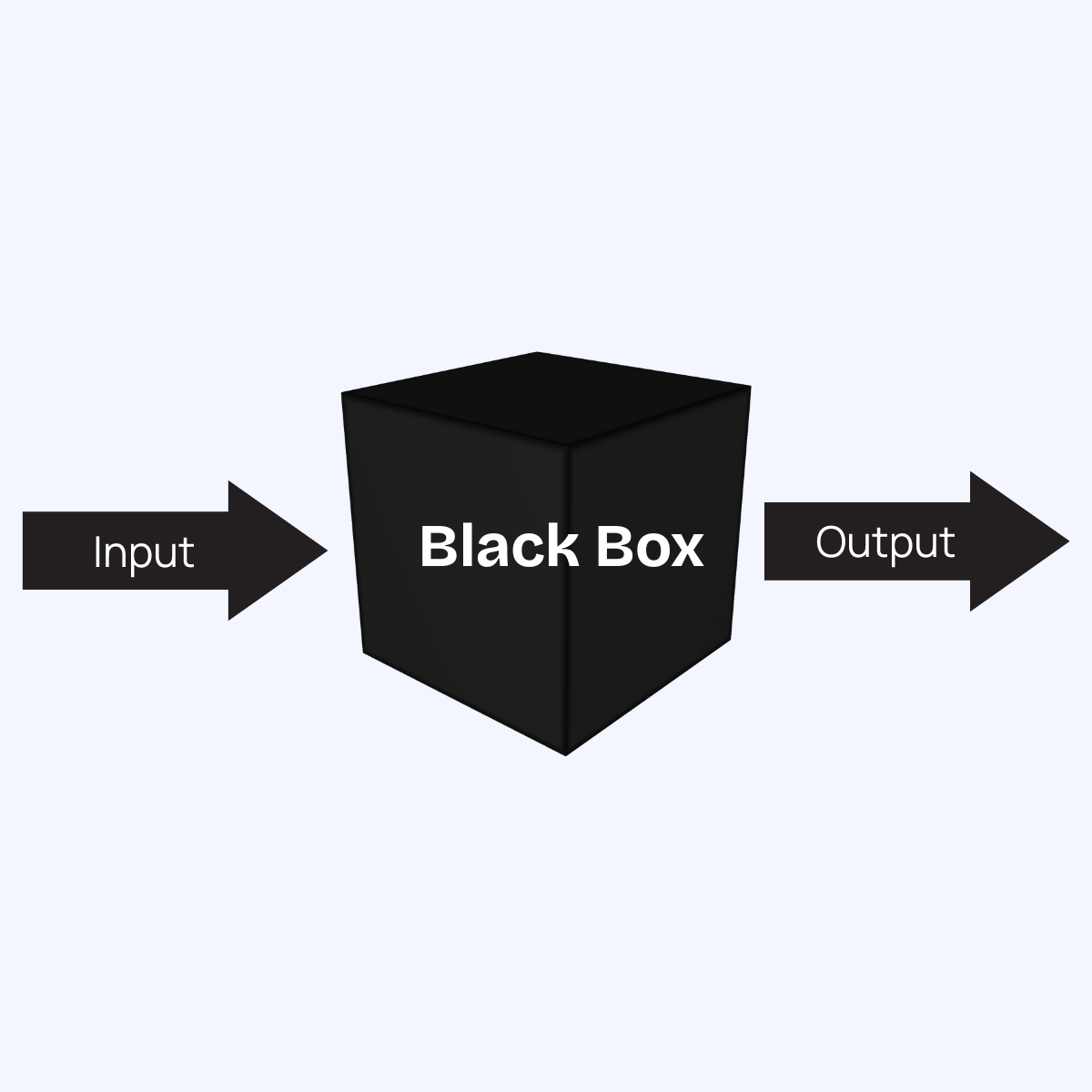
That’s why we need a glass-box approach rather than a black-box approach to understand model outputs.
ClickZ: Fospha built something called Model Spotlight. What was the “aha moment” that made you think you needed to show people what’s happening inside the model?
Milligan: For the Model Spotlight, I think the aha moment for me was when we started getting feedback on the initial Alphas, where basically bits from client calls were getting played in team meetings. And these clients were so energetic and happy about the changes. Tears on faces almost. It was incredibly exciting.
I think that’s when it really landed that I was like, oh, this is something that people are really going to change the way they make decisions on, which was exciting.
ClickZ: Let’s say I’m a Head of Growth at a DTC brand spending $300K a month on media. I’ve just come out of a QBR where my CFO questioned why we’re increasing spend on a channel that GA says isn’t performing. How would a “glass-box” approach change that conversation?
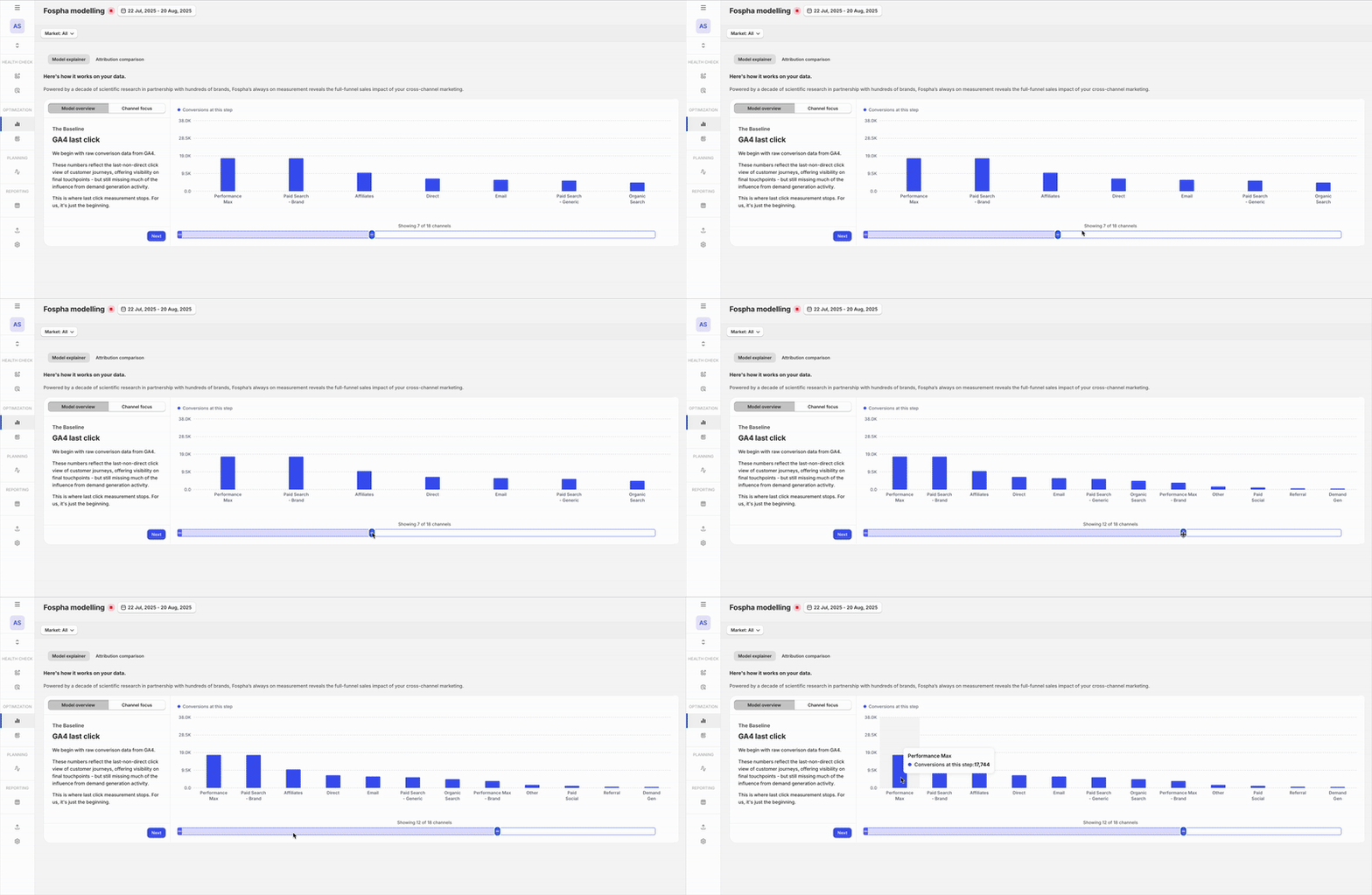
Milligan: I think that oftentimes CFOs are guided by last click, which makes sense for the view that they need to have. But with the Model Spotlight dashboard, you can actually give them a much better view at the channel level.
If they’re wanting to understand why a decision has or hasn’t been made, that is definitely the place to start because you can see at each stage of the Spotlight what the measurement is, and then you can make adjustments based on that.
ClickZ: One of the biggest debates in marketing right now is around upper-funnel investment. Brand. Video. Awareness… How does making the measurement logic transparent actually help teams justify spend that doesn’t show up in last click?
Milligan: We see it time and time again. When we get new clients on board, they see different views where instead of just looking at last click, which is what it says on the tin, they’ve now got this view that includes impressions of that activity. So the wealth of information that goes into the decisions you can now make is just way better.
ClickZ: There’s a huge conversation happening around AI and automation in media buying. What role does measurement trust play in whether brands are ready to actually hand over more decisions to algorithms?
Milligan: I think obviously we’re going that way where we’re wanting to automate a lot of this decision-making. But a lot of brands actually haven’t done the fundamental first step, which is, do I trust where these numbers are coming from?
Without that, then, I mean, it doesn’t really matter if you’ve got everything automated, if the source of truth is something bad.
The Model Spotlight dashboard allows you to get a drill-down into this channel-level view of measurement, where you can totally understand what is or isn’t good about it. It’s got everything broken down so you can really put a lot of trust in those numbers. It makes for setting up automations a lot better because you’ve got the peace of mind, and it ends up getting a better result in general.
ClickZ: For a marketing leader watching this who wants to start having better measurement conversations internally, what’s the one thing they should do this week?
Milligan: You need to open the Model Spotlight dashboard. You need to go onto the dashboards and open it because that’s really the only place that you’re going to get this stepwise breakdown of measurement that has holistic data included.
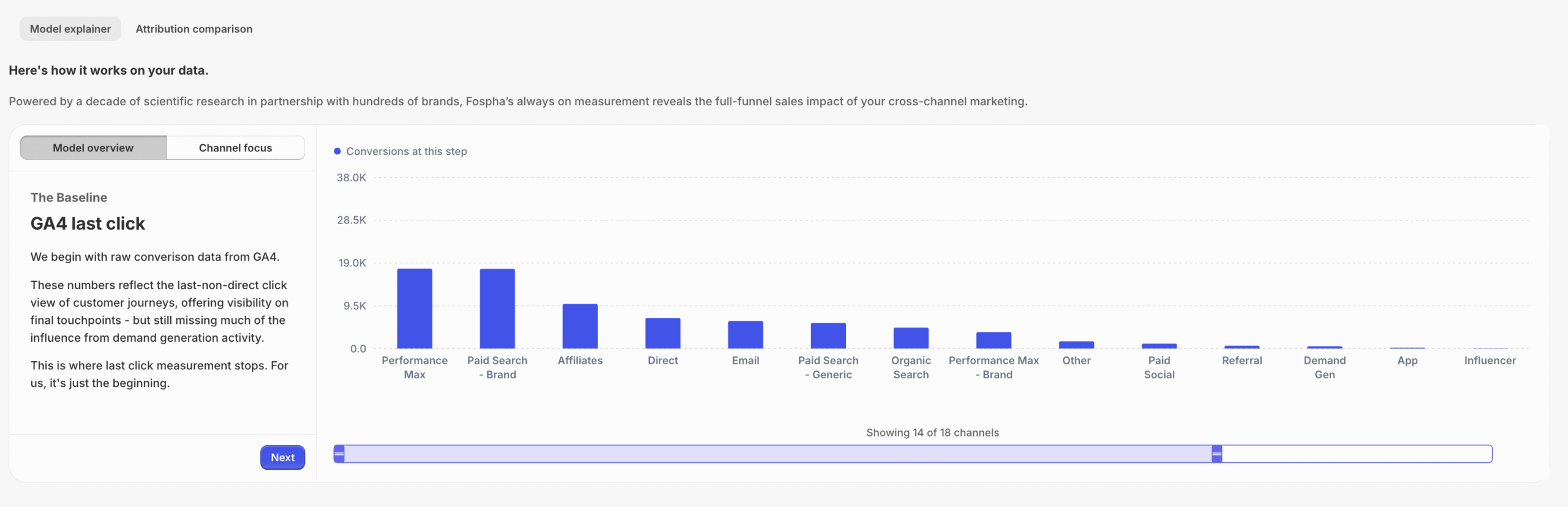
If you’re looking at last click, you’re really only getting part of the story. So it’s super important that if you want to make better decisions, you start there, by understanding and looking at the transparency behind what actual measurement values you’re using.
Milligan’s point about automation readiness deserves more attention than it typically gets.
The marketing industry is flooded with AI-powered tools promising to optimize spend automatically. But as McCall puts it, “it doesn’t really matter if you’ve got everything automated, if the source of truth is something bad.”
Most brands layer automation on top of measurement they can’t explain, let alone defend in a finance review. The automation either makes decisions based on flawed inputs, or, more commonly, teams override it because they don’t trust where the numbers came from in the first place.
This is why Fospha’s approach with Model Spotlight feels relevant beyond just their customer base. The principle applies everywhere. You can’t act on numbers you can’t defend. You can’t automate decisions you don’t understand. And you definitely can’t get your CFO to sign off on budget increases when you can’t walk them through how the data was constructed.
For marketing leaders caught in the measurement crossfire, the first question should be “can I explain, in plain terms, how any of my current measurement actually works?”
If the answer is no, that’s where to start
Fospha provides full-funnel measurement with MMM at its core, helping retail and eCommerce brands understand the true impact of their marketing across DTC and marketplaces like Amazon and TikTok Shop. Model Spotlight is their transparency layer, designed to show how measurement outputs are constructed at each stage.
Leave a Reply
You must be logged in to post a comment.