Latinos and the Language of Media
A look at how the launch of a new show can become a turning point for Hispanic TV.
A look at how the launch of a new show can become a turning point for Hispanic TV.
Last week, I had the pleasure to participate in the launch event for RPM Miami, the new show that can become a turning point for Hispanic TV.
What’s the turning point you might ask? Is it simply because it’s about cars, speed, danger, and love? Or is it about personal interest? Not necessarily, though I have to disclose I’m happy that our client Valvoline has an active participation.
Basically it’s a turning point because what’s considered to be mun2’s most ambitious original production happens to also be the first truly bilingual scripted drama ever.
And as I discussed in my first column, Latino marketing paradigms are shifting. And the approach to language, both in messaging and media, needs a turning point.
The Language Crossover
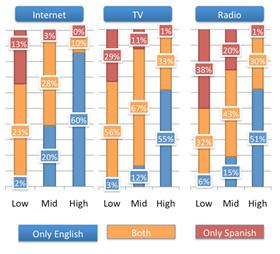
The following graph provides a clear picture of Latino media language preference across different types of medium and across acculturation.
One thing seems pretty clear: as acculturation evolves, Spanish decreases and English increases. When you look at the Internet, this change is even more dramatic.
This opens questions that many marketers don’t what to get into. If bicultural/bilingual Latinos are consuming English language, and therefore being reached by their English media campaign, what’s the need of doing dedicated messaging? Or is there any benefit for additionally targeting them in Spanish?
And those questions might be as misleading as those that want to limit Hispanic marketing to Spanish media or Spanish campaigns. Reality is a bit more complex.
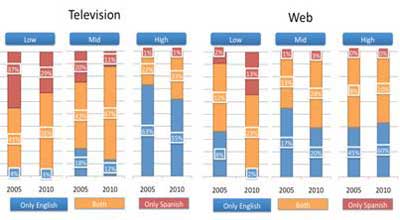
Latinos are consuming English media, but on the other hand, they are consuming more Spanish language media than they did in the past.
The Dynamics of Media and Language
When you see the evolution of media language consumption, things might look a little bit different. Let’s take a look at the graph below comparing preferences in 2005 versus 2010.
Check out these findings:
What’s driving this trend towards consumption of media in both languages? There are many reasons. Retroacculturation is driving more accultured Hispanics to (re)learn Spanish and watch content that creates a connection with their cultural heritage.
Also, Spanish TV progamming is becoming more diverse with more talk shows, reality shows, sports, contest shows, and significantly better production values. In addition, the development of network and cable channels such as MTV Tr3s, mun2, UrbanoTV, and Si TV (soon to become NuVo) is helping grow this space.
Reaching Bicultural Latinos: Thought-Starters
According to information released by mun2, both the RPM Miami TV ratings and website experienced a dramatic growth during the show opening. The Hispanic audience is eager for content that can create a bridge where they can switch between cultures and languages as seamlessly as they do in their everyday lives.
Now is the turn for agencies and clients to further embrace that opportunity as well. By being part of RPM Miami, brands like Valvoline, Chevy, and Burger King are making history. Will the rest follow?
Leave a Reply
You must be logged in to post a comment.