Amazon Prime's Vice President Says Loyalty Isn't a Reward
Event Coverage Sponsored By

Every retailer talks about loyalty. Few want to talk about what it costs to earn it.
At Shoptalk Fall’s Retail Stage, Jamil Ghani spent twenty minutes pushing back on that idea. He leads Prime worldwide for Amazon. For an industry built on punch cards and expiring points, his argument landed as a direct challenge.
Ghani opened with a correction: Prime is a paid membership that earns trust through usage, rather than a loyalty program that rewards it after the fact. That distinction, he argued, changes everything about how a company should treat a customer.
Amazon launched Prime in 2005. The company sold about a million items then, mostly books, CDs, and DVDs. It bet that free, unlimited two-day shipping could remove the friction of online shopping. Analysts warned the move would bankrupt the company. Twenty-one years later, Prime serves over 200 million members across 27 countries. It moves 300 million items at speeds as fast as 30 minutes.
Price has barely moved. Adjusted for inflation, the original $79 offer would cost $133 today. Prime costs $139. For six dollars more, members now get pharmacy, perishables, streaming, music, and a built-in AI assistant. Most marketers justify price increases with promises of added value, but Ghani pointed to restraint.
Ghani named three filters Amazon applies before building any Prime benefit. It must meet a real need. It must work at genuine scale. It must sustain itself financially.
Grocery is the clearest test case. Perishable customers grew 50% in the first half of this year. Same-day and next-day delivery volume grew 40%. Six of Amazon’s ten best-selling items are perishable. Bananas top the list.
The economics work because speed and cost support each other at Amazon’s scale. Faster delivery puts items closer to customers. That cuts time on the road, the most expensive part of fulfillment. Higher frequency then lets Amazon push costs down further. That logic explains how Amazon can discount Driscoll’s blueberries 22% and still turn a profit on the basket.
Ghani rejected the individual as the right unit to measure. Amazon tracks value delivered per household, not per account. That is why Prime spans 35 categories, from premium beauty to automotive. It layers in benefits for specific life stages too. There’s a 50%-off tier for young adults. There’s a discounted rate for households on government assistance. Bundled healthcare comes through One Medical. Entertainment ranges from Prime Video to NFL and NASCAR coverage.
Amazon tracks adoption rather than usage alone. A household that adds a second Prime benefit retains at a noticeably higher rate than one using just one benefit. A third or fourth benefit adds to that effect. Ghani framed the whole strategy around a longer horizon than most retailers use. He’s thinking five to ten years out, not this quarter’s sales.
Ghani aimed his sharpest comment at an entire category of subscription models. He named gym memberships that go unused after January. He named credit card points that expire before anyone redeems them. Amazon designed Prime against both. “Prime’s economics are not built on breakage,” he said. A business that bets on customers not using what they paid for builds fragility into its own revenue, he argued.
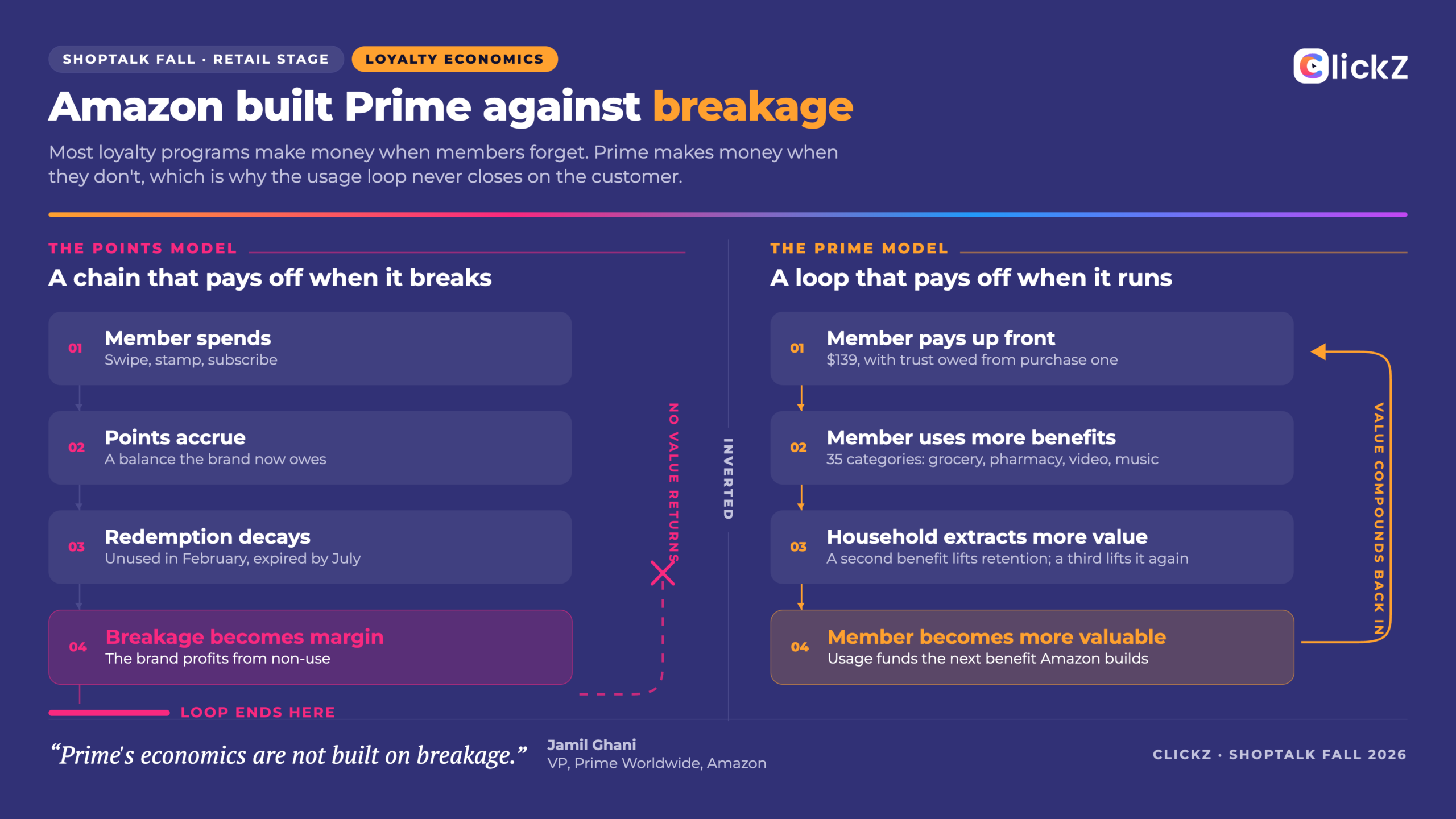
Amazon’s internal incentives reward the opposite. The more a member uses their benefits, the more value they extract, and the more valuable they become to the business. That inverts the logic of most loyalty programs, where unredeemed points quietly become profit.
Ghani’s closing point reframes loyalty as something a brand proves to the customer from the very first purchase, rather than something a customer earns over time by sticking around. The shift, from individual to household, from redemption to usage, from quarterly sales to multi-year trust, redefines the customer relationship entirely. For retailers still counting loyalty in points redeemed, Ghani’s framework asks a different question: how much value does a customer walk away with.
Leave a Reply
You must be logged in to post a comment.