Eyes Wide Open on Viewability
Viewability still poses its challenges for advertisers but the more viewability is introduced as a standard on campaigns, the quicker the quality will improve.
Viewability still poses its challenges for advertisers but the more viewability is introduced as a standard on campaigns, the quicker the quality will improve.
The industry is abuzz with talk of viewability.
The truth is that many ads being bought and paid for may never be seen, an issue that industry bodies are fervently trying to find a solution to.
Viewability forces the issue of quality and value on digital inventory and challenges the ad tech ecosystem to up its game. However, while current standards on viewability are built around the “opportunity to see” as sufficient for marketers seeking to standardize that concept, they are currently inadequate as measures of exposure quality and value.
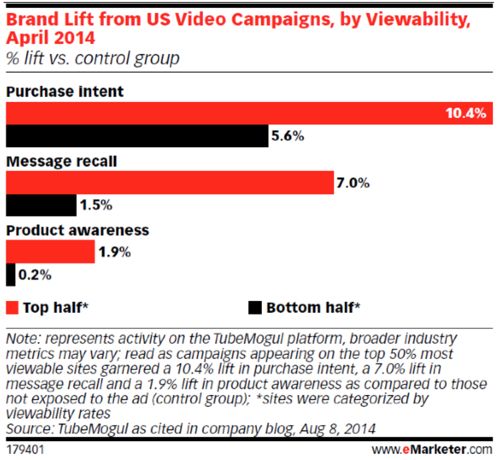
A Millward Brown study in 2014 found viewable impressions had twice the increase of purchase intent among category purchasers.
What’s more the results showed that the longer an ad was seen, the greater the impact. This eMarketer survey based on data from a TubeMogul study of video campaigns on the most viewable sites also demonstrates uplift on branding KPIs.
For advertisers that place value in view-through conversions viewability also instantly eradicate the problems of false-attribution.
False attribution occurs when a publisher loads multiple ad units below the fold in order to serve more impressions and capture conversions based on the last ad called. By serving only viewable ads this problem ceases to exist. So viewability is good and important.
The question is though, how confident should we be in viewability as a performance metric?
While there is no doubt that the awareness of viewability is an important step forward for improving trust and transparency in digital marketplaces, over-estimating the credibility of this metric at this early stage in its evolution could be counter-productive.
The standard definition of viewability as defined by the Media Ratings Council (MRC) is: 50 percent of pixels in the advertisement on the viewable space of the browser page for at least 1 second.
This definition is widely known and generally accepted but as with most digital metrics, it is never quite as simple as it seems.
For instance, if the measurer is able to determine a strong user interaction with the ad, the ad can still be counted as viewable even if it hasn’t met the above parameters.
Does that mean it is still shifting those brand metrics? Large ad formats have the viewable element reduced to 30 percent, again muddying the waters on the definition. Some measurers of viewability measure the ad unit while others measure the ad container and variance between measurement vendors can be as high as 40 percent, according to the IAB.
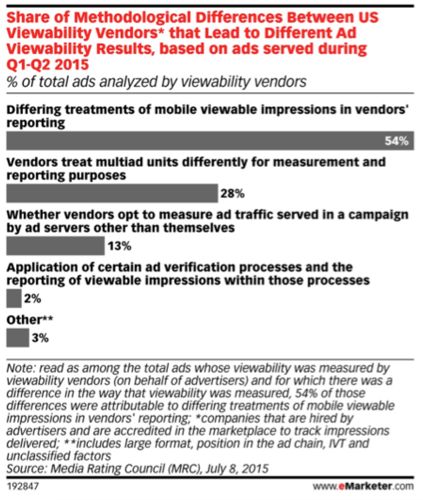
The Media Ratings Council released a measurement reconciliation study recently highlighting the continued discrepancies in the tracking methodology between different measurers illustrated in the chart below with mobile presenting quite a challenge and highlighting another issue in our increasingly fragmented media landscape.
It is also worth considering that no measurement vendor will track 100 percent of a campaign’s inventory. In 2012, the MRC conducted a pilot study in which the test campaigns indicated a range of between 0.7 percent and 77 percent of impressions were measurable.
Unfortunately, no amount of Googling has brought me more up-to-date data and it is interesting to note that the Media Ratings Council has not mentioned “measured impressions” at all in its industry statement announcing the lifting of the Viewable Impression Advisory for Display Advertising.
So it has its flaws.
It isn’t quite as straight forward or reliable as it seems but that doesn’t make it any less relevant and for this reason it should always be taken in context.
Forget industry benchmarks and instead focus on what is important and realistic for you as an advertiser. Experiment in controlled environments to understand the true implications of viewability on your campaigns. Ask the right questions to get the right answers.
Does it cost more? If so, is the increase in cost worth it?
Does it limit the reach and frequency standards we have come to expect?
Do we need to reset our benchmarks?
Over time, the demand for viewability will result in some important and valuable changes in the way publishers design their sites and their ad placements to ensure viewability.
The more advertisers introduce viewability as a standard on their campaigns the quicker the quality will improve.
Some companies today are guaranteeing viewability by applying stronger controls to the media environment assuming the risk, arbitraging pricing and delivering a fixed number of impressions without fraud versus an absolute percentage.
In our experience, there are often negative effects to optimizing only on viewability, resulting in lower KPI performance. We believe this is a result of a combination of limitations in viewability measurement and reductions in audience reach.
The lack of consistency in the way viewability is measured and the limitations on what can and cannot be measured, means it should be treated with care. Do not use it in isolation but define it in an overall performance context, and, before setting your viewability benchmarks, understand its impact.
Experiment and then draw your own conclusions.
*Image via Shutterstock
Leave a Reply
You must be logged in to post a comment.