On-Site SEO Still Works
How can you make your consumers' visit more productive using data you already have?
How can you make your consumers' visit more productive using data you already have?
With all of the talk about social signals and, before that, the emphasis people placed on links, you could easily be misled into believing that the opportunities for on-site SEO were so limited as to not being worth your consideration. I can assure you that on-site SEO can still be an important source of traffic growth. This is especially true if your company has a lot of data that it can repackage into useful content for users. I was fortunate enough to be in just such a situation recently and a fairly straightforward effort has led to some impressive incremental improvements.
What I’m about to describe is often referred to as targeting the long-tail. While that label is true, I think sometimes people mistake the long-tail to only mean phrases with a lot of words. But the long-tail is less about the number of keywords in a search phrase and more about the volume for each of those phrases and in aggregate: i.e., if each phrase has little volume, but in aggregate the volume is big, then you’re talking about the long-tail. It just so happens that one- or two-word phrases typically have a lot of volume so they end up being head terms. In my case, the phrases I wanted to target were just two words in length, but there were thousands of them so the opportunity was substantial.
Often, justifying a long-tail approach can be tricky because there isn’t sufficient keyword volume for any one phrase to show up in keyword research tools. This was true for me so I had to fall back on data from Google Analytics. Fortunately, I was able to show that despite poor visibility in the search engine results pages (SERPs), there still was some traffic coming in on the sorts of keywords I wanted to specifically target. Getting some traffic when SERP visibility is poor points to the potential for a lot of traffic if SERP visibility can be improved. Based on the lifetime value of a customer, I was able to estimate that within a month the effort I had in mind would pay for itself if I could achieve a doubling of traffic. My rationale seemed reasonable and so I received approval to proceed.
Since I was working with a database-driven system with several existing templates to choose from, the development time wasn’t that extensive. In addition, I didn’t need much additional copy to provide some context for users landing on the new pages or any design work at all. And so this effort turned out to be notable in another way – it was one of those rare win-win-win situations that we all look for but rarely find. The change was:
Fortunately, it was also a win from a performance perspective as you can see below.
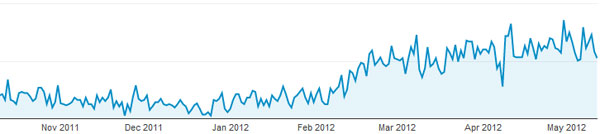
Yes, that steep climb starting in February is a direct result of the changes. Normally, pinpointing an SEO implementation to a resulting traffic change can be tricky, as there are often multiple simultaneous activities going on. But in this case the class of keyword targets was unrelated to anything else going on. In addition, no other class of keywords improved as strongly, suggesting that the improvement wasn’t a side effect of any of Google’s changes. All this with no promotional efforts (social or otherwise).
So while SEO success can sometimes seem elusive, you can still make great strides without the need for the latest and greatest tactic you read about on a blog. Instead, you may just need to look at your site from the perspective of a customer and answer the question about how you can make their visit more productive using data you already have.
Leave a Reply
You must be logged in to post a comment.