The State of Marketing 2025: The Year the Funnel Finally Collapsed A ClickZ Wrap-Up
If 2024 was the year of AI anxiety, 2025 was the year of the “Great Collapse”. Not of the market, but of the marketing funnel itself.
As we close the books on a year defined by commerce media dethroning TV and the Grinch stealing Q4, the message for Chief Marketing Officers is stark: The polite separation between “brand awareness” and “performance” is dead. In 2025, discovery became purchase, content became commerce, and the store moved to the social feed.
Here is the ClickZ retrospective on the state of marketing in 2025, and the critical pivot points for the 2026 boardroom.
The Big Shift: Commerce Media Takes the Crown
For decades, television was the undisputed king of reach. In 2025, the crown officially passed. ClickZ reported this month that commerce media is set to surpass traditional TV advertising globally, a structural shift that has forced marketers to rethink where “attention” actually lives.
“Commerce media performs well for a very simple reason,” ClickZ analysts noted in December. “It combines first-party data, real purchase signals, and measurable outcomes. When someone sees an ad inside a commerce environment and then buys, marketers can connect the dots without guesswork.”
This wasn’t just about retail media networks (RMNs) cluttering the landscape. It was about the integration of “commercial layers” into every digital touchpoint. Google deepened shopping capabilities; Pinterest turned inspiration into conversion; and TikTok, as we saw during Black Friday, became a bona fide transaction engine.
The 2026 Mandate: Stop treating commerce media as a “lower funnel” tactic. As ClickZ advises: “Give commerce media meaningful budget weight rather than small experimental testing.”
The Social Storefront: Black Friday’s New Engine
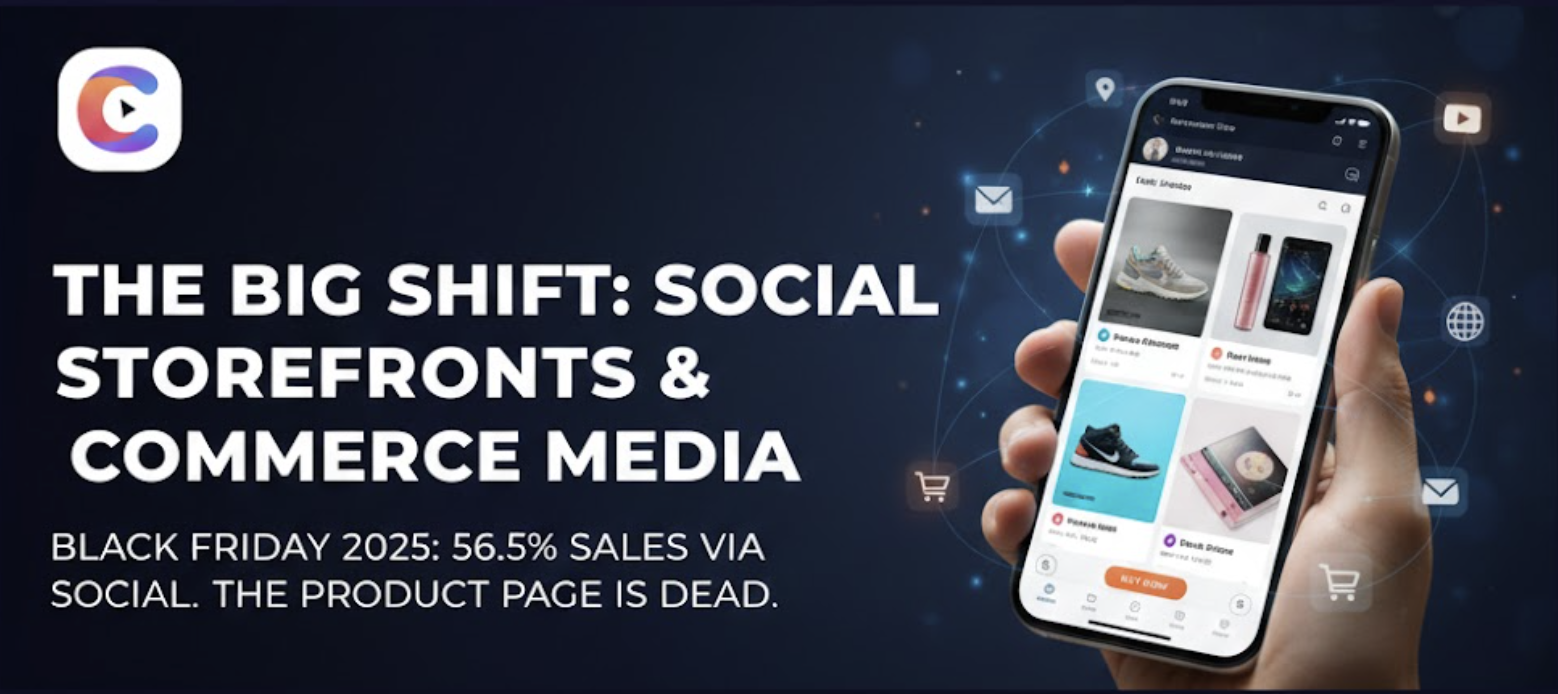
If you want to understand the consumer of 2026, look at Black Friday 2025. While total online spend hit a record $11.8 billion, the real story was the 56.5% year-over-year explosion in sales generated directly via social platforms.
“The speed of that activity shows that shoppers no longer treat inspiration and checkout as separate stages,” ClickZ reported. “They move through discovery and validation within a single environment.”
Major players didn’t sit this one out. Samsung and Disney joined TikTok Shop for Black Friday, signaling that the platform is no longer just for low-cost impulse buys—it is a venue for full-funnel brand activity.
The Insight: The product page is dying. “The traditional product page no longer serves as the sole source of credibility,” ClickZ observed. Trust now flows through “distributed signals”—creator videos, comment sections, and live streams. For DTC brands, this means your “store” is now wherever your content lives.
The Return of the Brand (With a Hard Edge)
Despite the obsession with performance, 2025 wasn’t the death of brand-building—it was the year brand got serious about business metrics.
At Cannes Lions 2025, Rory Sutherland cut through the noise with a memorable analogy: “A brand is like a pension.” It’s a long-term vehicle that builds future demand and pricing power. This sentiment was backed by hard data from Fospha, which found that brands spending more than 10% on brand campaigns saw double the marketing efficiency ratio of their peers.
We saw this “Brand + Performance” synthesis play out in Q4 with McDonald’s and Asda. Both brands leaned heavily on the Grinch IP, but not just for fuzzy feelings. Asda used the character to deliver a sharp value message about the cost-of-living squeeze, while McDonald’s built an entire ecosystem around the IP—from menus to apps to Times Square.
“There’s no gentle way to say it: in 2025, the Grinch has once again EATEN Christmas advertising,” ClickZ noted. But the lesson was in the execution: “McDonald’s doesn’t just borrow the Grinch for a 30-second spot; it builds a whole ecosystem.”
The Calvin Klein Lesson: Hero Products Over Hype
Perhaps no brand exemplified the 2025 discipline better than Calvin Klein. Under PVH Corp’s “PVH+” plan, the brand pivoted away from runway spectacles toward “hero products”—the underwear and denim people actually buy.
Stefan Larsson, PVH CEO, noted that the brand is “driving some of the highest consumer engagement in the history of the brand,” by focusing on cut-through campaigns with globally relevant talent like Bad Bunny, but tethering them to core commerce.
The 2026 Mandate: “Sell what made you famous,” ClickZ urged. In a high-interest-rate environment, CFOs have no patience for abstract awareness. Every campaign must prove it moves the needle.
What This Means for 2026
As we look toward 2026, the era of “channel-based planning” is over. It is being replaced by “audience-based decision making.”
1. The System is the Strategy: Seasonal campaigns can no longer be single hero films. They must be “systems” of repeatable assets that live natively on TikTok, YouTube, and Retail Media.
2. Profitability is the New Growth: At Savant eCommerce 2025, the mood was one of “resetting growth for profitability.” Retailers are cutting the noise, focusing on margin, and refusing to discount for customers who would have bought anyway.
3. Measurement Independence: With the “cookie apocalypse” finally settling into a new reality of server-side tracking and AI modeling, brands are seeking truth outside of platform grading. Independent measurement tools that can track the “halo effect” of top-of-funnel spend are becoming essential tech stack requirements.
The Final Word: 2025 proved that technology isn’t just enhancing marketing; it is reshaping the fundamental architecture of how we sell. For the DTC CMO, the instruction for 2026 is clear: Build a brand that can travel, a store that lives in the feed, and a measurement model that your CFO actually believes.

Leave a Reply
You must be logged in to post a comment.