At NRF, two companies showed what strategy actually looks like in 2026: systems that make customers come back on purpose.
- Fanatics is building momentum. Every interaction feeds the next one.
- Dick’s is building gravity. The store becomes a destination that earns the trip.
Different mechanics. Same marketing job: reduce replacement risk.
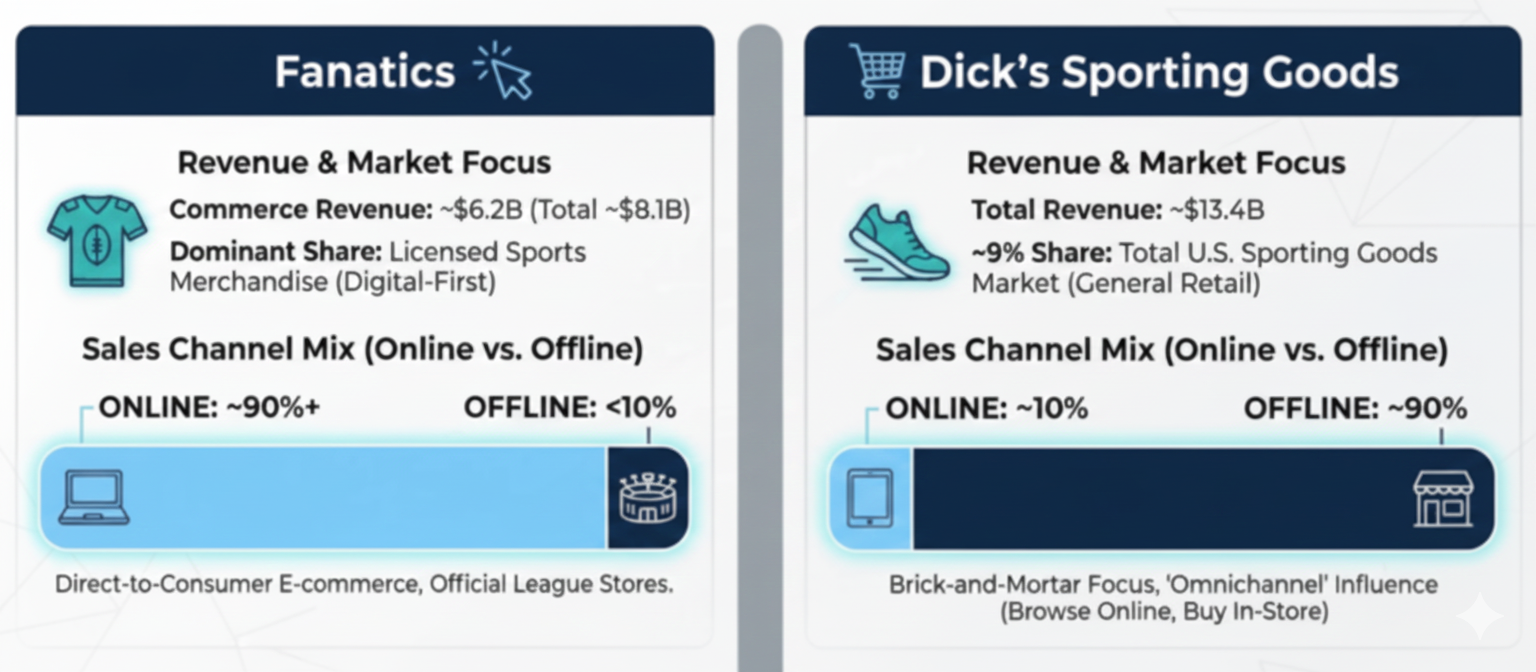
Fanatics: the 90% online flywheel built to make loyalty portable
Michael Rubin’s core point was simple: Amazon scared him, so Fanatics had to stop acting like a retailer and start acting like a platform.
Fanatics is not trying to win by having more SKUs. It is trying to win by owning the relationship across categories, then using that relationship to enter new categories cheaper and faster than anyone expects.
1) Build a platform, not a storefront
Rubin described Fanatics as three businesses: commerce, collectibles, and betting and gaming. The useful marketer translation is: one brand promise, expressed in multiple transactions.
In commerce, Fanatics is not just a DTC site. It also runs ecommerce for a huge network of league and team partners, plus physical retail assets like Lids. That is distribution, but it is also control of the customer moment.
2) Turn rewards into a currency, not a program
Fanatics’ betting wedge was FanCash, positioned as a “currency of sports” that can be redeemed across the wider Fanatics ecosystem. Rubin said Fanatics expects to issue and redeem around $1B of FanCash in a year.
Marketing implication: loyalty works better when it travels. If rewards move across products, you reduce churn and you reduce the cost of launching the next thing.
3) Win trust by removing pain
Rubin also highlighted “injury protection” for certain player prop bets: if a player is hurt early, Fanatics adjusts the bet rather than letting the customer eat a loss that feels unfair.
That is the deeper pattern: the best retention lever is often a product decision that removes a predictable moment of frustration.
4) Add a “daily habit” layer
Rubin teased a Fanatics credit card as the next business line, built to deepen engagement through richer rewards and access perks. Whether the card succeeds is almost secondary to the strategy: make Fanatics part of everyday life, not just game day.
What senior marketers should steal from Fanatics
- Design loyalty so it connects products, not campaigns.
- Treat perceived fairness as brand equity, especially in emotionally charged categories.
- Use ecosystem advantages to cut CAC when you expand into new lines.
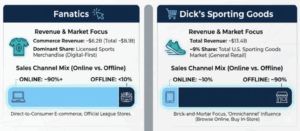
(Press image above to enlarge)
Dick’s Sporting Goods: the 90% offline bet that stores can still be the best media channel
Dick’s is making the opposite bet: physical retail can still grow, but only if the store earns time, not just transactions.
The most important line from Ed Stack’s session was the provocation behind House of Sport: build the concept that would kill Dick’s Sporting Goods if someone put it across the street.
That is not a tagline. It is a design constraint that forces real differentiation.
1) Community only works when you operationalize it
House of Sport is built around community, service, and product, but the “community” part is not a poster on the wall. These are destination-scale spaces with experiences that make sport feel present in the building.
From a marketing lens, the store becomes media in the behavioral sense: a place where people spend time, build memories, and attach identity to the brand. Points programs struggle to beat that.
2) Leadership alignment is a growth lever
The session also pulled back the curtain on governance: a “diamond” org chart with the athlete (customer) at the top, and leadership at the bottom. The closer you are to the athlete, the more you speak. The farther away, the more you listen.
For marketers, this matters because internal alignment is a performance channel. When leadership signals are consistent, priorities stick, and brand execution stays coherent.
3) Culture is the execution engine
Dick’s reinforced culture as a filter, not a feel-good story: no “brilliant jerks,” a competitive mindset focused outward, and a “left tackle” award celebrating the unglamorous work that makes the team win.
If you are trying to scale experience, culture is the moat. Experience falls apart when teams chase credit instead of outcomes.
4) Purpose with operational teeth
Sports Matter was framed as a long-term commitment tied to youth access to sport, grounded in personal story and scaled through real programs and outputs.
For marketers, the lesson is blunt: purpose resonates when it is specific, measurable, and repeatedly activated, not when it is seasonal.
5) M&A as access, not just synergy
Dick’s positioned Foot Locker as a way to reach global markets and urban communities where a Dick’s big box does not fit. That is brand distribution strategy: show up where the athlete lives.
What senior marketers should steal from Dick’s
- Treat stores as brand-building channels, not just fulfillment nodes.
- Operationalize community with experiences that earn time.
- Protect execution with culture systems that reward collaboration.
The bridge between the two: closed-loop measurement that matches the flywheel
There is a hidden commonality in both models: flywheels are only as good as the feedback loop behind them.
Fanatics can stitch together commerce, betting, and collectibles because it is building a connected system. Dick’s can justify bigger experiential boxes because it is betting the trip is worth more than the cart.
In both cases, marketers need measurement that reflects the real world, not just last-click comfort.
A clean example comes from Gymshark, a brand that lives at the intersection of sport, culture, and performance marketing. In a Fospha case study, Gymshark used Fopsha’s full-funnel measurement integrated with Smartly’s Predictive Budget Allocation to create a tighter feedback loop between what drives new-customer revenue and where budgets get deployed. Fospha reports outcomes like a 13% uplift in cross-channel ROAS, plus channel-specific gains like 98% TikTok US revenue growth during the measured period.
This is not about tooling for tooling’s sake. It is the marketing point Fanatics and Dick’s are both making in different languages: when your strategy is a loop, your measurement has to behave like a loop too.
If you are heading into 2026 planning and want a framework that maps to this reality, Fospha also publishes a 2026 Marketing Planning Guide positioned around clearer forecasting, cleaner data, and better decision-making.
The shared lesson: stop optimizing moments. Build a system.
Fanatics is building momentum.
Dick’s is building gravity.
But both are doing the same high-level job: creating repeatable returns by making the next interaction easier, more valuable, and harder to replace.
If you are leading marketing in 2026, the question is not “what is our channel mix?”
It is:
- What loop are we building?
- What behavior are we rewarding?
- What friction are we removing?
- What proof do we have that the loop is compounding?
Online or offline is not the strategy. The flywheel is.

Leave a Reply
You must be logged in to post a comment.