Last week we started to look at the thorny issue of understanding the return on investment (ROI) in analytics by looking at the different types of investments required: technology, services, and people. This week it’s time to look at the returns generated by analytics for organizations and the extent to which it is possible to quantify them.
So how does an organization benefit from analytics? Where can the impacts be seen? Well, there are generally two ways that most organizations see benefits; they’re either making more money or creating more value as a result, or they’re spending less money (or a combination of the two).
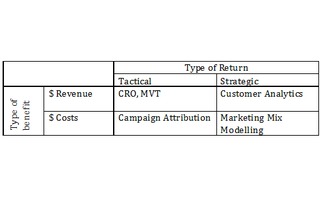
Perhaps one of the most obvious benefits is when the use and deployment of analytics can be shown to directly impact revenue or sales. This is the classic definition of optimization where you “test, learn, and adjust.” Analytics provides the learning, which could be a manual process or automated like in a multivariate testing (MVT) tool. I think this is why MVT tools have been successful of late, as they’re able to demonstrate the use of analytical approaches to directly positively impact the commercial bottom line.
Benefits can also be realized through reducing costs. One of the classic uses of analytics is to improve the cost-effectiveness of marketing expenditure. Marketing analytics has been around nearly as long as marketing. The reality is that when done properly, it isn’t necessarily that difficult to measure the benefit of analytics in improving marketing ROI. It does require the development of some frameworks and protocols to capture information around the development of insights and the decisions that are taken as a result of them. In more analytically mature organizations, this is standard business practice and the beauty of analytics sometimes is that it doesn’t necessarily need to be sophisticated to be powerful.
It’s also useful to classify the potential returns in terms of how and when the benefit is realized and to look at them separately as well. For example, there are immediate or “direct” returns. These are the benefits you might get from analytics immediately or in the short to medium term. This might be that by adopting a new analytical approach that you are able to immediately realize some benefits that you weren’t able to achieve before. It’s likely that these returns are “relatively easy” to identify and measure but you’ll need to have those frameworks in place in order to be able to ensure that the returns can be measured.
MVT tools and other conversion rate optimization technologies at the “applied” end of analytics are good examples of tools that fit into this direct or immediate type of return. Another example could be a campaign attribution analytics.
There are also likely to be longer-term and indirect benefits from analytics in the business and these are probably harder to measure or quantify. The impact and benefit is likely to be more strategic in nature than the direct returns, which can be more tactical. For example, analytical technologies that improve the “time to insight” or improve the productivity and effectiveness of the analytics team have a clear benefit but can be harder to quantify. Ask any analyst and they will probably tell you that they spend too much time doing low-value tasks like moving data around from one place to another and not enough time actually doing analysis. Investments that improve the overall analytics capability of a business are also more strategic and harder to define the benefit of. In a way there has to be a “leap of faith” that the returns will be realized further down the line rather than today.
So, separating the benefits between revenue-generating ones and cost-saving ones and looking at them in terms of direct or tactical benefits vs. indirect or strategic benefits provides some framework for formalizing an approach to understanding the ROI of analytics. The table below shows how this might look for a selection of analytical approaches and disciplines.
So how can we measure the impact of our measuring? That’s something that I’ll look at next time.
Leave a Reply
You must be logged in to post a comment.