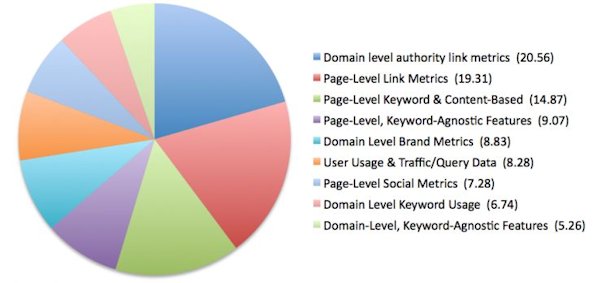
Moz has released their 2013 search engine ranking factors, surveying 120 SEO professionals and having them rank different search factors. While this isn’t the full survey data, it does have a lot of interesting information to consider when you’re optimizing websites for search engines.
Moz uses search correlations in order to make estimates as to what is being used for Google’s ranking algorithm, based upon features on higher ranking sites versus ones that are lower ranking. They used over 14,000 keywords from Google AdWords across multiple categories then use of keywords to extract the top 50 organic search results in June, post Penguin 2.0.
One interesting correlation was that despite SEOs knowing that over optimization of keyword anchor text could be problematic and a sign of spamming, they found that the correlations for exact match and partial match was fairly high. But not surprisingly, the SEOs surveyed believed that diversity in anchor text, including both branded and nonbranded terms, was more important than the number of links themselves.
Moz also looked at on page keywords and not surprisingly found a very high correlation of those keywords in body text, title, meta-description and H1 tags. Likewise, the SEOs surveyed believed that including keywords in both the title and on page are important factors.
Moz also discovered that rankings of exact match domains (i.e., Keyword1keyword2.com) has declined over the past year, although the correlation is still high. While having the keywords in the domain name was extremely important many years ago, SEOs have definitely shied away from exact match keywords in favor of partial match domains or branded URLs.
The look Moz took at social signals and its correlation with ranking factors is important. Google +1’s came out ahead of Facebook shares and tweets for correlated factors, although the surveyed SEOs did not believe that social signals are very important to Google search algorithm.
Their last look at ranking factors was in 2011, when they were still known as SEOmoz.
The full survey will be released by Moz in a few weeks.
This article was originally published on http://searchenginewatch.com/sew/study/2281153/2013-search-ranking-factors-survey-results-from-moz.
Leave a Reply
You must be logged in to post a comment.