AI Search Is Rewriting the Rules of Discovery. Most Brands Aren’t Ready
At Shoptalk Spring 2026, one of the most practical sessions did not focus on vision. It focused on survival.
Iced Media’s CEO Leslie Hall, alongside leaders from COS and e.l.f. Beauty, laid out what may be the most important shift in marketing today. If your brand is not visible inside AI, it effectively does not exist.
Unlike previous platform shifts, this one is not unfolding gradually. It is happening at speed, and the implications are immediate.
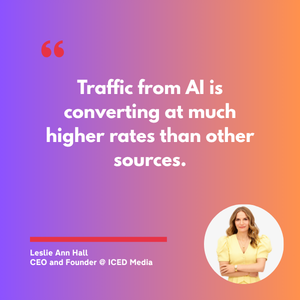
The session opened with a stark reality check. AI is no longer an experimental channel. It is already shaping purchase behaviour at scale. A majority of US consumers are expected to use AI to support purchase decisions this year, with adoption even higher among younger audiences. More importantly, traffic originating from AI driven environments is converting at materially higher rates than traditional channels.
This is not a future opportunity. It is a high intent one, already influencing outcomes.
 From Ranking Links to Becoming the Answer
The core shift is simple, but deeply disruptive.
For decades, digital marketing has been built around ranking. Success meant appearing in a list of links, competing for clicks within a defined interface.
That model is now being replaced.
AI search does not return a list. It generates an answer. And in doing so, it draws on a wide ecosystem of sources, often synthesising information from dozens of inputs into a single response.
As was noted during the session, a single AI generated answer can reference a large number of sources. If your brand is not present within that ecosystem, it is unlikely to appear at all.
Visibility is no longer about position. It is about inclusion.
The most resonant idea from the session was captured in a single question:
“What do you deserve to be best in the world at?”
It is a deceptively simple prompt, but it challenges one of the most common behaviours in digital marketing. Many brands attempt to maximise coverage, spreading effort across as many keywords, products, and categories as possible.
In an AI driven environment, that approach becomes inefficient.
Instead, the focus shifts to areas of genuine authority. The brands seeing early success are those identifying their “right to win”, whether that is a hero product, a specific attribute, or a clearly differentiated proposition, and building depth in those areas first.
This is not about limiting ambition. It is about sequencing it.
That focus on authority is closely tied to how content is created and structured.
AI systems do not prioritise product pages in the same way traditional search engines have. They prioritise usefulness. Content that answers questions, provides context, and reflects real user needs carries significantly more weight.
This has clear implications. Long form content, FAQs, reviews, and customer language are no longer supporting assets. They are central to visibility. In many cases, they form a substantial portion of what AI systems ingest and interpret when generating responses.
The shift is subtle but important. Content is no longer simply a vehicle for messaging. It becomes infrastructure for discovery.
Another major change is the erosion of the website as the primary centre of gravity.
In an AI driven landscape, your owned channels are only one part of a much broader ecosystem. Platforms such as Reddit, YouTube, and high authority publishers play a critical role in shaping how brands are represented and recommended.
For some categories, this may mean prioritising established editorial platforms. For others, it may be communities, reviews, or creator led content. The specifics vary, but the principle remains consistent. Visibility is distributed.
A diversified presence is no longer optional. It is foundational.
As visibility changes, so too does measurement.
Traditional metrics such as traffic and conversion remain important, but they are no longer sufficient on their own. Brands must now consider how often they appear in AI generated responses, the volume and quality of citations, and the sentiment associated with those mentions.
At the same time, these signals must still be tied back to commercial outcomes. Growth in AI visibility is only meaningful if it translates into increased demand, engagement, and revenue over time.
This introduces a more layered measurement model, combining presence, perception, and performance.
One of the more unexpected themes from the session was the renewed importance of PR.
Not in its traditional form, but as a critical driver of AI visibility.
As AI systems rely heavily on third party sources, the role of high authority publications, influencers, and earned media becomes significantly more influential. Brands that are consistently represented across these channels are more likely to be surfaced in AI generated responses.
For organisations like COS, this has meant a closer alignment between PR and performance functions. Consistency of messaging, clarity of positioning, and presence across trusted platforms are no longer brand building exercises alone. They are performance drivers.
In this context, PR is not separate from search. It is integral to it.
If there was one operational challenge that surfaced repeatedly, it was discipline.
The instinct to pursue every opportunity remains strong. New keywords, new trends, new product categories all present potential avenues for growth.
Yet the brands making progress in AI search are doing less, not more. They are concentrating effort on a defined set of priorities and executing against them with consistency.
This idea of focusing on “holy grails” rather than spreading resources thinly reflects a broader shift. In a world where AI rewards clarity and authority, focus becomes a competitive advantage.
The session concluded with a recognition that this transition is already in motion.
Discovery is increasingly happening within AI environments. Decisions are being shaped before users reach a brand’s website. Trust is being built through aggregated signals rather than controlled, owned experiences.
While fully integrated, agent driven commerce is still evolving, the direction is clear.
Brands that engage early, experiment, and adapt will define how they are represented in this new landscape.
Those that wait will be responding to a system that has already been shaped without them.
ClickZ is covering Shoptalk Spring 2026 live from Las Vegas. Stay tuned for more insights from the floor.

One thing came up in almost every conversation this week. With more channels than ever, teams are finding it harder to understand what is actually driving incremental growth.
That is exactly the problem Fospha is built to solve.
Fospha helps brands move beyond last click measurement and understand the true impact of every channel, turning insight into action.
Find Fospha at Booth #2480 at Shoptalk, or visit fospha.com to learn more.
EVENT COVERAGE SPONSORED BY FOSPHA
Leave a Reply
You must be logged in to post a comment.