Blog Readers Spend More Time and Money Online
The blogosphere is big and its users spend more time and money online than the online population that doesn't read them.
The blogosphere is big and its users spend more time and money online than the online population that doesn't read them.
The blogosphere is big and its readers spend more time and money online than Web users who don’t read them.
Fifty million Americans, or 30 percent of all American Internet users, visited a blog in the first quarter of 2005, according to a new report from Comscore, and sponsored in part by SixApart and Gawker Media. Traffic increased by 45 percent from the first quarter of 2004.
The average blog reader viewed 77 percent more pages than the average Internet user who doesn’t read blogs (16,000 versus 9,000 for the quarter), the report found. Blog readers average 23 hours online per week, compared with the overall Web user’s average of 13 hours.
Blog readers are 11 percent more likely than the average Internet user to have incomes of or greater than $75,000. Similarly, blog readers are 11 percent more likely to visit the Web over broadband either at home or the office.
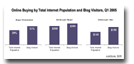
Blog readers tend to make more online purchases. In the first quarter of 2005, less than 40 percent of the total Internet population made online purchases. By contrast, 51 percent of blog readers shopped online. Blog readers also spent six percent more than the average Internet user.
“Blog readers are an attractive audience to advertisers: they are more likely young, wealthy, on broadband, and spend significantly online,” said Rick Bruner, co-author of the report. Bruner has since joined DoubleClick as research director.
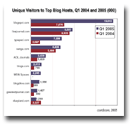
Nearly 40 million blog readers visited blogs hosted by BlogSpot, LiveJournal, TypePad, Xanga, AOL Journals, Blogs.com and MSN Spaces. As blog readership has grown overall, so has the traffic on the hosted blogs. Six of the major host report growth of greater than 100 percent on a year-over-year basis. Blogs.com had the highest growth rate at 241 percent, followed closely by TypePad with 240 percent growth. Overall, BlogSpot holds the top spot in terms of the greatest number of unique visitors, at 19 million, up from 7.7 million a year ago.
 |
| Click on graphic to view chart |
Bruner told ClickZ Stats the scale of consumer-generated content was among the notable findings in the report. “Blog hosting site Blogspot, owned by Google and affiliated with Blogger.com, with more than one million blogs hosted, gets more traffic than NYTimes.com, USAToday.com or WashingtonPost.com,” Bruner stated.
 |
| Click on graphic to view chart |
Among the 30 million users who also visited a non-hosted or stand-alone blog, news and political blogs held the largest audience share at 43 percent. A “Hipster” category was a distant second at 17 percent. Additional categories include tech (15 percent), women (8 percent), media (8 percent), personal (6 percent) and business (3 percent).
Leave a Reply
You must be logged in to post a comment.