How Marketing Teams Move From AI Assistance to Autonomy
AI’s role in marketing has moved from helping with tasks to carrying them out. Suggestions came first, then chat, then actions, and now autonomous agents that can run in the foreground or the background. For marketers, that shifts the job from operating each tool to directing the agents that operate them.
As these systems take on more work, marketers face a question: when can AI act without someone checking its work first? The next step is to decide which tasks to delegate whole and how closely to steer each one. A team may be comfortable letting AI analyze campaign performance but hesitate to let it change a live budget. Where a team draws that line depends on how much responsibility it is prepared to hand over. That willingness to delegate is AI autonomy.
AI is advancing faster than many businesses can adapt around it. The gap shows up between the people who set direction and the people who use the tools every day. Epsilon’s 2026 benchmark found that 73% of C-level marketers call their AI tools extremely valuable, while only 25% of senior managers say the same. It also found that 86% of US marketers using or weighing AI agents are concerned about losing control of marketing decisions.
That divide, plus the fear of losing control, is where rollouts stall. An AI rollout that opens at full autonomy skips the stages that build trust, so it stalls even when the technology works. Doing it right means widening AI’s role in stages. Leaders and daily users look at the same evidence at each step, so confidence rises on both sides together.
Before any stage begins, a team has to settle where AI gets its data.
AI acts on whatever performance data it is given: which channels return, which campaigns bring in new customers, and what each customer costs to win. Once it can shift spend, as the platforms above already do, those figures decide where budget goes. Ad platforms and analytics tools often report different results for the same campaign, since each counts in its own way. The system acts on whichever one it is pointed at.
Media buyers, finance and the approving leader need to work from the same figures. That means one source of truth, and it should be the only data the system acts on. What the system may do with that data is the question the three stages answer.
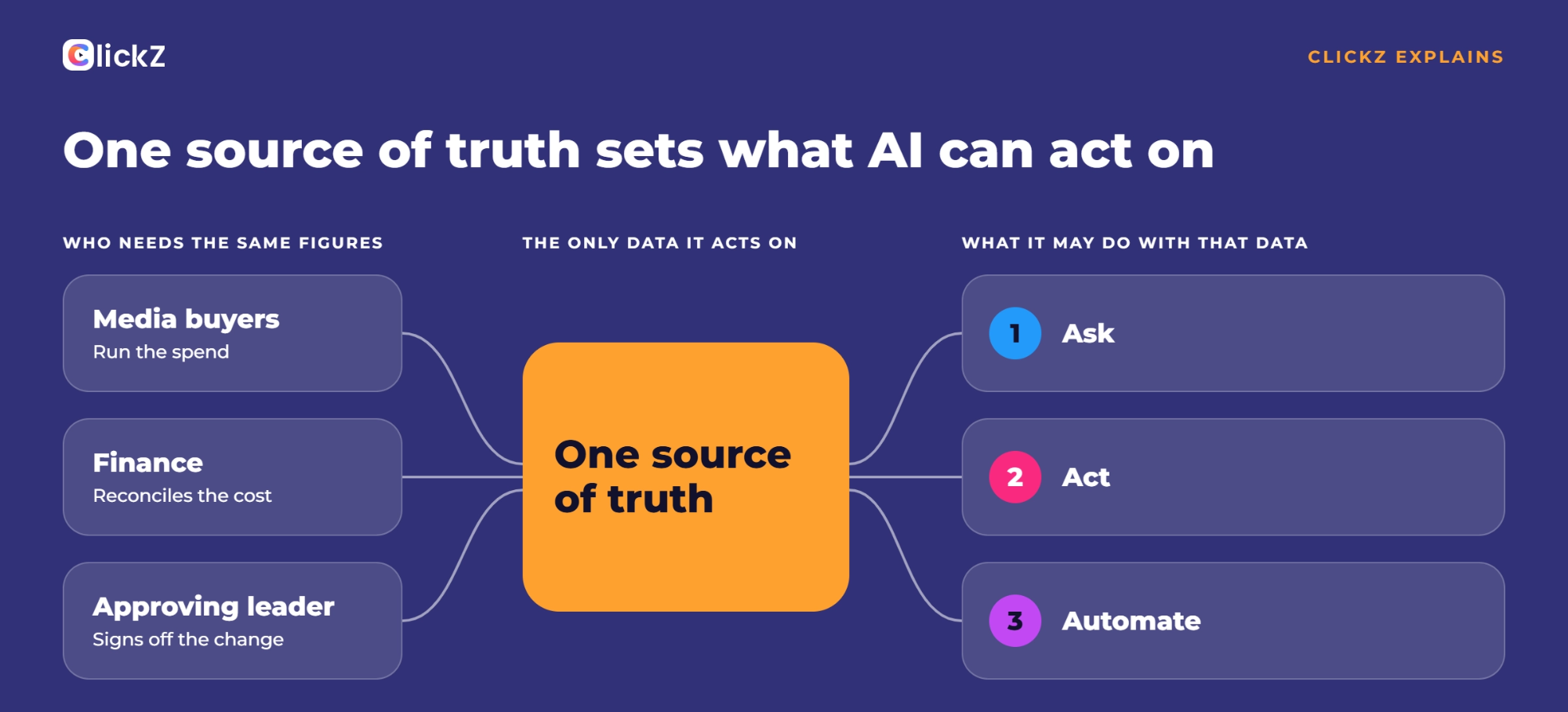
Trust builds slowly, and each step earns AI a little more autonomy than the last. Fospha’s From Measurement to Action: The AI and Automation Guide for Modern Marketers, draws on its customers’ experience and reports that they built trust in these three stages: Ask, Act and Automate.
At stage one, AI reports what happened and marketers check whether it reaches the same conclusions they would from the same data. AI cannot change anything in the ad account at this stage.
Marketers connect AI to their campaign data and start with questions such as:
Trust builds through checking. Analysts compare each answer with numbers they already know are right, and every answer traces back to the agreed source. The output of this stage is a track record of questions where AI’s answers match the verified figures and no longer need routine rechecking. That record earns AI the move from reporting what happened to recommending what to do, which is where stage two begins.
A StackAdapt survey found that only 6% of marketers almost always act on in-platform AI recommendations. The report adds that marketers act more often when a recommendation explains itself and ties to campaign goals.
So the question here becomes whether its judgment is good enough to act on. For example, AI sees the spring sale campaign stay profitable for two weeks and suggests raising its daily budget from $100 to $120.
Each suggestion shows its supporting data, and nothing changes until the budget owner approves, adjusts or declines it. The owner may know things the AI cannot see, such as a stock shortage. The output of this stage is a record of which recommendations people accepted, which they overruled and why. A team is ready for the next stage when it can explain why it trusts the recommendations and most overrides come from business context. Those overrides then become the rules for stage three, since each one marks a limit the agent needs to know before it acts alone.
At stage three, marketers write the rules once and let AI execute recurring work without approval each time.
Automation turns human judgment into rules the AI can follow, and the person’s job moves upstream. They set the limits first: what the agent can change, by how much, and when it has to hand a decision back.
For example, every Monday an agent might post last week’s campaign results in team chat. Each weekday morning, another might move budget toward the best-performing campaigns, within a 15% daily cap. The second task carries more risk because it moves money, so a team needs to be sure of a few things before allowing it. Three Things Have to Be True Before Marketing Teams Let AI Move Their Budgets sets out what those are.
The output of this stage is routine work that runs without a request each time. People steer through the limits they set and the log of changes they review. Few teams reach this point for every task at once, so the next step is to locate where each one stands.
Teams grant autonomy task by task, so no single stage can describe a whole team. A team might be at stage three for weekly reporting and still at stage one for budget changes. Knowing where each task sits shows what to delegate now, what still needs a person’s approval, and what needs more evidence first. That map sets the course for AI autonomy, since a rollout that jumps ahead of a task’s stage is the one that stalls. To check where a task stands, ask one question per stage.
Microsoft CEO Satya Nadella uses a short phrase for how people should work with AI agents: “We macro delegate and micro steer.” A person hands over a large piece of work, then keeps giving instructions while the agent carries it out. The three stages give that idea a sequence for marketing. Each one widens what AI may do alone, and people keep steering at every step. A task earns its next stage through evidence the team can point to.
As AI grows more capable, the question that matters is who answers for a decision once AI makes it. An agent can move a budget, change a campaign or send a report. Whether it should act without a person involved is a separate call. Teams that know which decisions to delegate, which need human judgment and where the line sits can make that call task by task.

Leave a Reply
You must be logged in to post a comment.