Synthetic Customers Are Here. Can AI Personas Replace the Focus Group?
Before a campaign goes live, someone in the room usually asks how customers will react. Surveys and focus groups give direct answers, but they take weeks and reach a limited group of people. Deadlines often arrive first, and decisions can end up leaning on instinct.
A trend is forming around an AI version of the customer. Teams can describe a customer to an AI model, ask it the same question and get a reply in minutes. Salesforce’s agreement to buy Listen Labs, an AI customer research startup, in late September is one sign of the interest.
That raises a fair question for any marketer: can an AI version of the customer stand in for a real focus group? To judge that, it helps to know what these AI customers are.
A synthetic customer, also called an AI persona, is a model set up to answer like a member of a specific audience. Take a team choosing between two offers for shoppers who have not bought in six months. They describe that shopper to the model, with details like age, location and buying habits, then ask which offer would earn the click. The team can repeat the exercise across hundreds of shopper profiles.
A short description gives the model general patterns to draw on, while real survey answers or interview transcripts give it more of the actual customer. Either way, the speed raises the key next question: how close do the answers get to what real people would say?
On broad questions, often close. A large study led by the London School of Economics surveyed 7,755 people across several online sampling services. The questions covered topics such as financial outlook, shopping habits and social media use. Electric Twin, a synthetic audience firm that funded the study and whose co-founder and a science advisor led it, ran the same questions through its synthetic respondents.
Across most questions, the synthetic answers landed in the same range as the human ones. The authors said the synthetic answers captured central tendencies, meaning the most common response a group gives to a survey question. They saw that as a useful step before research with people.
That closeness has a catch. A persona answers from patterns in its data, so it skews in three ways.
Those skews matter most when a decision is expensive.
Use personas to explore and real people to commit. Exploring covers early work where a wrong turn costs an afternoon, such as screening messages, tightening survey questions and a first read on price ranges. Committing covers moments where a wrong turn costs budget, such as a launch, a price change or a new segment strategy.
A related test points the same way. Strat7, an insight and analytics group, checked synthetic respondents that top up real survey samples against a nationally representative UK sample. The provider tested in both years read year-on-year change in brand awareness correctly only 19% of the time. Co-author Hasdeep Sethi, Strat7’s AI lead, called the data “trustworthy for the topline,” meaning headline results, but not safe enough for the decisions beneath it.
The rule only holds if the exploring stage is dependable.
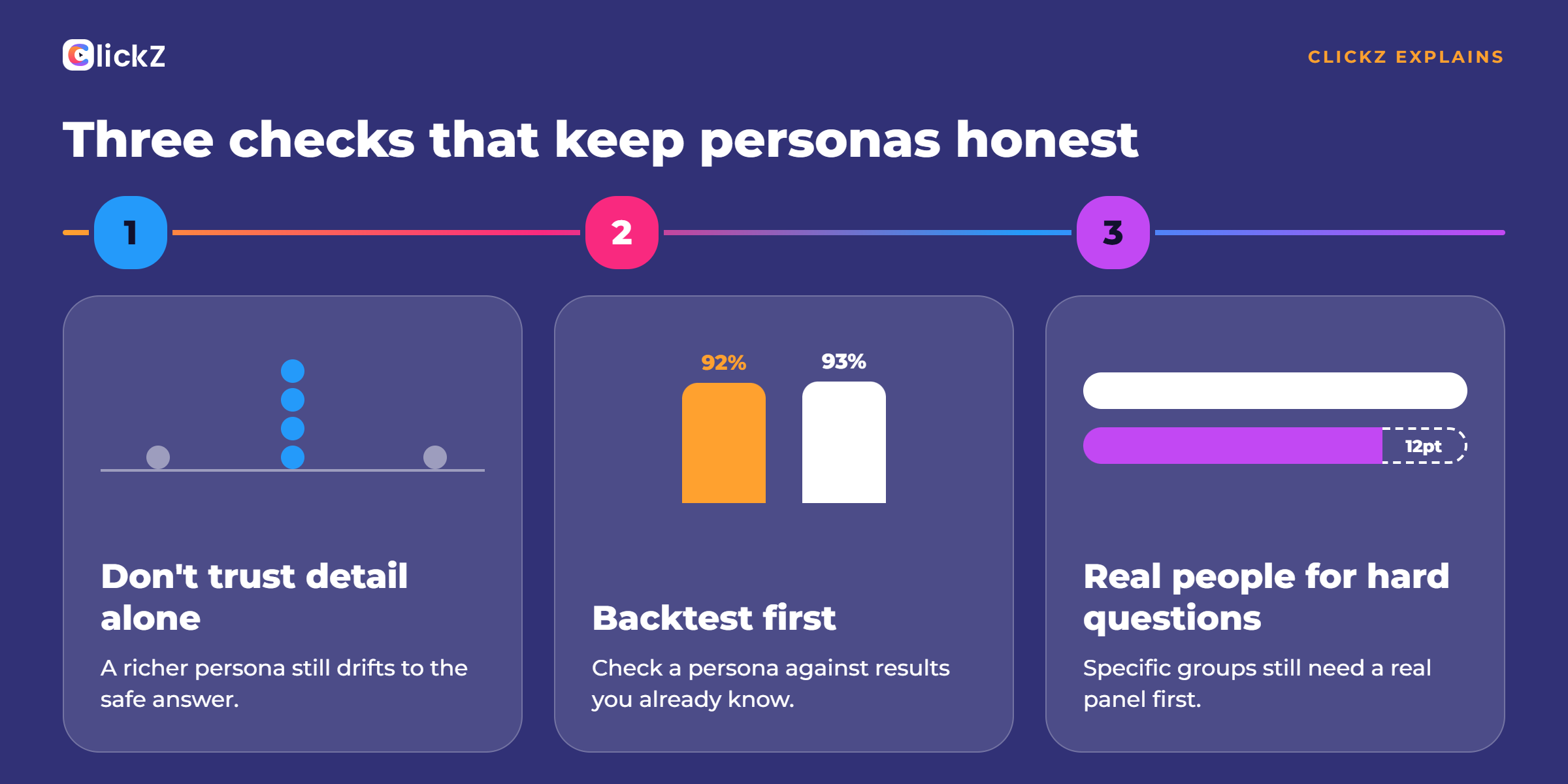
Say a retailer builds a persona from its own survey answers and interview transcripts. More detail does not guarantee a better persona, since a model can still settle on the safest answer.
The Times held back part of its audience and asked its synthetic panel to predict their answers. It reports about 92% accuracy, against 93% for conventional research. A team can run a similar check by showing a persona last quarter’s paid ads and comparing its favorites with real performance.
Questions about specific groups belong with real people first. Pew Research Center had an AI model retake three of its surveys as real panel members. The results differed from the human polls by an average of 12 percentage points, and no demographic group came in under 12.
Behind every persona sits a decision about who the customer is, made before the model answers anything. A language model returns the most ordinary version of whatever customer a brief describes.
So can a persona replace the focus group? It can extend one once the audience it describes has survived contact with real customer behavior. Until then, it hands the team’s own assumptions back in a confident voice. Before the next persona answers, ask who wrote its brief and what real customers have done to confirm it.
Leave a Reply
You must be logged in to post a comment.