Could Google AMP be better than Facebook Instant Articles?
Google has initiated “Accelerated Mobile Pages (AMP)” to help articles load instantly. While it sounds just like Facebook Instant Articles, AMP will serve as an open source.
Google has initiated “Accelerated Mobile Pages (AMP)” to help articles load instantly. While it sounds just like Facebook Instant Articles, AMP will serve as an open source.
Publishers will soon have another platform to distribute their content: Google’s “Accelerated Mobile Pages (AMP),” which the company announced this morning at an exclusive press breakfast in New York City.
The AMP project is designed to improve the performance of the mobile web. It relies on AMP HTML, a new open framework that allows websites to build lightweight pages so rich content – such as video, animations and graphics – can load instantly, according to Richard Gingras, head of news products at Google.
For example, if you Google “Taylor Swift,” a carousel of related news articles from different publications will show up. When you click on a select story, it will appear immediately.
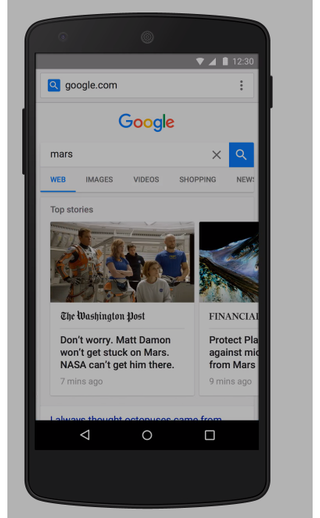
“Web is great, but it does not fully satisfy users’ expectations. We want to give every publisher, regardless of the size, a tool to serve their content. The goal is to be ‘instant everywhere,’ no matter whether it’s mobile Web, mobile apps or social networks,” said Gingras.
Many think that AMP looks like Facebook Instant Articles. But Gingras explained that while Instant Articles is a third-party tool, AMP is designed for mobile Web specifically and will serve as an open source. The project will help publishers get better engagement on a variety of platforms, including Google search and Twitter, as well as direct readers to publishers’ own sites.
Cory Haik, executive director for emerging news products at The Washington Post, thinks that all the distribution platforms, including Google AMP and Facebook Instant Articles, put publishers into an advantageous position.
“AMP is just another channel for us to push out our content. Different distribution platforms have their own complication. Although we have a mobile app, we are looking to extend the reach of our content through Facebook, Google and other platforms,” said Haik.
The first group of technology partners includes nearly 30 publishers, such as BBC, BuzzFeed, New York Times and Twitter. Since today’s announcement is just a preview of what AMP content will look like, it’s unclear if publishers involved will have to pay in order to rank high. But Gingras pointed out that Google will “objectively surface AMP content based on many signals.”
AMP content has not yet gone live in the regular Google search results, but you can play around with AMP search here.
Homepage image via Shutterstock
Leave a Reply
You must be logged in to post a comment.