Global Commerce Review 2018: Takeaways from changing purchasing habits
How does the rise of mobile usage affect retailers? What can we learn from global commerce 2018 about what the future of ecommerce will look like?
How does the rise of mobile usage affect retailers? What can we learn from global commerce 2018 about what the future of ecommerce will look like?
How does the rise of mobile usage affect retailers? What can we learn about the future of ecommerce?
Retailers need to be aware of the changing trends in ecommerce to stay competitive. As we are spending more time online, it is important to understand how consumers behave when considering a purchase.
The advertising platform Criteo released its third Global Commerce Review to help us understand how consumers behave through a report that involved more than 5000 retailers in more than 80 countries.
It’s no surprise that mobile transactions are on the rise. As more people integrate mobile usage into their browsing and shopping experience, retailers realize that there is a big opportunity to tap into a rising trend.
Americans have used their smartphones more frequently this year to complete a transaction. In fact, the share of sales through smartphones has increased by 14% from Q3 2017 to Q3 2018.
This means that retailers should be prepared to adjust their strategies to a mobile-first world. From online promotion to multi-channel marketing, there are many opportunities to reach a new audience and increase engagement and sales through a good mobile experience.
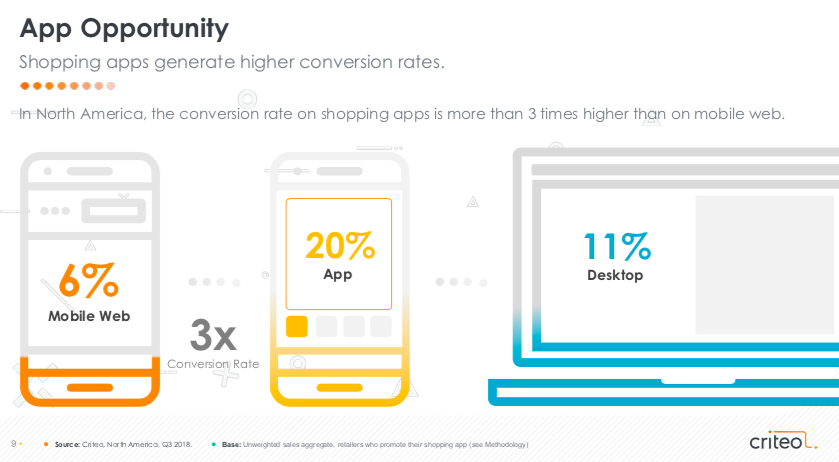
According to Criteo’s report, the conversion triples through shopping apps. Retailers who are serious about mobile users invest in shopping apps as a primary way to showcase their products. A good mobile web browsing is still important in terms of the user experience, but it’s not enough.
The next step after realizing that shopping apps bring higher conversions is to invest in actually promoting them. Retailers who promote their shopping apps see their mobile transactions reaching 63% of all their transactions.
This means that it’s not enough to be present, but you also need to tell everyone about the shopping app and the new way of completing a transaction.

Omnichannel customers don’t rely on one channel. They want to move the process across different channels and possibly devices. The consideration process may differ from the actual purchase. However, all channels are equally important in the journey, which highlights the importance of offering a great user experience in all channels.
What’s interesting is that although omnichannel customers have the highest lifetime value, they are still representing only 7% of all customers. This is the ideal audience that retailers need to target in a more personalized way to deliver the best shopping experience.
The best way to benefit from an omnichannel strategy is to get access to valuable data. Retailers who decide to bring together offline and online data can improve the customer experience to learn more about their consumers.
The more you analyze the data, the easier it is to improve your campaigns.
When it comes to the promotion of their shopping app, online retailers who promote their app see 31% of their transactions coming from the app.
Brick-and-mortar retailers who promote their app see 21% of transactions coming from the app. Although the percentage is lower than the success of online-only retailers, it still highlights a great opportunity that comes along with a unified strategy to blend the offline and online data.
Jaysen Gillespie, Vice President and Head of Analytics and Data Science at Criteo, commented on the findings:
“Given that the share of mobile transactions continues to grow in most countries and that the share of in-app transactions continues to grow in all countries, retailers are well positioned to drive awareness, consideration and conversion through digital audiences.”
Moreover, he reminded us that brick-and-mortar retail is not dead since “the omni-shopper is one of the most valuable audiences, demonstrating the desire from consumers to have both an in-person experience and the convenience of purchasing online.”
A good way to organize your ecommerce strategy for 2019 is to keep these takeaways in mind:
Leave a Reply
You must be logged in to post a comment.