30-second summary:
- Adobe’s attribution modelling is increasingly data-driven with an incremental approach to assigning credit to touchpoints
- AI feeds into propensity modelling to predict the likelihood customers will purchase, upgrade, churn
- Tools and techniques are getting more sophisticated with AI, but there are always bumps in the road
- Understanding your business, as well as a basic understanding of data science are key marketer skills in the AI era
This past Thursday, Adobe’s Director of Business Strategy Don Bennion gave an enlightening presentation at our online AI in Marketing event.
The talk offered practical advice and examples of how Adobe has increasingly used artificial intelligence and machine learning in their internal activities in recent years.
Their practices are borne from the predictive power of customer experience metrics and their own data driven operating model (DDOM). The company is now moving to make these tools and techniques available to external partners.
Here are my key takeaways.
AI and Attribution
Attribution was really the first area Adobe started using AI and machine learning.
Moving away from the simple models such as ‘first click’ and ‘last click,’ and later ‘u-shaped’ and ‘linear’ models, the incorporation of AI and ML improved Adobe’s models massively.
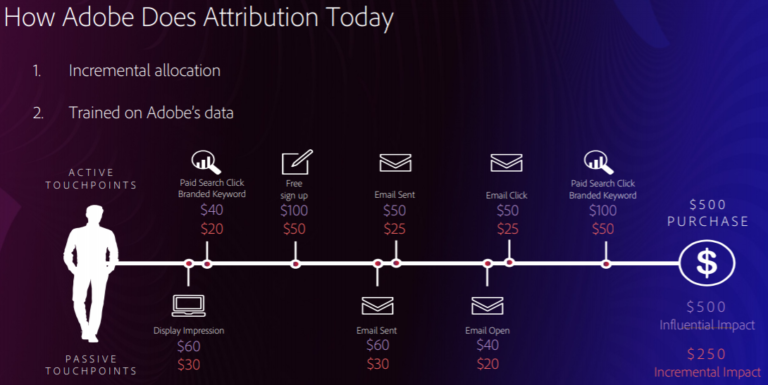
Bennion highlights two ways to assign credit in attribution:
- Influential: when touchpoints are hit, all credit is shared to these touchpoints
- Incremental: calculates how much of the credit should be assigned back to media and marketing
Adobe moved into the incremental area. The hypothesis is that if Adobe stops all their marketing efforts, they would still sell products. After all, customers make purchases which are at least partly based on factors like brand loyalty and word of mouth.
Using AI trained on their internal data, they were able to establish a baseline of 50% marketing value from each purchase. From here, they could then weight all their touchpoints individually and – crucially – cut marketing costs, or better allocate it, more efficiently than would be possible by assigning credit with the influential method.
AI and Personalization
Another area in which Adobe are incorporating AI is in personalization.
‘One to one marketing is the nirvana,’ Bennion says. ‘But segmentation is still an important tool for us.’
In the past, Adobe used to segment from attributes and behaviour. This has value but is clearly limited in the big data era. Adobe’s response was to use AI to develop propensity modelling.
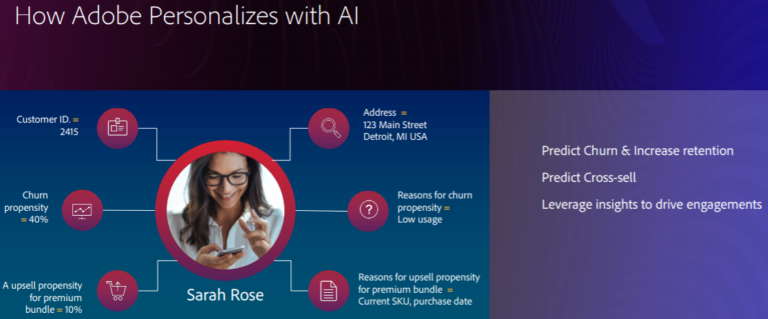
Adobe allocated a ‘propensity score’ for any success event, be it a conversion or a purchase etc. They could then ask the following of potential customers:
- What’s the propensity score for an individual to buy a product?
- What’s the propensity score for an individual to upgrade?
- What’s the propensity for churn?
…then use this to create segments.
Tech company Nvidia did just this. They created propensity scores for ‘frequent gamers’ and ‘infrequent gamers’ respectively. They understood that both these segments have differing habits when it comes to making purchases, upgrading, or responding to marketing messaging.
The result was that Nvidia could use these predictions to personalize their customer experiences to within 96% accuracy.
How has sophistication changed?
One of the key questions that arose during Bennion’s presentation shifted focus to how he has seen data sophistication change over the years.
While attribution and personalization which incorporates AI is still an approximation, he highlighted how the sector is always evolving.
‘More data is accessible from non-web touchpoints. We have better modelling. Speed and processing is quicker with AI data – which is important for drive and scale,’ Bennion said.
That’s not to say there was no mention of any potential bumps in the road for data-driven marketers. Not least in light of Google’s recent announcements to phase out third-party cookies in Chrome within the next 2 years.
Takeaways for marketers in the AI era
Marketers certainly need to be adaptable in this ever-changing landscape, but Bennion is a believer that it is at least as important for them to have a solid understanding of their business, rather than simply striving to better understand data science.
Key growth strategies for Adobe are:
- Acquiring new customers.
- Cross-selling/Up-selling.
Undoubtedly, growth strategies such as these will be familiar to companies of all sizes, and across many sectors.
For customer acquisition, Adobe is asking: Who has the propensity to buy from us? When it comes to cross-selling, i.e. getting customers to upgrade or make a related purchase, churn propensity models are proving massively useful.
It is clear to see how AI via incremental attribution, as well as propensity modelling which feeds into personalization, is helping Adobe achieve their goals here. And it is not too much of a leap to see how other brands can leverage AI to improve their marketing ROI too.
Leave a Reply
You must be logged in to post a comment.