Mobile customer lifecycle management in 2019: How to reach the hyperconnected
Today’s consumers spend an average of three hours and 43 minutes a day on their mobile devices. How do we reach all these hyperconnected users in 2019?
Today’s consumers spend an average of three hours and 43 minutes a day on their mobile devices. How do we reach all these hyperconnected users in 2019?
Customer lifecycle management (CLM) isn’t a new idea. But it is a useful tool for figuring out how to market to your mobile users in a way that keeps them engaged and, more importantly, wanting more.
But there are some very real challenges if you want to engage meaningfully with today’s hyperconnected users.
Today’s consumers are always plugged in, spending an average of three hours and 43 minutes a day on their mobile devices. 50% of that time is spent in one app and 97% in their top 10 apps.
But they’re also on multiple devices, from mobile phones to tablets, laptops, and even gaming consoles. According to Forrester, today’s consumers use an average of four different devices each day.
And then there’s the fact that they’re on the move, accessing devices and data from various locations as they go about their days.
So how do we, as marketers, reach all these hyperconnected users in 2019?
This is where customer lifecycle management (CLM) comes in.
CLM is a simple concept: it’s marketing to users based on what lifecycle stage they’re in. After all, the marketing message you send to a brand new user should be different from the message you give to a loyal customer.

You should be tracking and maximizing the purchase experience at each and every stage of the customer buying cycle.
For growth and retention teams, this process gives you a way to foretell what customers need at every stage so you can communicate with them in the most relevant way.
The hyperconnectivity in 2019 presents several challenges.
Firstly, traditional customer lifecycle stages are not immediately actionable. For example, it’s great to know you need to “retain” users, but which retention strategy will work for a specific user?
Secondly, many of the older lifecycle marketing models follow a sequential and inflexible pattern. The problem is that today’s hyperconnected customers take very little time between stages. They can go from “Acquire” to “Monetize” in mere minutes if they see the value in your product. And if your marketing is two steps behind them, they’re going to have a poor customer experience that will immediately fling them into the “Reactivate” stage.
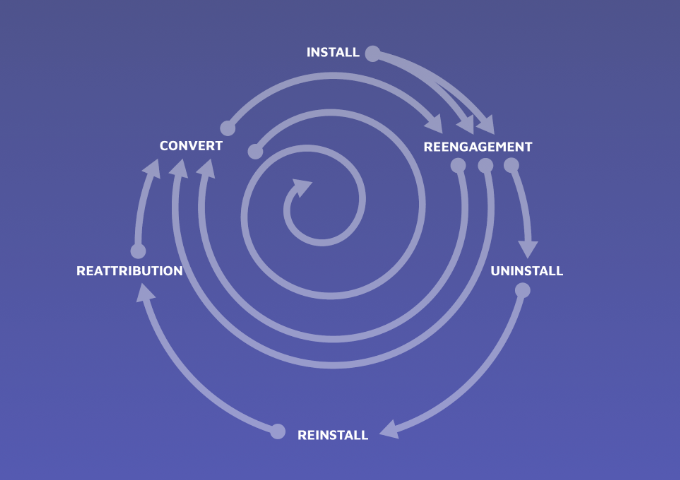
One effective way to market to this quickly-moving audience is to figure out from the get-go who you should be spending time and resources on.
We recommend that our clients use a tool that can look at the recency, frequency, and monetary value of user actions within their apps. This kind of analysis, called RFM, can examine an entire customer base to identify new customers, champions, and even those who are at risk of churn. This will allow companies to focus marketing resources on the segments that matter most.

Recency shows how engaged customers are with a brand, and it’s also a great metric for retention. Frequency and monetary values show how much time and money these customers are spending with a brand. In short, they’re the best indicators of revenue and customer lifetime value (CLTV).
If you want a robust CLM process, incorporating some form of RFM analysis will open up new possibilities for you. The process helps identify which actions are optimal for each lifecycle stage: who to invite to loyalty programs, who to re-engage, and who to leave alone.
When you map out each of the RFM segments to a lifecycle stage, it becomes clearer what the next step for each segment is. Suddenly, each segment becomes intuitively actionable.

The second step is to use the insights gained from the RFM analysis to build out relevant campaigns that resonate with the customers in each segment.
After all, just because a customer is in the reactivate stage doesn’t mean you send only one type of messaging to everyone in this stage. Lifecycle marketing is about spending the time to build different reactivation messages for at-risk customers versus hibernating customers versus customers about to sleep.
| Segment | Messaging |
| At-risk | Ask for feedback about their declining app behavior. “How can we improve our app?” |
| Hibernating | Send SMS with reactivation offer/discount. |
| About to Sleep | Give them access to exclusive features or content to get them to engage with your app. |
The third step is to make use of a wide variety of marketing automation tools to orchestrate your engagement campaigns and allow them to run with minimal intervention.
Ideally, your automation tools give you a way to send out campaigns in real time as well as to trigger them automatically when a specific behavior is done by a customer. At any moment, your system should be looking to send out a highly relevant campaign that was created in the previous step.
The hyperconnected world of 2019 is simply one where there is widespread and habitual usage of Internet-connected devices. But the constant flux of users to each lifecycle stage shouldn’t deter marketers from using the breadth of tools available to send relevant marketing messages. Just as long as they send the right message to the most crucial segments of their customer base that have been defined by RFM analysis.
Almitra Karnik is the Head of Marketing at CleverTap. She has held leadership roles at Cisco, EMC, Splunk, and Twilio in the past and has recently been named as one of the Top 50 Women in SaaS.
Leave a Reply
You must be logged in to post a comment.