90% of Sales Still Happen in Stores. So Why Is Retail Media Ignoring Them? A Shoptalk Q&A With Sean Crawford
Sean Crawford, MD of SMG North America, on why the next wave of retail media growth won’t come from another programmatic ad slot… it’ll come from the store floor.
Retail media is one of the fastest-growing advertising categories in the world. By most estimates it has already overtaken linear TV in total ad spend, and the growth trajectory shows no sign of flattening. But for all the momentum, the vast majority of retail media investment is concentrated in a single environment: digital.
Sean Crawford thinks that’s a problem. As Managing Director of SMG North America, he has spent the past two years building the company’s US operation from scratch and doing it with a thesis that runs counter to much of the industry’s current direction. His argument: if 90% of retail transactions still happen inside physical stores, then treating retail media as a purely digital channel is leaving the biggest growth opportunity on the table.
At Shoptalk Spring 2026 in Las Vegas, Crawford sat down with ClickZ to unpack what he’s seeing across the US and UK markets, why in-store media deserves more attention than it’s getting, and where he thinks brands should be placing their next retail media dollar. His answers were refreshingly direct, including a take on CTV in retail media that he freely admits might be controversial.
Crawford has an unusual vantage point. Before relocating to New York to launch SMG’s North American business, he spent years embedded in the UK retail media ecosystem, helping build and operate networks for retailers like Boots, Morrisons, Co-op, and Deliveroo (recently acquired by DoorDash). In the US, SMG’s most notable launch has been WHS Media, the in-store retail media network for WH Smith’s airport retail operation: 350+ locations, 700 screens, and 900 million travellers passing through annually.
That transatlantic experience gives him a clear read on how the two markets differ. North America, he explains, has been overwhelmingly digital-first. The playbook has centred on growing on-site ad inventory, then expanding into off-site activation using first-party data to target audiences across the digital journey. Europe, by contrast, started with the store. Retailers there built media experiences around physical environments: digital screens, audio, and even printed formats that in Europe are classified as retail media rather than trade or shopper marketing.
What’s happening now is a convergence. North American retailers are pushing into in-store. European networks are building out digital capabilities. Crawford sees this as a net positive, but cautions that the two markets can’t simply copy each other. The nuances are real, and each market needs to find its own path.
The digital bias in retail media isn’t accidental, Crawford acknowledges. Digital is easier to measure, easier to attribute, and easier for agencies to buy. It came from a programmatic world that people already understood. He describes it as the low-hanging fruit of retail media.
But he argues that the easy digital dollars are running out. If the industry is going to deliver on the growth projections published by the likes of eMarketer, it needs to find new avenues. And the store, where the vast majority of transactions actually happen, is the obvious next frontier.
So why hasn’t it happened already? Crawford identifies three barriers. First, complexity: brands fear the operational challenge of activating media in physical environments. Second, capital expenditure: there’s a perception that in-store requires heavy upfront investment in technology. Third, and most critically, measurement. The industry is trying to replicate the one-to-one attribution model that works in digital, and that standard simply doesn’t transfer cleanly to the store floor.
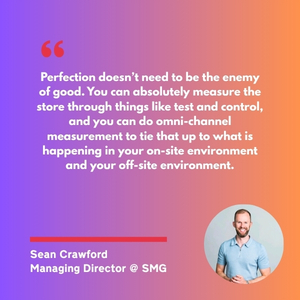
His plea to the industry is pragmatic: stop waiting for perfect measurement before investing in the store. Test-and-control methodologies are proven. They may not tell you whether it was a specific individual who converted, but they can show whether stores with active media saw an uplift compared to those without. For now, that’s enough to move forward.
Even when brands recognise the opportunity in-store, Crawford identifies a structural problem that gets in the way: the teams running different parts of the media journey are siloed.
A retailer might have one team managing on-site digital campaigns through the retail media network, while a separate merchandising team handles in-store promotions through a direct relationship with brands. The result, Crawford says, can be absurd. He cites a scenario familiar to anyone in grocery retail: Pepsi has an in-store deal through the merchandiser, while Coca-Cola is running a campaign through the retail media team. A shopper walks in and gets two competing messages at once. Nobody wins.
This is where SMG’s technology platform, Plan-Apps, fits in. It’s a retail media orchestration system designed to give retailers visibility across all their media touchpoints: in-store, on-site, and off-site, in one place. Crawford argues that without this kind of unified view, retailers can’t plan campaigns effectively, can’t avoid conflicts, and can’t measure accurately because they’re not accounting for all the variables at play.
The retailers who are getting this right, he says, share three things in common: clear reporting structures, the right technology (whether built or bought), and a senior champion in the C-suite who’s willing to push through the organisational discomfort of bringing siloed teams together.
On the thorny question of cross-channel measurement, how do you actually prove that an in-store screen, an on-site banner, and a CTV ad are working together? Crawford comes back to first-party data.
Loyalty cards, he explains, are the backbone. They allow retailers to tie media exposure to individual purchase behaviour. And the rise of membership pricing and loyalty pricing has dramatically improved swipe rates, making the data more reliable. But he’s also clear that one-to-one attribution across every channel isn’t realistic today, and retailers shouldn’t let that stop them.
Instead, he advocates for layered testing. Imagine one group of stores with digital screens running an offer. A second group has the same offer but no screens. A third group adds audio and social media on top. By comparing results across these cohorts, brands can start to isolate which media combinations are driving uplift, without needing a perfect, deterministic match at the individual level.
But here’s the catch: this only works if the testing is designed into the media plan from the start. Retrofitting measurement onto a campaign that wasn’t structured for it rarely produces clean results.
“Brilliant measurement only comes from brilliant media planning. That’s why visibility of what’s going on across the retail media network is so important.”
Structural shift, says Crawford, without hesitation. He acknowledges that colleagues in traditional agencies might disagree, but his reasoning is straightforward: linear TV no longer commands the attention it once did. Consumers are on the move, interacting with media in fragmented ways, and retail media offers the ability to reach them at multiple points along the journey. He sees continued acceleration ahead, with no sign of a ceiling.
The long tail. Crawford’s argument is that brands already know what’s happening with their top accounts. They’re already investing heavily in Amazon and Walmart. The smarter move is to divert some budget into the 200+ smaller networks that now exist. These networks are more open to testing, more willing to go on the journey with a brand, and, crucially, offer access to audiences that the major players don’t reach. The learning from those tests can then be applied back to the bigger networks. And Crawford suspects many brands will be surprised by the results: the long tail may earn a larger share of budget over time on its own merits.
A way to spend a lot of money very quickly. Crawford acknowledges this is probably his most controversial take of the conversation. He’s not dismissing CTV entirely. It’s premium inventory, it works well for certain brands and categories, and there are strong case studies. But his view is that not every brand needs to pay the CTV premium. There are more cost-effective retail media channels that deliver better returns for most advertisers.
Crawford moved from the UK to New York two years ago with zero US brand recognition and a mandate to build SMG’s North American operation from scratch. Today, the company operates multiple retail media networks across the region and Crawford is a regular presence at major industry events.
His advice for anyone making a similar leap is characteristically direct: be open to discomfort, and be a sponge. Despite sharing a language, the US and UK markets operate differently in ways that aren’t always obvious, and the only way to learn is by spending time on the ground, at events, with clients, with people who’ve been in the market longer than you have.
He also points to one of SMG’s core company values: stay hungry. It’s a mentality he tries to embed across his team: always striving for more, whether that’s for clients, for the brands that work with their networks, or for personal growth. The expansion into North America, he says, is that value in action.
ClickZ is covering Shoptalk Spring 2026 live from the floor at Mandalay Bay, March 24–26. Catch our on-site video interviews, session recaps, and daily insights at ClickZ.com and across our social channels.
Brand leaders, if you’re attending and want to share your perspective on what’s shaping retail in 2026, apply to be interviewed here or reach out at editorial@clickz.com.

FROM OUR SPONSOR
Sean’s call for better cross-channel measurement echoes what Fospha hears from brand marketers every day. Fospha’s full-funnel measurement platform gives brands a single source of truth across every channel — with daily, ad-level insights that replace guesswork with action. Brands using Fospha see an average 37% ROAS uplift when Amazon halo sales are included.
Find Fospha at Booth #2480 at Shoptalk, or visit fospha.com to learn more.
EVENT COVERAGE SPONSORED BY FOSPHA
Leave a Reply
You must be logged in to post a comment.