How Bombas Keeps Its Mission Intact as It Moves into Mainstream Retail
Most brands that talk about purpose treat it as a channel. A campaign lever. Something to activate when the quarterly numbers need a story. The result is the familiar texture of modern brand marketing: giving programs that feel bolted on, mission language that evaporates once a customer reaches the checkout.
Bombas was built differently, and the test of that claim is getting sharper. The sock and apparel brand, long known for its one-for-one giving model and premium product positioning, is now expanding aggressively into wholesale, with recent partnerships at Target and DSW putting the brand in front of audiences it has never reached at scale. That kind of growth tends to expose the gap between what a brand says it stands for and what it actually does when the distribution gets harder to control.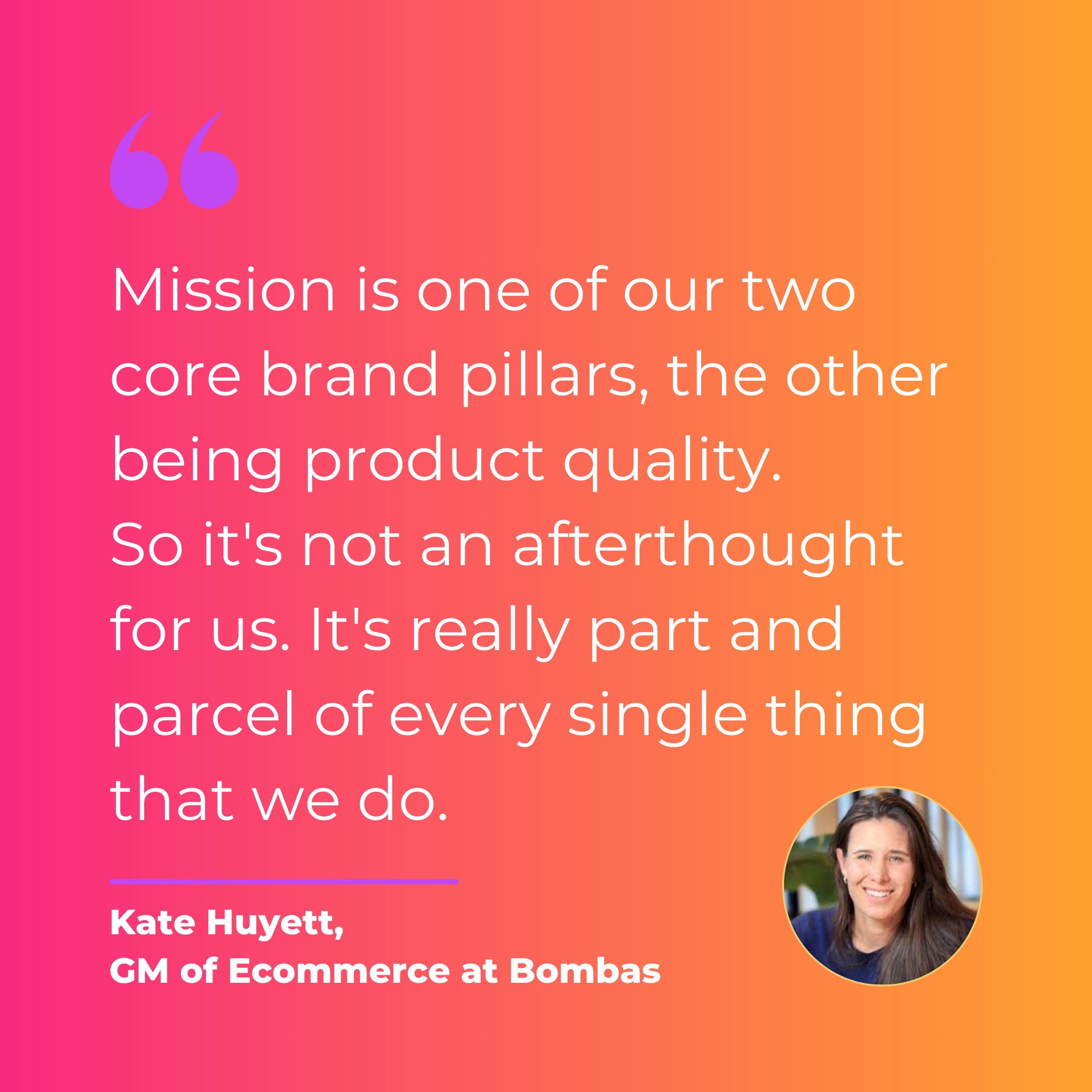
Speaking with ClickZ at eTail Palm Springs 2026, Kate Huyett, GM of Ecommerce at Bombas, laid out how the brand thinks about that challenge, and what it actually looks like to operate a mission-driven business when the pressure to scale is real.
“Mission is one of our two core brand pillars, the other being product quality,” she said. “It’s really part and parcel of every single thing that we do.”
That is a familiar claim. What makes it credible at Bombas is the specificity of how it is applied. When asked how the brand measures the ROI of its giving mission, Huyett pushed back on the premise entirely. “Mission is so ingrained in what we do, it’s a little bit like asking Disney what the return on entertainment is. It’s quite hard to divorce from the brand in aggregate.”
Instead of a revenue attribution model, Bombas tracks two distinct metrics on a quarterly basis: awareness of the mission and, separately, belief in it. The distinction matters.
“It’s one thing to know we have it,” Huyett said. “It’s a very different thing to trust that it’s true, particularly in today’s environment, where customers are quite a bit more skeptical.”
That trust metric is, in effect, a brand health indicator. It acknowledges something most performance marketers do not build into their dashboards: that customer skepticism has risen to the point where stated values require ongoing proof, not just awareness.
Bombas has been in wholesale for years, but the footprint was intentionally small. The logic was not caution for caution’s sake. “We really wanted to prioritize working with partners that we thought could represent the brand well, and that was inclusive of their excitement around our mission,” Huyett explained.
“We’ve really thought from the beginning about wholesale, not just as a place to find incremental revenue or reach incremental customers, but a place that can help publicize our mission and help drive awareness of it.”
The recent expansion into Target and DSW reflects that same filter applied at much larger scale. Target, with 30 million visitors a week, is a platform for the mission. The footwear expansion into DSW – Bombas’ first retail partner dedicated to its growing footwear line – follows the same logic: reach that serves the giving story.
For senior marketers managing brand partnerships or retail expansion, this is the useful reframe. Channel selection is a brand decision, and every new partner is either reinforcing or diluting the identity the brand has built.
One of the more instructive parts of the conversation was Huyett’s description of how Bombas manages its performance marketing mix. The brand made a deliberate choice years ago to reduce its reliance on Facebook, at a time when many DTC peers were doing the opposite. In 2026, Facebook remains in the mix, but the approach has evolved significantly. “Within Facebook, the way that we are using creative to target different types of audiences, our approach to essentially lower funnel on Meta versus mid or upper funnel, has evolved,” she said. “That’s true of all of the channels that we’re in.”
The governing principle is not finding the best-performing channel and concentrating there. It is distributing spend so that no single platform can destabilize the business. “If your spend is more distributed across more partners, you’re able to absorb whether they’re more permanent changes in how the platform is evolving, or this month XYZ partner has made some changes to the platform and you need to see how it works through,” Huyett said. “It just gives you the ability to absorb those shocks and move more cohesively.”
She described this explicitly as portfolio theory applied to media. Concentration risk in a financial portfolio and concentration risk in a media mix have the same structure: when one position dominates, a single adverse event becomes a business problem.
Pushed on whether charity fatigue is a real risk for the one-for-one model at scale, Huyett answered with a structural argument rather than a brand assertion. The question is not whether giving programs resonate. The question is whether the giving is genuinely useful.
“One of the things we’re most conscious of is asking them what clothing items they need,” she said, referring to Bombas’ network of 4,000 giving partners across the country, each of which the brand surveys regularly. “We want to make sure that we’re not just donating this many socks because we’ve sold this many socks. We want to make sure that we are meeting the needs of our partners.”
That rigor directly shaped the product roadmap. The brand’s expansion into underwear and T-shirts was a response to data: those are the second and third most requested clothing items in homeless shelters across Bombas’ giving partners. A dedicated internal team manages those 4,000 relationships, and the brand has donated over 150 million items to date.
The scale of that infrastructure is what separates a credible one-for-one model from a marketing construct. It is a supply chain, a survey program, and a service operation. That is not the profile of a brand using giving as a tagline.
The Bombas model is not easily replicated, but the underlying discipline is. Mission that survives scale is a mission that is designed into operations, into partner selection, into measurement frameworks, and into the small product decisions that most brands never bother to make.
Huyett’s leadership reading list reflected that same sensibility. Alongside management classics like Andy Grove’s “High Output Management” and Claire Hughes Johnson’s “Scaling People,” she cited C.S. Lewis’s “The Screwtape Letters” for a reason that was entirely operational: “Drift happens in the small moments where you can sort of make the easier decision that’s not aligned.” In a scaling culture, where decisions multiply faster than culture can keep pace, that is the real risk.
EVENT COVERAGE SPONSORED BY FOSPHA
Leave a Reply
You must be logged in to post a comment.