Most retailers now have an AI roadmap. Few can say which business problem it is meant to solve, and that is the first question Santhi Ramesh asks before any other.
Ramesh has led change management across three very different kinds of ownership: a public multinational at Hershey, a family-owned business at Ferrero, and now a Berkshire Hathaway company at Pampered Chef, where she is chief commercial officer. She also runs her own AI advisory firm, FuturePropel, coaches C-suite leaders and board members through it, and sits on the board of the Pratham Education Foundation. She spoke with ClickZ at Shoptalk Fall in Nashville about what separates AI transformation that sticks from AI transformation that stalls.
The operating model decides the toolkit, not a universal playbook
“The transformation fundamentals don’t change. It all comes around to thinking about the audience, thinking about the culture, and thinking about the outcomes,” Santhi Ramesh said. The approach to each of those, though, still bends to the structure around it. A public company like Hershey runs on a quarterly cadence and has to meet market expectations. Ferrero, privately held, builds around the long term instead. Pampered Chef, under Berkshire Hathaway, comes with more autonomy than either, and Ramesh is blunt about what that autonomy costs. “With autonomy comes accountability,” she said. Three ownership structures, three different versions of the same discipline: design the change management around the operating model and the people who make the decisions.
Transparency, proof, and capability move a 50,000-person sales force
Pampered Chef’s growth runs through 50,000 independent consultants, a direct sales model built on personal relationships long before anyone coined the term omnichannel. Getting that network to adopt a new digital behavior takes three things, Ramesh said: transparency, proof, and capability. Consultants need to understand why a change is happening before it happens. They need evidence that it will help them sell, not just a promise that it will. And they need training and tools that make the new behavior easy to pick up.

Ramesh resists calling any of this change management at all.
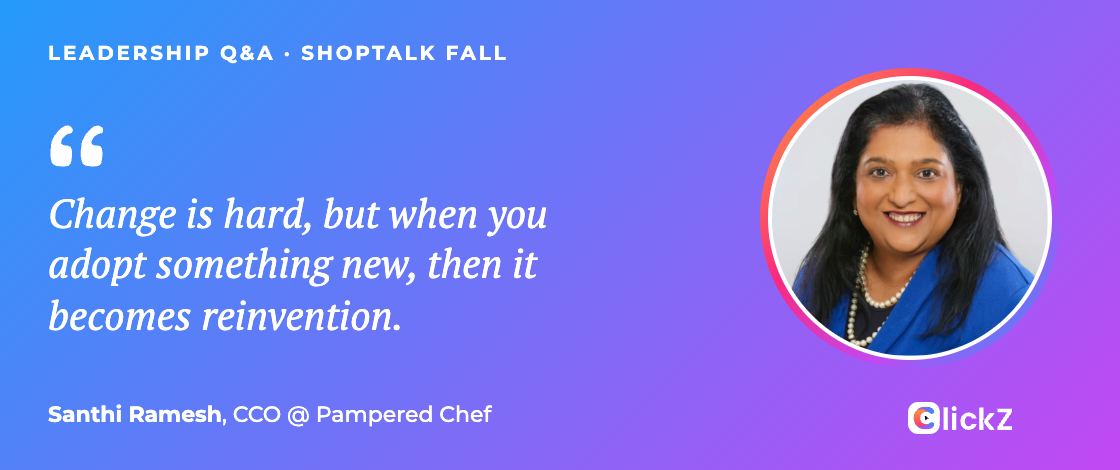
“I don’t like to use the word change. I like to say adopt a way of working. Change is hard, but when you adopt something new, then it becomes reinvention.”
A consultant who chooses to adopt something new, experiences it as her own reinvention rather than a mandate handed down from above.
Most AI agent deployments fail before they start
Santhi has written about why AI agent deployments fail. “What is the business problem that you’re solving?” is the question she asks first, before a company picks a technology or drafts a roadmap. Metrics come next: what needs to move, and by how much, before the AI choice even enters the conversation.
The second failure shows up just as often, in her experience: handing the whole effort to IT. A chief information officer or chief AI officer can design the infrastructure, but infrastructure alone cannot solve a problem it was never told about. The constraints the business team operates under daily have to be fed into the model directly, Santhi said, since only the business owner knows them. Those constraints, not the architecture, decide whether the deployment earns its investment.
Personalization that finds new customers, not just new efficiency
Pampered Chef’s consultants built their businesses selling to friends and family. The limit of that network is obvious, and Santhi’s team used AI to push past it, mapping customer cohorts by geography so consultants could reach people outside their existing circle. Consultants were skeptical at first, unsure what the tool would do or who it would be talking to on their behalf. Santhi’s answer was the same sequence she applies everywhere: explain how it works, show it with real examples, then hand over the techniques to use it. The payoff showed up directly in the numbers, in new customers and revenue growth for the consultants themselves.
Efficiency gets the credit; growth is where AI earns its keep
Efficiency dominates most retail conversations about AI, and Santhi thinks that’s the wrong headline. “It’s all about efficiency. People think about AI in terms of driving efficiency. Where they’re missing the mark is on driving growth,” she said. Combine the two, in her view, and the return on the investment compounds instead of simply holding costs down.
Reinvention, on repeat
Santhi calls this year’s Shoptalk theme, Retail Unplugged, a word for reinvention: redesigning how a business operates, rethinking how customers discover and buy a brand, and redefining roles so people can use more of their own capacity. It also happens to describe her own career. Beyond the P&L at Pampered Chef, she runs FuturePropel and sits on the Pratham board, work she traces to one motivation. “I enjoy building the future generation of leaders,” she said.

Leave a Reply
You must be logged in to post a comment.