Email Deliverability Takes a Turn for the Worse
After several stable years, the inbox placement rate fell from 81% in the first half of 2012 to 76.5% in the second half.
After several stable years, the inbox placement rate fell from 81% in the first half of 2012 to 76.5% in the second half.
Consumers unclear on the concept of opting out are damaging email marketers’ reputations and reducing their delivery rates, according to a new report from Return Path.
Return Path, which provides a solution for marketers to increase email deliverability, as well as sender scoring and certifying services for ISPs, found that the proportion of global email delivered to consumers’ inboxes dropped six percentage points in the second half of 2011, according to its Global Email Deliverability Benchmark Report. While the inbox placement rate was 81 percent in the first half of last year, the rate dropped to 76.5 percent in the second half. For the past three years, the inbox placement rate, or IPR, had stayed steady at around 80 percent.
Return Path used data from its Mailbox Monitor service for campaigns conducted in the second half of the year, tracking delivery, blocking and filtering rates for more than 1.1 million campaigns, reviewing data from 142 global ISPs.
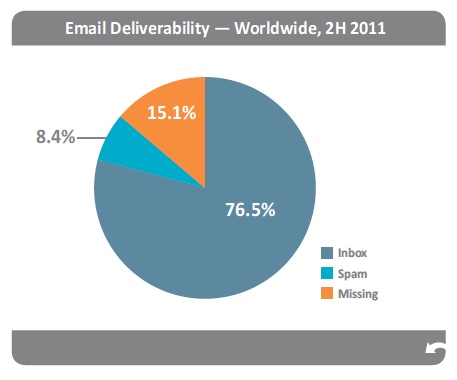
Image source: Return Path
While ISPs have tightened their screening, some marketers’ reputations have been harmed by consumers who blithely click the “Spam” button on their webmail interfaces, according to Tom Sather, senior director of email research at Return Path.
The report references research by Microsoft that found that only 2 percent of true spam now reaches consumer inboxes. But consumers are staggering under the weight of their own opt-ins, with only 14 percent of their inbox being actual personal emails. The rest is newsletters, personal daily deals and such.
“People are suffering from inbox overload and receiving email they don’t want to receive, even though they have opted into it. As a result, we’re seeing subscribers reporting it as spam,” Sather says. “They don’t realize that by doing that, it’s affecting all of that marketer’s emails. Every time someone reports an email as spam, it does hurt the sender’s reputation.”
Noting that the time frame covered in the report includes the United States’ nearly six-month holiday shopping season – from back to school through Christmas – Sather says that complaints about legitimate senders also increased, from 2 percent to over 3 percent. ISPs, meanwhile, like to see complaint rates of no more than .1 percent.
Consumers clicking the spam button instead of that often obscure “unsubscribe” link at the bottom of marketing emails is not the only reason for the decline, Sather says. The ISPs use changes in volume as part of their filtering algorithms, so an upsurge in emails promoting events such as Black Friday sales often trigger deliverability issues.
Taken by region, the report found that the EMEA region had the best email delivery rate, at 85 percent, while Asia Pacific had the worst, at 67 percent. The IPR for North America was second best at 79 percent.
Leave a Reply
You must be logged in to post a comment.