Pinterest and Wolt on Proving Retail Media Works, From Discovery to Delivery
Retail media used to mean one thing: a sponsored slot at checkout. That is no longer true.
A shopper now gets inspired to cook something new on Pinterest on a Friday night. She orders the ingredients from Wolt twenty minutes later. Budgets have followed that shift, spreading across more platforms and more networks than ever.
That shift sat at the heart of a panel on day two of Retail Media Pioneers 2026. The session, “Proving Retail Media From Discovery to Delivery,” took place at The Hurlingham Club in London. Zihan Lyu, Editor-in-Chief at ClickZ, moderated the discussion.
Her guests were Natasha Spencer-Warren, Lead Client Partner at Pinterest, and Alberico de Nardis di Prata. He leads global agency partnerships for Wolt within DoorDash’s wider organisation, and has recently taken on Deliveroo too. Together, they cover two ends of one journey: the moment a shopper finds inspiration, and the moment she pays.
Spencer-Warren opened with a simple case. Discovery deserves its own budget line, not a spot on someone else’s media plan.
Pinterest users arrive undecided, she said. They are still building an idea, not executing one. That makes them a different audience to the shopper who is already comparing prices in an aisle.
She was honest about where UK retail media data still falls short. “We’re like a good wine, we’re on the road to maturity,” she said.
The bigger risk, she added, is treating offsite partners like Pinterest as a reach top-up. The better approach is understanding the specific “superpowers” each partner brings to a plan. 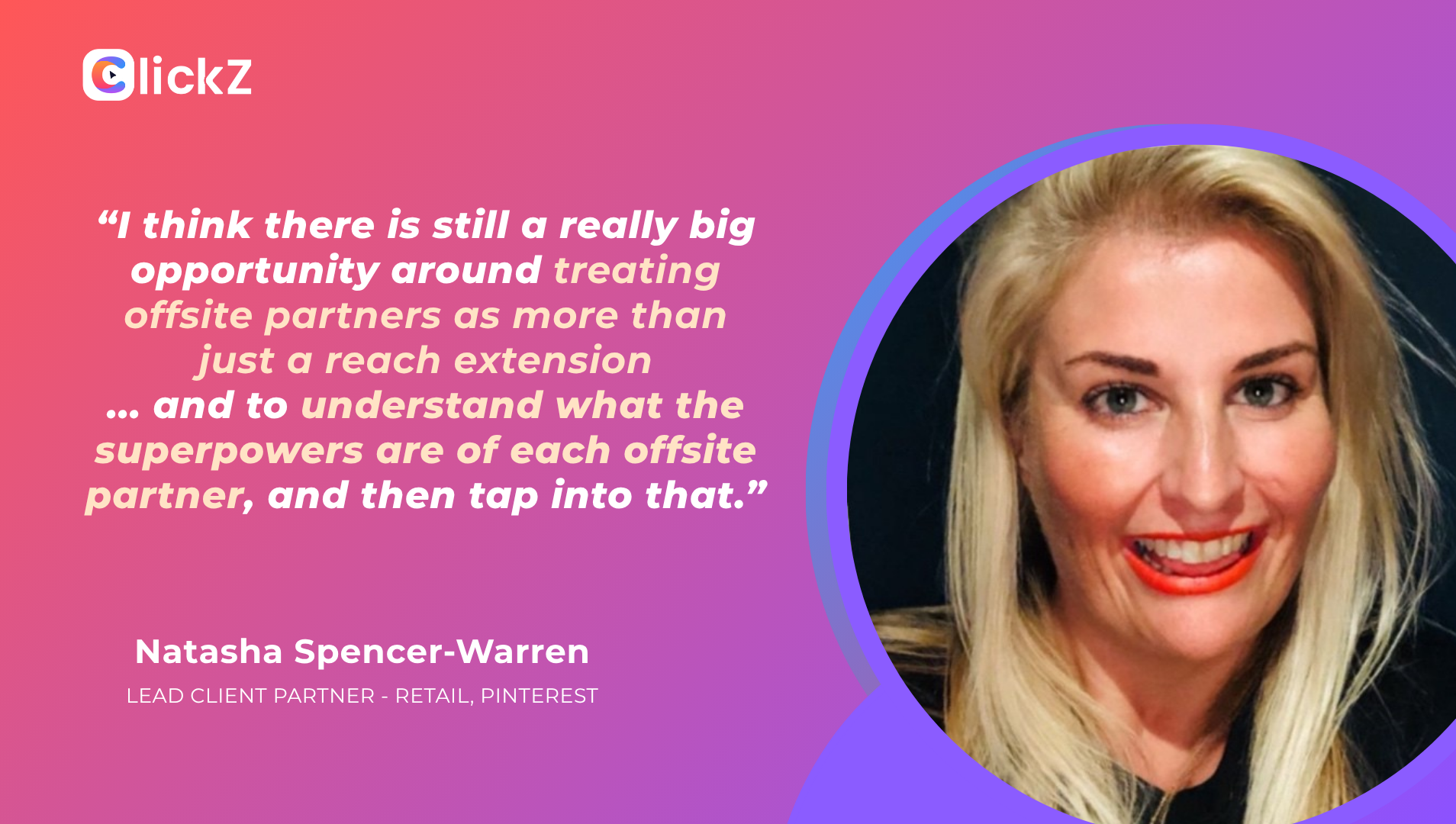
Every retailer defines its measurement windows differently. Most systems still give full credit to whichever channel a shopper touched last. That model writes Pinterest out of results it helped create.
“For a platform like Pinterest, we are reaching a shopper when they’re at that point of inspiration, and we often don’t get to that point of last click. It kind of gets stolen away from us,” Spencer-Warren said. “Yet your media money shouldn’t then all go through into that last click. It’s really important that you are capturing the shopper in that early stage as well.”
Her point rested on what she called two things. The first is consistency: agreeing “where are we starting at,” the retailer’s objective, the brand’s goal and the measurement source of truth, before a campaign runs. The second is a single, unified goal, one that keeps the focus on the shopper rather than on which channel gets the credit. A retailer who measures only the final touch misses both. It cannot see which channels created demand in the first place, and it misses which ones brought a genuinely new shopper into a category.
She backed it with a real example. “We were able to identify, by analysing Pinterest campaign data and the Tesco Clubcard data, just what a pinner’s behaviour was when they were shopping at Tesco,” she said. Pinners turned out to be 26% more likely to shop at Tesco than non-users, added 6.1% more to their average basket, and were more willing to switch brands and categories once Pinterest reached them.
De Nardis di Prata’s end of the funnel looks different, but he faces the same problem. Wolt, Deliveroo and DoorDash all sit close to the final, high-intent purchase.
Rather than force one playbook across three platforms with different habits, his team builds shared capability instead. That covers measurement, audiences and brand partnerships.
Symbiosis is the link that makes this work. DoorDash bought the data collaboration platform roughly two years ago. It lets brands reach Wolt and Deliveroo audiences across the open web, including on Pinterest. It can then trace that reach back to a completed order.
“The user journey doesn’t start necessarily on Wolt or Deliveroo, although it might,” de Nardis di Prata said. “When it does start on Pinterest, we need to be able to make that journey more connected.” He described the shift in four words: “streaming, scrolling, searching, and then shopping.” His example was a Friday night dinner search, where someone browses Pinterest for recipe ideas, ends up “25 minutes from Pinterest to a bag delivered at your door.”
That closed loop already delivers results worth repeating. De Nardis di Prata’s team ran a campaign with Unilever. It layered the brand’s own first-party data onto Wolt’s consented audiences inside a clean room.
“The objective, right from the first QBR, was around delivering privacy-centric data sharing to enable a much sharper audience strategy to boost results,” he said. The campaign added Unilever’s own first-party data in the markets where it had it, off the back of events and sponsorships. The result: “a just over 30% increase or uplift in attributed revenue off the back of a new targeting strategy.” His team is now rolling the same approach out across a further fifteen markets.
For de Nardis di Prata, trust decides who wins the budget. Technology matters less.
Agencies now answer to their clients the same way retail media networks answer to brands, he said. That raises the bar on what any network must prove. It needs to become a real planning partner. Buying it just for reach is not enough.
Spencer-Warren made the same point from the brand side. Retailers and platforms should agree the measurement definition before a campaign starts, she said. Then a discovery platform and a delivery platform can work towards the same goal. Neither one then competes with the other for credit on the same sale.
A shopper’s journey already runs continuously, from inspiration to delivery. The measurement stack has not caught up with it yet.
Senior marketers should audit budget against where demand starts, not just where it lands. Retail media’s next fight is not for more platforms. It is for one shared definition of what each platform is actually worth.
Leave a Reply
You must be logged in to post a comment.