Retail Media Pioneers Day 1: Growth Math Beat the AI Pitch
Sixty-three percent of people who show up on Bol’s marketplace aren’t there to buy. They’re still browsing. Many haven’t even picked a brand yet.
Justin Sandee, Director of Commercial Development at Bol.com, opened his session with that number. He argued browsing behavior is data, not noise. A product page viewed only once, which happens 26% of the time, is still worth reading as a signal.
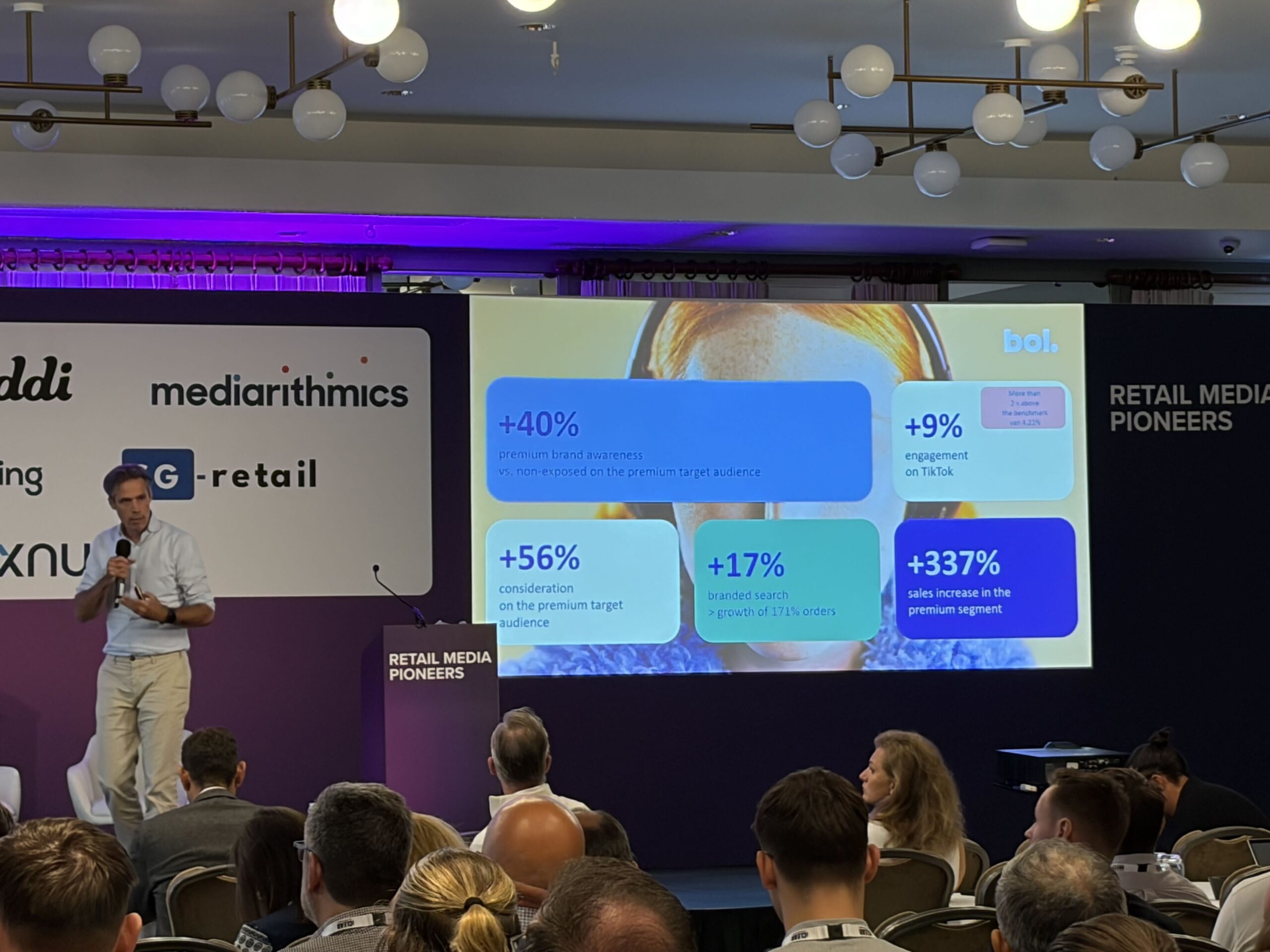
Sandee built his case around a campaign for JBL, the headphone brand. JBL wanted to shift from volume seller to premium player. His team combined rational search signals, like queries about noise cancellation, with emotional ones, like queries tied to travel and calm. Both fed into creative built around specific buying moments.
The results were sharp. Sales rose 337%. Searches tied to premium terms rose 17%. Combining channels rather than running them separately pushed conversion rate up 78%. Return on investment grew 23%. “It’s about understanding the behavior of consumers,” said Sandee.
Steve Gray, Founder of SG-Retail, reached a related conclusion from a different career. He spent years at Procter & Gamble, PepsiCo, and Dunnhumby. His framework draws on Byron Sharp’s How Brands Grow and the Ehrenberg-Bass Institute. It puts penetration ahead of loyalty as the number that predicts growth.
“You can’t grow a brand unless you acquire new customers,” Gray said. He traced the idea back to Amazon’s own founding insight for its ad business: “When people shop with us, they don’t actually know what they want.”
Gray illustrated this with a search for sausages on a retailer’s site. Roughly 60% of shoppers search rather than browse by category. A well-distributed brand that doesn’t appear in that search result is functionally invisible, no matter how strong its shelf presence is elsewhere. Retail media, he argued, is the one channel that can build physical and mental availability inside a single search result.
Sandee and Gray were making the same point. The behavior between search and purchase carries more predictive weight than the purchase itself. 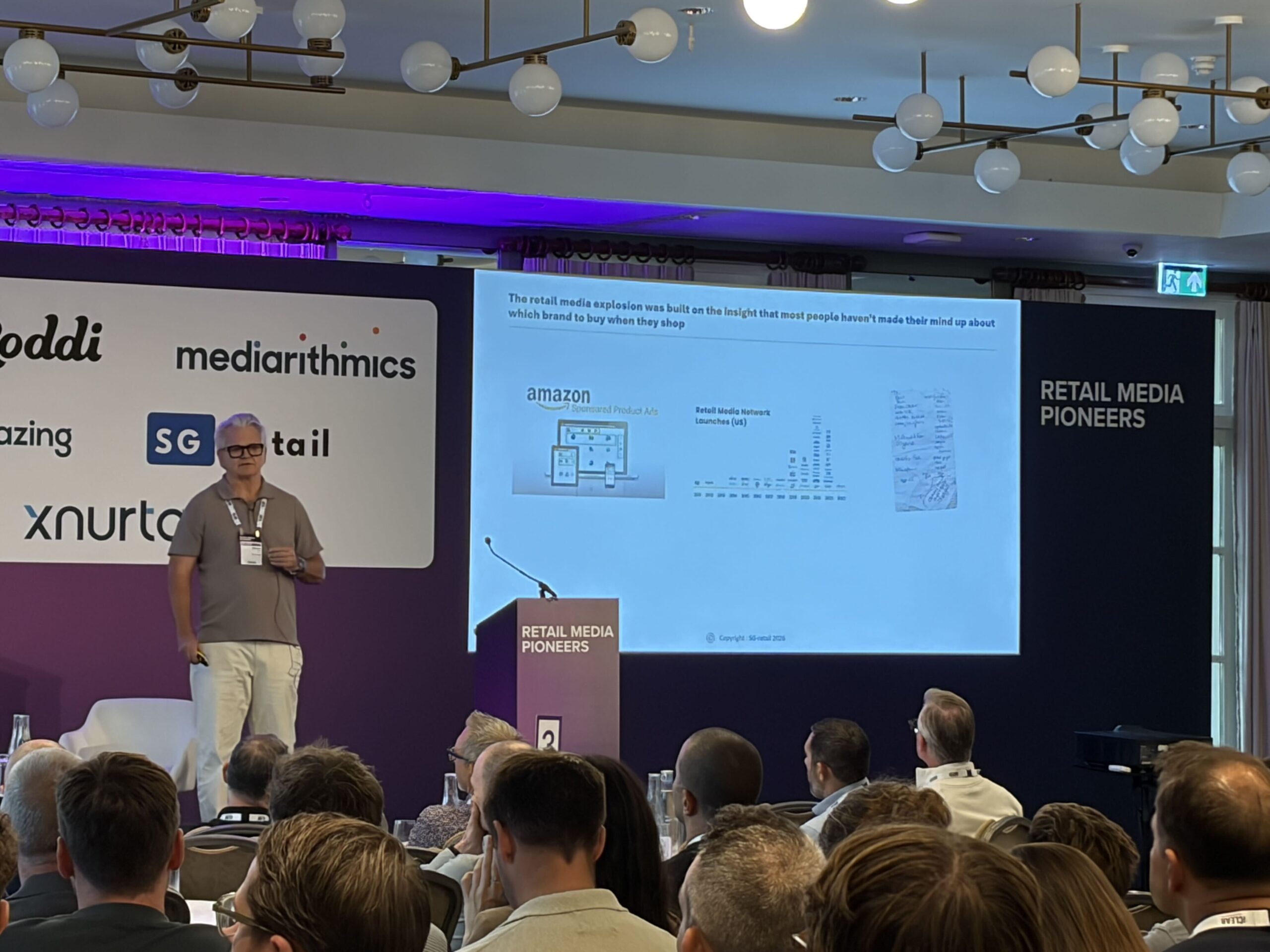
Lasse Storgaard, Nordic Head of Creative Agency at Matas, tackled a less glamorous problem. Matas runs a retail media business worth roughly 400 million kroner a year. A 2023 acquisition doubled the markets, languages, and operating models it had to run on.
His fix wasn’t more AI. It was structure first. “Retail media… will actually scale at the speed of content production,” Storgaard said. His sharpest line pushed back against leading with tools: “Operating models beat AI models, and AI belongs in workflows.”
Even with AI generating creative variants at scale, Storgaard kept the brand work itself outside the machine. “We really believe that creativity belongs where the brand lives,” he said.
The day’s Oxford-style debate picked up that same boundary line. Deni Petrova of WPP Media argued paid media will decide brand influence as AI assistants take over more of the shopping journey. She cited a WPP Media study of over a million purchase journeys. It found 84% of purchases go to brands people were already buying, a pattern she said AI won’t disrupt. 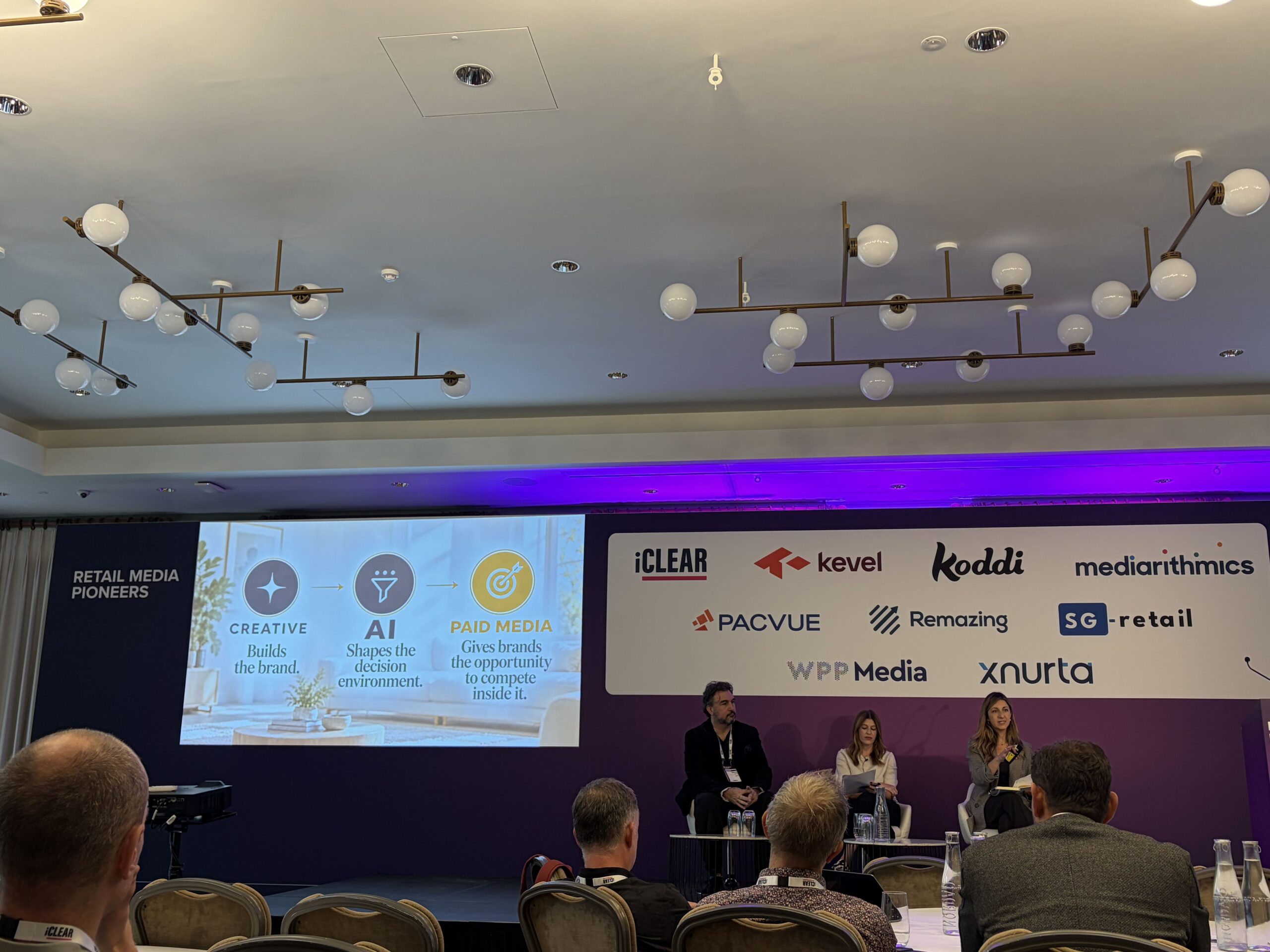
What changes, she argued, is the moment an AI assistant sits between the brand and the shopper. Adobe research found that people moving from an AI assistant to a sponsored placement to a website convert 60% more often. The bigger challenge for brands now, she said, is “how I earn my share of solution,” not where they place a sponsored slot.
Marco Bazerra, Executive Creative Director at WPP Creative, argued back with his own car purchase. An AI assistant, given his budget and requirements, recommended a Toyota Corolla. He bought a Honda HR-V instead, after his daughter said the Corolla wasn’t beautiful.
“Creativity is a combination of innovation and storytelling, where innovation creates differentiation and storytelling creates meaning,” Bazerera said. His closing line drew a hard boundary around what AI can optimize: “If the price is the same, I think brand and creativity will win 100% of the time.” The room’s live vote landed close to where it started. Neither side had fully displaced the other.
Mark Leith, Argos Media & Insights Director at NECTAR360, shared a case study built on Argos data. It made the measurement argument concrete.
NECTAR360’s clean room process runs through four stages: discovery, matching, modeling, and distribution. It matches hashed customer data between brands and the retailer. This can reclassify a shopper who looks occasional in one brand’s own data but turns out loyal once matched against a partner’s dataset. “Unified identity is what makes that collaboration accurate and consistent across every channel,” Leith said.
The campaign he shared targeted a multi-category electronics brand. It aimed at incremental rather than repeat customers, and was measured against a holdout group to isolate genuine lift from existing demand. The result was a five-times increase in campaign conversions and a 27% increase in average customer spend. 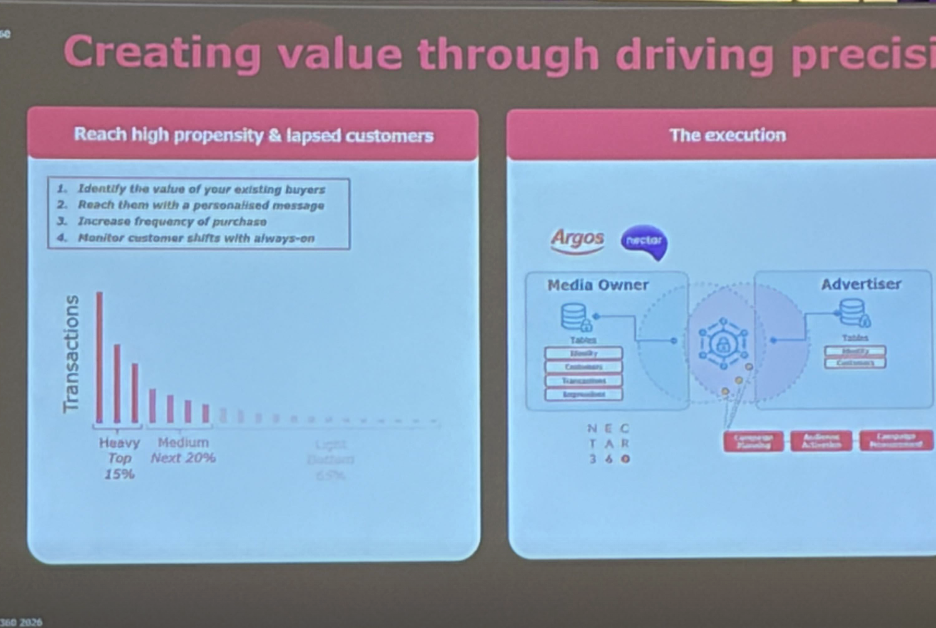
Penetration, honest behavioral signal, and proof against a holdout group decided which case studies delivered. AI changed how fast Matas could produce content and how JBL’s creative got built. It didn’t change what Gray, Sandee, and Leith were all measuring against.
For brand and retailer teams building out their retail media investment, the tools worth funding are the ones that sharpen an existing growth argument.
Leave a Reply
You must be logged in to post a comment.