WeChat Strengthens SE Asian E-Commerce Capabilities With Easy Taxi Partnership
Through a recent collaboration with cab-booking app Easy Taxi, WeChat is diving deeper into e-commerce outside of its native Chinese market.
Through a recent collaboration with cab-booking app Easy Taxi, WeChat is diving deeper into e-commerce outside of its native Chinese market.
In an effort to expand its e-commerce business outside of China, mobile messaging app WeChat has partnered with Easy Taxi, a taxi-booking app, to enable consumers in Singapore, Thailand, Malaysia, and the Philippines to secure a ride via its platform.
The partnership with Easy Taxi is WeChat’s first foray into the e-commerce space outside of its native China.
To book a cab, a consumer must first follow the local Easy Taxi account on WeChat. For example, if a user is in Malaysia, they can follow Easy Taxi Malaysia with the WeChat ID “easytaximy.” Then, after the user logs into their Easy Taxi account, they can simply order a taxi on WeChat in the same way as they would from within Easy Taxi’s own mobile app.
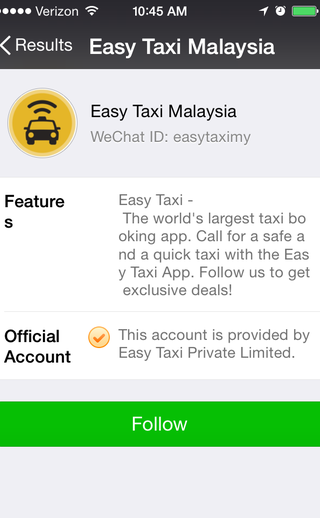
The partnership is currently only available in Singapore and Malaysia, but it will soon be rolling out in Thailand and the Philippines.
Ohad Hecht, chief operating officer of global digital marketing company Emarsys, thinks this collaboration is a logical step for both WeChat and Easy Taxi, as both are looking to increase their market share in new areas.
“[The WeChat-Easy Taxi deal] supports the strategy of Tencent [WeChat’s parent company] to penetrate to international markets and grow its position in Southeast Asia first, and from there to expand to other close markets,” Hecht says.
“[And] the same argument is true for Easy Taxi,” he continues, explaining that the market for mobile taxi apps is getting more competitive, with the growth of big players like Uber, as well as start-ups like Easy Taxi and GetTaxi.
Chris Baker, managing director of digital agency Totem Media, agrees that this partnership indicates more international progress from WeChat. “I’d like to see how this could signal further integration of e-commerce between China and other markets,” he says. “There are so many great e-commerce and service functions inside of WeChat in China, but most non-Chinese users don’t have access.”
Baker points out, however, that payment could be an obstacle for WeChat if the company wants to be competitive in e-commerce outside of China. “Right now, a foreign brand that wants to add payment capabilities to a branded WeChat account has to have a registered Chinese company,” he explains. “WeChat’s real advantage right now is bringing chat together with content and payments.”
As of now, in the WeChat-Easy Taxi partnership, there’s no online booking system within WeChat for users outside of mainland China, so consumers have to pay for their taxi rides via Easy Taxi’s system.
“If a brand located in Malaysia cannot transact with a user in Malaysia via WeChat, then WeChat’s regional or global expansion will be limited,” Baker notes.
It’s unknown if WeChat will introduce a better payment approach. As of press time, neither Easy Taxi nor WeChat were available to comment.
In spite of the potential payment issue, reports suggest that the WeChat-Easy Taxi partnership could be a good regional marketing strategy for both brands, as their pilot program in Singapore has generated 5,000 rides in just two weeks.
Hecht believes that if the WeChat-Easy Taxi deal continues to succeed, other cab-booking apps and mobile messaging services within the region are likely to follow suit.
“If proved successful, other players from the taxi-related apps and mobile messaging solutions may partner [as well],” he says. “We can see other services integrated in mobile messaging in the future.”
Homepage image via Shutterstock.
Leave a Reply
You must be logged in to post a comment.