Where Did All the Eyeballs Go? The Customer Journey Has Left the Funnel
The marketing funnel that e-commerce was built on is a decade-old agreement between brands and consumers. Brands pay for attention, consumers click through, and somewhere between the search bar and the checkout page, a purchase happens. That sequence has governed everything from media budgets to tech stacks.
The agreement is breaking. Not because consumers stopped buying, but because they stopped following the steps.
Consumers are no longer searching with keywords, browsing product pages, reading hundreds of reviews, and filling out checkout forms. They are asking LLMs full questions in natural language, receiving curated answers, and purchasing inside AI applications without ever visiting a brand’s website. The four-step journey that marketers have maintained and optimized for years is compressing into something faster, more conversational, and largely outside their control.
That compression was the subject of Amera Khalil’s chairperson remarks at eTail Palm Springs 2026, where the Director of Sales Account Management at BigCommerce and Feedonomics laid out why declining site traffic is not a channel problem. It is a behavioral one.
Khalil did not ease into the provocation. She walked the audience through the traditional four-step purchase funnel, using a grass suit inspired by Bad Bunny’s Super Bowl halftime performance as the running example: search, browse, PDP, checkout. Familiar. Comfortable. A decade of optimization baked into every step.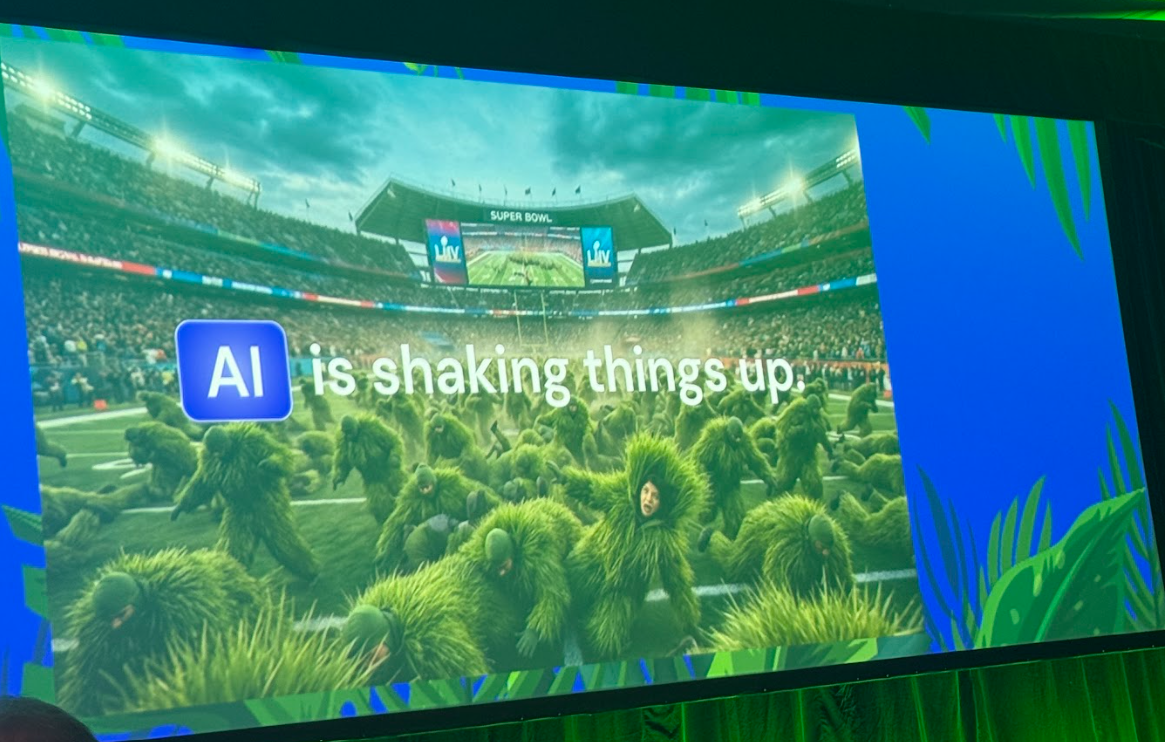
Then she broke it. “The search bar is dead,” she told the room. “Nobody seemed angry. Love that.”
Her point was not that search has disappeared but that the nature of the query has changed entirely. Where a consumer once typed “green grass suit” into Google, they now tell Perplexity, “I want to be just like Benito and his crew. I want to have an outfit that’s comfortable, because I’m going to go out on Halloween, and I want to wear my grass suit.” The shift from cryptic keywords to native-language intent is not cosmetic. It demands a fundamentally different kind of product data: not just structured attributes, but intelligent context that an LLM can interpret and serve.
Khalil made a sharp distinction that many marketers have been slow to internalize. The old funnel required the consumer to do significant work: scroll through results, read reviews, compare options, navigate checkout. The new dynamic inverts that labor. Consumers are outsourcing the analysis to AI.
“How many of us have time to read through 400 reviews?” Khalil asked. She described using Perplexity to run what amounted to a cost-benefit analysis in three minutes. That anecdote was not about convenience. It was about the consumer expecting synthesized intelligence, not raw data. If brands serve information that is not the TLDR, she said, they will simply be ignored.
For senior marketers, this reframes the data investment. Having comprehensive feeds is no longer sufficient. The question is whether your product information is intelligent enough to win inside an AI’s curation layer.
Khalil was emphatic on this point: the single biggest mistake her clients are making is treating AI as another channel in the stack.
“I hear many people come to me and say, Amera, it’s just a channel. It’s not just a channel. This is a change in your customer behavior.”
The distinction matters because it changes what brands need to build. Adding OpenAI to an omnichannel feed alongside Google, Meta, and TikTok Shop is necessary but insufficient. The underlying data has to move from structured product information to enriched intelligence. Inventory, reviews, influencer content, YouTube presence, TikTok signals: all of it has to be condensed and served contextually through the LLM. Khalil called this the shift “from data to intelligence.”
She referenced a client named Shirley who came to BigCommerce and Feedonomics with what Khalil described as “the question of the century”: how do I make my data into intelligence? The answer required stitching together multiple systems, including BigCommerce as the platform, Feedonomics for feed syndication, and additional partners, to enable on-site checkout directly within Perplexity.
Khalil demonstrated a live example. She searched for PacSun jeans on Perplexity, received intelligent product recommendations, selected a size, chose a payment method, completed the purchase, and received a confirmation email, all without leaving the Perplexity app. The experience looked and felt like a PacSun storefront, but the brand’s website was never visited.
The infrastructure required to make this work, real-time inventory feeds, synchronized payment systems, accurate product data across platforms, is far more complex than most brands realize.
Khalil positioned this as the critical near-term priority: if brands are not thinking about how to enable transactional checkout inside AI environments, they are already behind. She estimated that 20 to 50% of traditional website traffic is at risk of migrating to AI-driven purchase paths.
Khalil projected that AI-influenced consumer spend could represent $750 billion by 2028. Whether that figure lands precisely is less important than the trajectory it implies: consumers are adopting AI-assisted shopping.
For marketing leaders, the operational implication is clear. Product data strategies built for keyword-driven search are not structured for conversational AI. Feed management designed for Google Shopping and Meta catalogs does not automatically prepare a brand for LLM-native commerce. And measurement frameworks built around website traffic as the primary signal will increasingly misread where demand is actually converting.
Khalil ended where she began, with the Super Bowl halftime show. The grass performers that initially looked like chaos eventually formed choreographed scenes of precision and artistry. Her argument to the room was that the same transformation is available to brands willing to rethink the journey, from chaotic overwhelm to intentional alignment.
EVENT COVERAGE SPONSORED BY FOSPHA

Leave a Reply
You must be logged in to post a comment.