Why ROAS Is No Longer Enough for Retail Media in 2026
E-commerce teams are measuring their retail media performance with a number that can be engineered to look good.
ROAS is clean, reportable, and easy to present in a quarterly business review. It is also, according to Bill Schneider, VP of Product Marketing at CommerceIQ, routinely manipulated. “ROAS can be easily gamed,” Schneider said at eTail Palm Springs 2026, “because ultimately you can spend behind placements where you already have great search rankings.” The impression of performance is real. The incremental revenue behind it often is not.
Brands are scaling spend across Amazon, Walmart, Target, and a growing field of retailer-owned networks. Many are doing so knowing what happened, not what their investment actually caused. Schneider came to eTail with both a diagnosis and a product roadmap. CommerceIQ works with more than 2,000 CPG brands across major marketplaces. His argument was plain: a lot of retail media reporting produces confident numbers about spend that was never necessary in the first place.
A brand with strong organic search rankings on a given keyword can pour retail media dollars behind that keyword and report excellent returns. Those returns do not tell you whether the sale would have happened anyway. That is an accounting illusion.
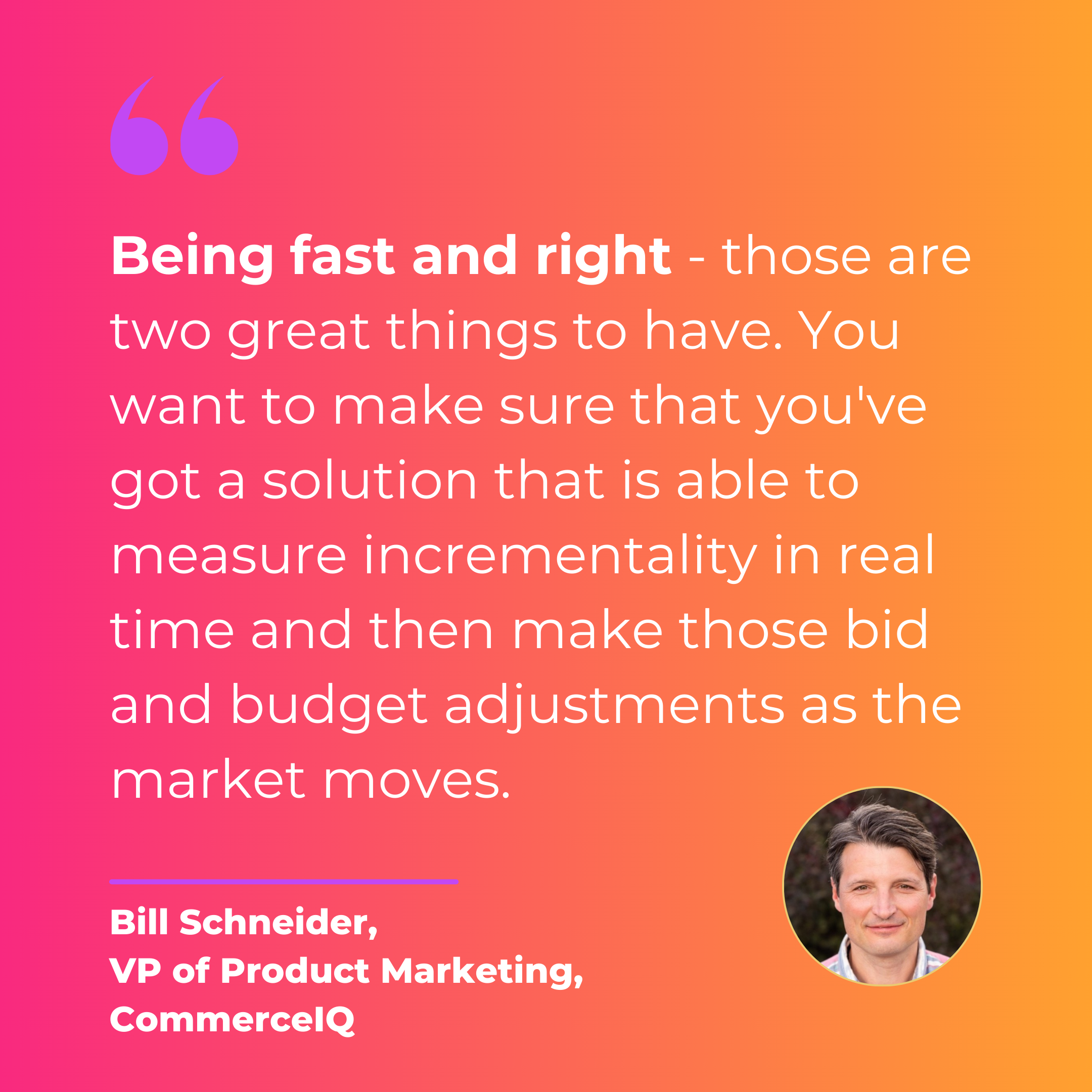
“Using a solution that measures real-time incrementality down to the keyword level provides great visibility into where you’re performing well and where you should be spending more, spending less,” Schneider said. The practical result is a different kind of output. It is not a cleaner version of the same number. It is a number that tells you where to actually move money. An agentic layer then executes bid and budget adjustments as market conditions shift, turning the insight into action.
CommerceIQ recently surveyed CPG leaders about their biggest operational challenge in 2026. The answer was not strategic misalignment. It was not better processes or culture.
“It was: I have too much data and not enough time,” Schneider said. “This is where agents really help fill that gap.”
Schneider described a picture most commercial leaders will recognize. Teams hand-assemble weekly performance reviews. Analysts spend Sunday nights pulling data from multiple systems. Insights surface too late to shape Monday’s decisions. “Typically, you’ll have a job where you need to update the team the following week about last week’s performance, and you’ll be staying up Sunday night putting four or five hours together,” he said. “Now you can just run a job and the report is ready for you Monday morning.”
Where to compete, how to differentiate, which retail partnerships to prioritize: a model cannot answer those questions. But the data assembly work that crowds out that thinking can move to an agent.
CommerceIQ is launching four new AI agents at eTail Palm Springs. One handles content, one covers the digital shelf, one manages retail media, and one tracks sales performance. Each targets a category of repeatable work that currently consumes commercial team hours without requiring commercial judgment.
The Content Agent tackles catalog coverage directly. “When you think about a brand typically dealing with 1,000 SKUs, they’re likely going to optimize the 20% due to bandwidth constraints,” Schneider noted. “Now, with Content Agent, you can do your whole SKU catalog.” Each listing that once took 35 minutes now takes 35 seconds, with human review still in the workflow.
The broader architecture connects through Ask Ally, CommerceIQ’s conversational AI capability. Teams can ask Ally about sales performance, shelf health, retail media impact, and inventory levels at once. Ally returns a synthesized recommendation in under a minute. It does not replace a commercial leader’s read on a situation. It removes the hours of data pulling that came before that read was even possible.
Every enterprise AI vendor eventually faces the hallucination question. Schneider’s answer rested on two things: grounding and explainability.
CommerceIQ built what it calls a retail AI context engine. It layers macroeconomic, industry, category, brand-level, and retailer data before it generates any recommendation. Each client engagement also includes a forward-deployed engineer who tunes the model to that brand’s commercial context. “You have to have trust in the data,” Schneider said.
Every recommendation also carries a transparency layer. “In all the recommendations that we provide, there is a context layer that explains how the recommendation was made, how it was considered,” Schneider said. An agent that suggests a PDP keyword change cites the specific search traffic signal behind it. An agent that proposes a media investment change for a SKU surfaces a recent drop in incrementality. Teams see the reasoning. They can interrogate it, override it, or act on it.
ROAS has been the dominant language of retail media long enough that many organizations built incentive structures, agency contracts, and executive dashboards around it. Moving to incrementality as the primary signal is not just a tooling decision. It means accepting that some of what teams counted as performance was spend the brand would have converted regardless.
On the agentic side, the question is what becomes possible when the Sunday-night report, the PDP backlog, and the bid management queue stop competing for the same hours as category strategy and retailer negotiations. The future Schneider describes is not a smaller commercial team. It is one whose time goes to problems that actually require them.
EVENT COVERAGE SPONSORED BY FOSPHA
Leave a Reply
You must be logged in to post a comment.