Ryan Hamburger on Instacart's Shift From Marketplace to Enterprise Partner
Event Coverage Sponsored by

Grocery retailers spent years worried that a partnership with Instacart meant handing over the customer relationship. That fear has largely faded. Ryan Hamburger was named Instacart’s Chief Commercial Officer in March 2026, after more than a decade building the company’s commercial organization. He spoke with ClickZ at Shoptalk Europe in Barcelona about how retailer expectations have shifted, and why Instacart’s next phase of growth looks less like a delivery marketplace and more like an enterprise technology supplier.
The conversation with retailers has moved past marketplace anxiety. Now it centers on a different problem: how to run a strong first-party digital experience without building the underlying technology from scratch. Hamburger said retailers increasingly see a partner like Instacart as a way to stay ahead of the innovation curve. Building that infrastructure alone pulls them away from what they do best. “Their specialty is being a grocer, ensuring their customers can get what they want when they want, not necessarily building the tech behind the scenes,” he said. Some retailers tried the do-it-yourself route. Most came back once they saw the gap between ambition and execution.
Instacart’s pitch has moved from delivery toward being the enterprise technology layer behind a retailer’s omnichannel business. That layer spans Storefront, Storefront Pro, Carrot Ads, Caper Carts, and the underlying data and AI stack. Hamburger said the scale of that build is the easiest part to demonstrate. “We’re north of 300 retailers deployed at this point, and we launched 70 new experiences in 2025 alone,” he said.
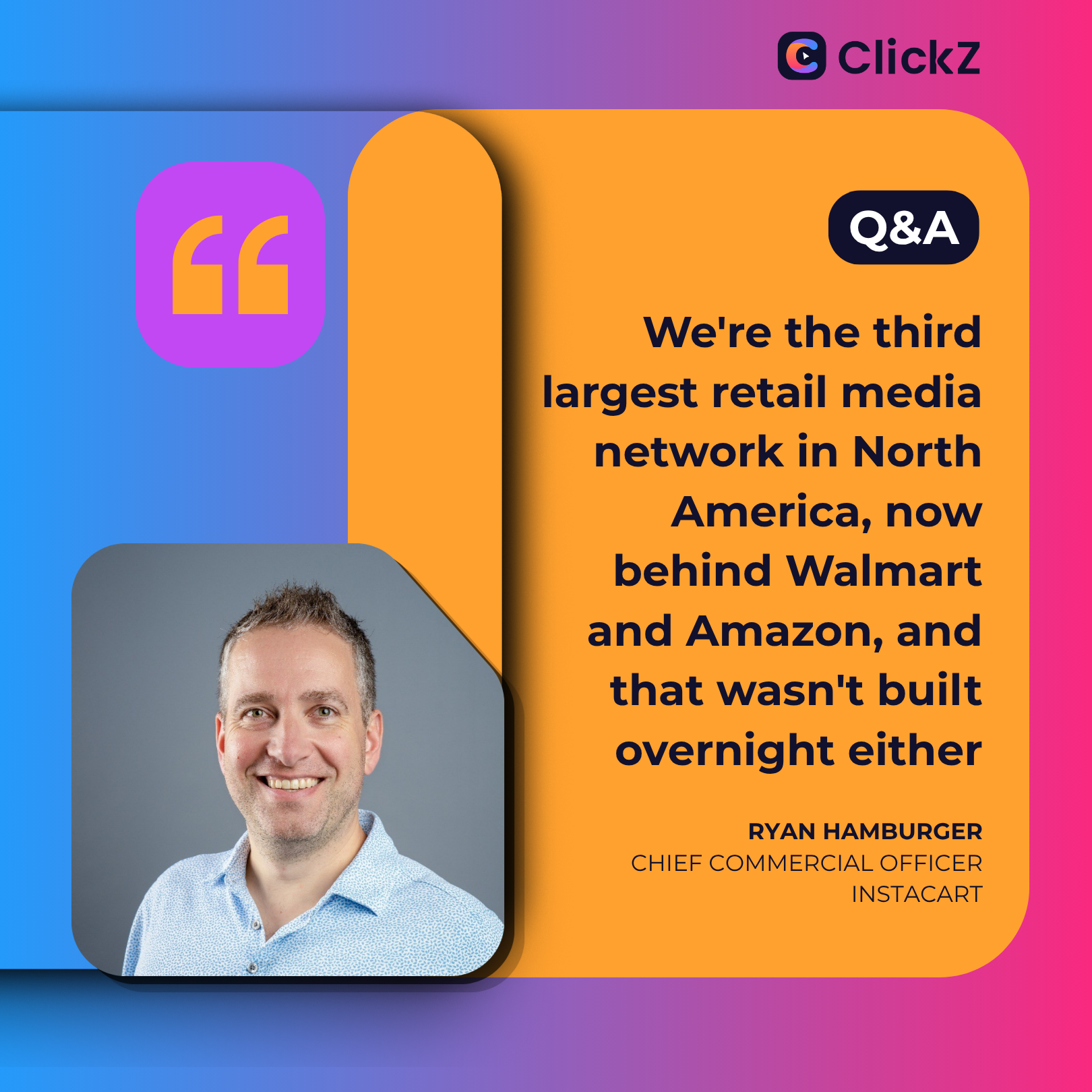
Retail media is the harder sell. The term has become a catch-all long before most networks earned it. “We’re the third largest retail media network in North America, now behind Walmart and Amazon, and that wasn’t built overnight either,” Hamburger said. He pointed to Sprouts as an example: the retailer’s front end, eCommerce, and loyalty program all run on Instacart’s stack, built over time in close partnership rather than delivered off the shelf.
Instacart’s acquisition of Instaleap gives it a route into nearly 30 countries, through retailers including Cencosud, Jerónimo Martins, and SPAR. Hamburger said the deal came down to two things beyond the balance sheet. “There were really two things that stood out to us, first and foremost an amazing team,” he said. He also pointed to Instaleap’s purpose-built fulfilment and storefront technology, already shaped to European and Latin American retailer needs ahead of the deal. Instacart plans to layer its own products in gradually, building on the roughly 100 retailer relationships Instaleap already holds.
Every grocery platform is making similar noise about agentic AI right now. Instacart’s hyperscaler partnerships with Anthropic, OpenAI, and Gemini exist for the same reason everyone else’s do: being where the customer already is. The distinction sits in how the data gets handled. “Those hyperscaler partnerships were set up in a way that do not give them access to the data like some others have done,” he said, citing 1.6 billion lifetime orders as the asset Instacart is protecting. Instacart is building its own agentic shopping assistant natively on its platform.
Hamburger was equally direct about where the AI hype outpaces the substance. He singled out generic party-planning agents that lack the purchase history to make a genuinely useful recommendation. Without that data, a system can only guess. “What does Ryan want for his friend’s party or his kid’s birthday party” is hard to answer without behavioral history behind it, he said. A platform with that history can be specific instead of generic.
Asked whether marketplace or enterprise growth would define Instacart’s next five years, Hamburger didn’t hesitate. More than 2,200 retailers already sit on the North American marketplace. He said the bigger opportunity now lives in enterprise, particularly outside North America, where the strategy is deliberately enterprise-first rather than marketplace-led.
He named incrementality as the number he wishes retailers tracked more closely. Instacart’s marketplace drives sales that are more than 90% incremental to a retailer’s existing business. Retailers running on Instacart’s own technology stack see a 10 percentage point lift in sales and a five percentage point improvement in 90-day retention, compared with competing systems.
Twelve years after joining a company that has since gone through an IPO and two CEO transitions, Hamburger named the thing worth protecting: the belief that the job is to make retailers’ businesses stronger, paired with an R&D culture that still moves with the urgency of a startup rather than the caution of an incumbent.
Leave a Reply
You must be logged in to post a comment.