Retail Media's 2028 Bet Is on Integration, Not AI
Retail media’s newest disruption arrives wearing the shape of an AI agent. It can research a purchase, compare options and, before long, complete the transaction itself. At Retail Media Pioneers 2026, a panel took on that question directly. Its brief: forecast three years forward, to 2028, and be specific about what the industry gets wrong today.
Ben Penrose, founder of STRIQE, moderated the session. His panel brought together Markus Vones of OTTO Advertising, Nick East of Mars Pet Nutrition and Jan Schmitz of Zalando Marketing Services. Malisa Irabor of Amazon completed the lineup. 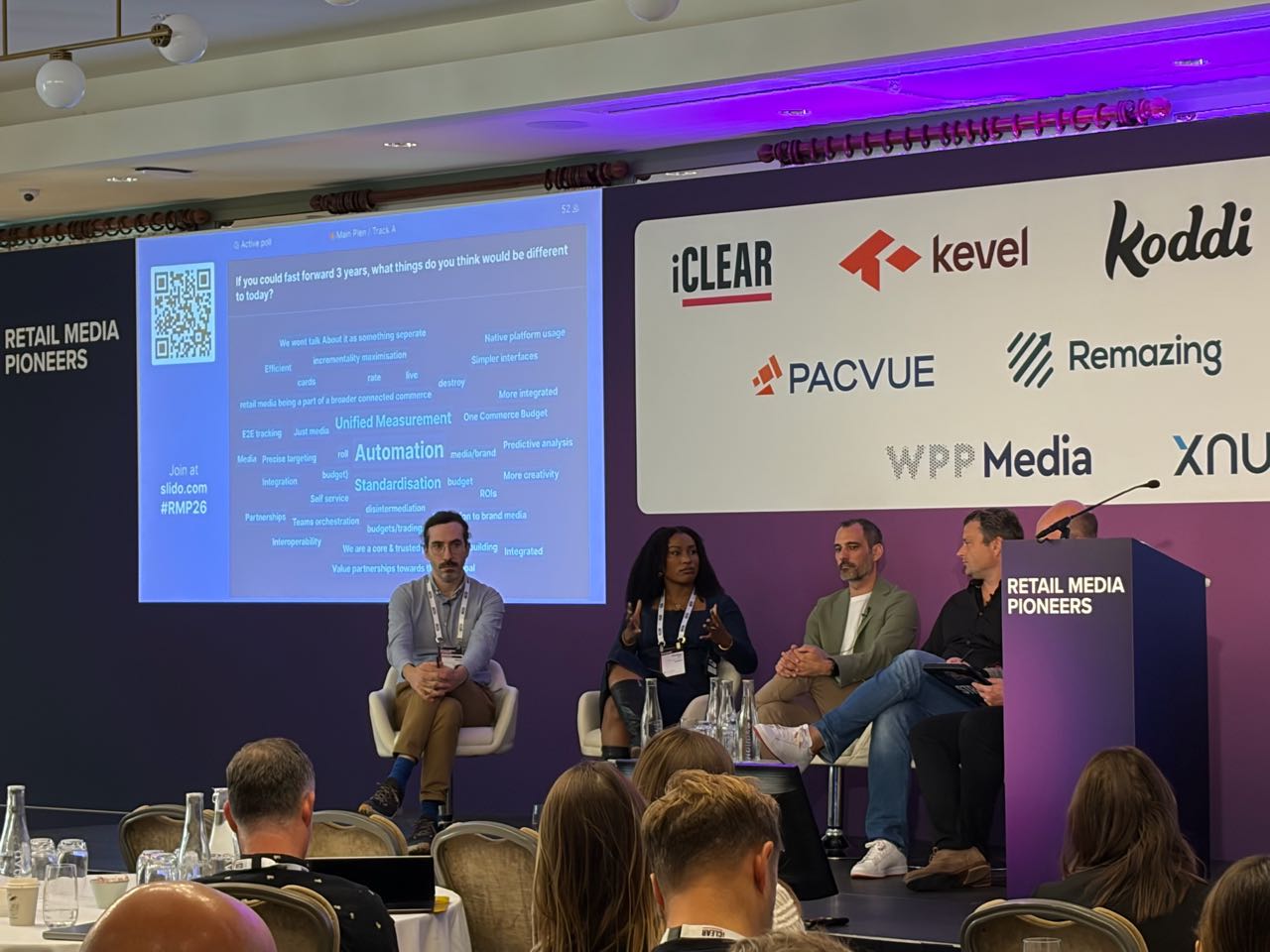
Vones connected AI directly to brand strategy rather than treating it as a separate topic. Because AI is changing how customers move through the journey, he argued, brand building matters more than it used to, since a brand still has to earn a place in the shopper’s relevant set before any algorithm gets involved in the decision.
East picked up the thread but split AI’s impact into two problems that most conference talks treat as one. Automation, he said, is already solving a real operational headache: running media across fifty or more regional networks in Europe with limited headcount. Path to purchase is a different question entirely, and one he is far less certain about.
East grounded that scepticism in a demonstration from the previous day. An audience of marketers was asked who uses AI for email, then asked who actually sends emails through it, and the show of hands dropped sharply between the two questions. He expects the same gap to show up in retail: shoppers will use AI to research, but the transaction itself will stay with the retailer for longer than most forecasts assume.
Irabor reached a similar conclusion from a different angle, framed as a risk rather than reassurance. “Customers don’t think in terms of channels,” she said. “They always think in terms of needs.” Advertisers, in her view, can get so absorbed in the technology that they lose track of what the customer is actually trying to achieve.
The most memorable exchange of the session came when East, by his own admission reluctantly, defended a metric that had spent the previous two days under attack. “I’m going to defend ROAS.” He argued that no credible replacement for ROAS exists yet. That is why brands still have to justify every pound of media spend, and why marketers keep returning to a metric they otherwise criticise.
What he does expect to change by 2028 is the completeness of the picture underneath that number. Attribution above the funnel should start to catch up with the strong, tangible data that already exists below it.
East and Schmitz both pushed back on treating AI’s role in purchasing as uniform across the industry. Reordering a routine shopping list is ripe for automation, East said, while a considered purchase, such as choosing what to feed a pet, is not. “You think very carefully about the products you’re feeding your pets,” he said, “just as you would the products you feed your children.” Schmitz made the equivalent case for fashion, where customers want discovery and inspiration rather than a fast, optimised transaction, and where a platform built purely for speed risks losing the reason customers came in the first place.
Schmitz’s central argument was structural. Retail media still sits in its own fixed, separate budget line at most brands, distinct from performance and brand spend, and that separation is what caps how much it can grow. “Retail media needs to become more boring,” he said, arguing for a single budget built around business objectives rather than channel allocation, since a fenced-off bucket will only ever move in small increments regardless of how well it performs.
Vones raised a related risk from the retailer side of the table. If CTV and programmatic media start pulling retail data in directly, retail teams could find themselves cut out of a value chain they helped create, widening the very gap between brand and performance that Schmitz wants closed. He was equally blunt about hype for its own sake, describing a narrow industry focus on “robots” as something that misleads budget decisions rather than informing them.
By the end of the session, none of the panellists expected AI agents to own the shopper relationship within three years. What they agreed would decide the outcome instead was closer to home: fragmented networks, budgets that sit apart from the rest of the business, and a measurement problem nobody has solved. As East put it, defending the metric everyone loves to criticise, the industry still needs “to be furnished with an alternative, and at the moment there isn’t one.”
Leave a Reply
You must be logged in to post a comment.