The Ordinary Found 62% of Its Revenue Hiding in Plain Sight
Most of a brand’s revenue now happens somewhere the marketing team can’t see. A pixel tracks a website. It has no view of a shelf on Amazon, a cart inside TikTok Shop, or a browse session that started on one platform and closed on another.
D2C sales have plateaued below 20% of US ecommerce, and the rest now moves through marketplaces and retail media networks that last click attribution was never built to read. The gap between where a brand sells and where it can measure has become the largest blind spot in retail marketing, and it is getting wider every quarter that a brand adds another selling surface.
At eTail Boston 2026, Dom Devlin, Chief Product Officer at Fospha, used the Main Stage to size that blind spot, then handed the floor to Vanessa Mac, Senior Global Media Manager at DECIEM, who walked through what closing it looked like inside The Ordinary.
Across Fospha’s customer base, over 40% of sales on Amazon are influenced by off-site paid media, and every bit of that influence is invisible to platform measurement. Amazon alone pulls in roughly $440 billion a year from US ecommerce, and 42% of Fospha’s Amazon-selling brands have sales influenced by Amazon’s own paid media on top of that.
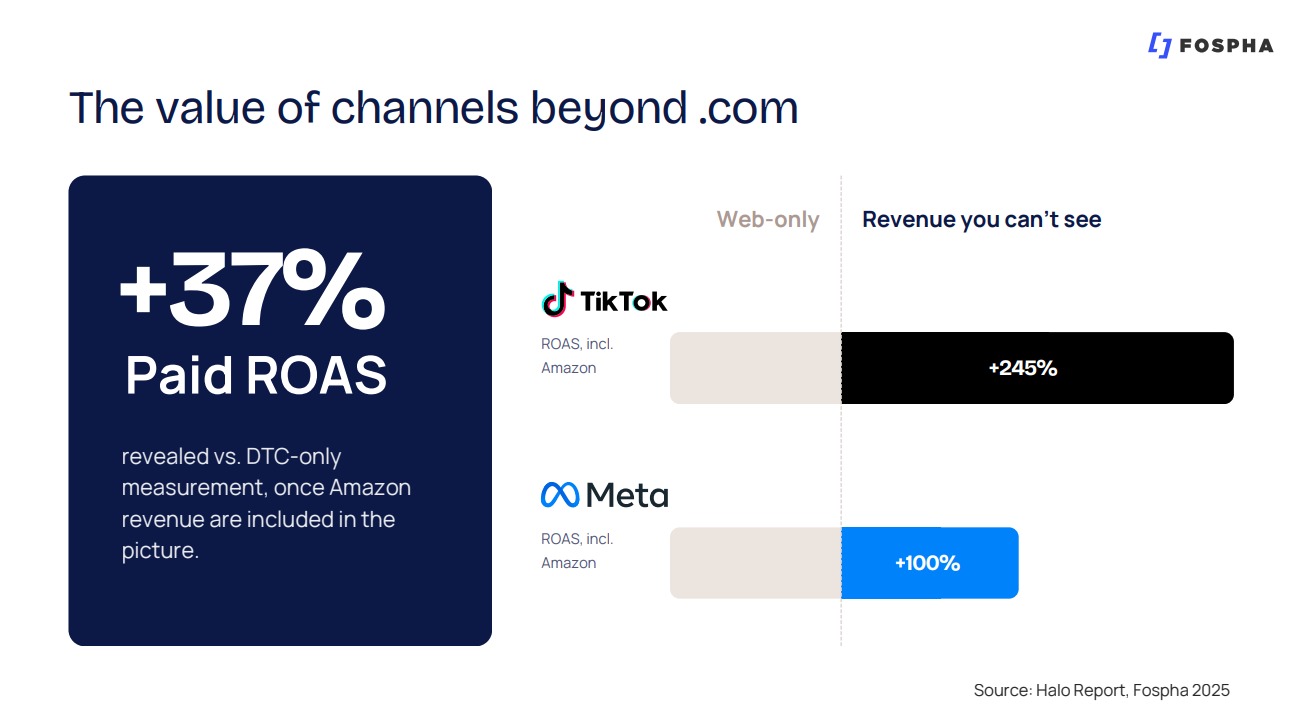
Run the conservative math and the industry is likely missing north of $100 billion in paid media measurement from Amazon alone, before Walmart, Sephora, or Target enter the picture. When Fospha modeled the halo effect of demand-generating media once Amazon revenue was included, paid ROAS moved up 37%. Devlin’s framing was that discovery channels get penalized hardest by last click, precisely because they are the ones doing the most invisible work.
Last click is easy to explain internally, which is exactly why it survives long after it stops being useful. Devlin argued that scaled brands using it in isolation are choosing efficiency in the short term at the cost of demand generation in the long term, since last click cannot make the case for investing in the upper funnel at all.
The evidence he pointed to: across Fospha’s client base, the top 25% of performers heading into peak season spent roughly twice as much on awareness and brand media throughout the year as the remaining 75%. That consistent investment is what let them capitalize when competition for attention peaked. None of that spending pattern shows up in a last click report, which is why, in Devlin’s words, “you’re not going to be able to make the case.”
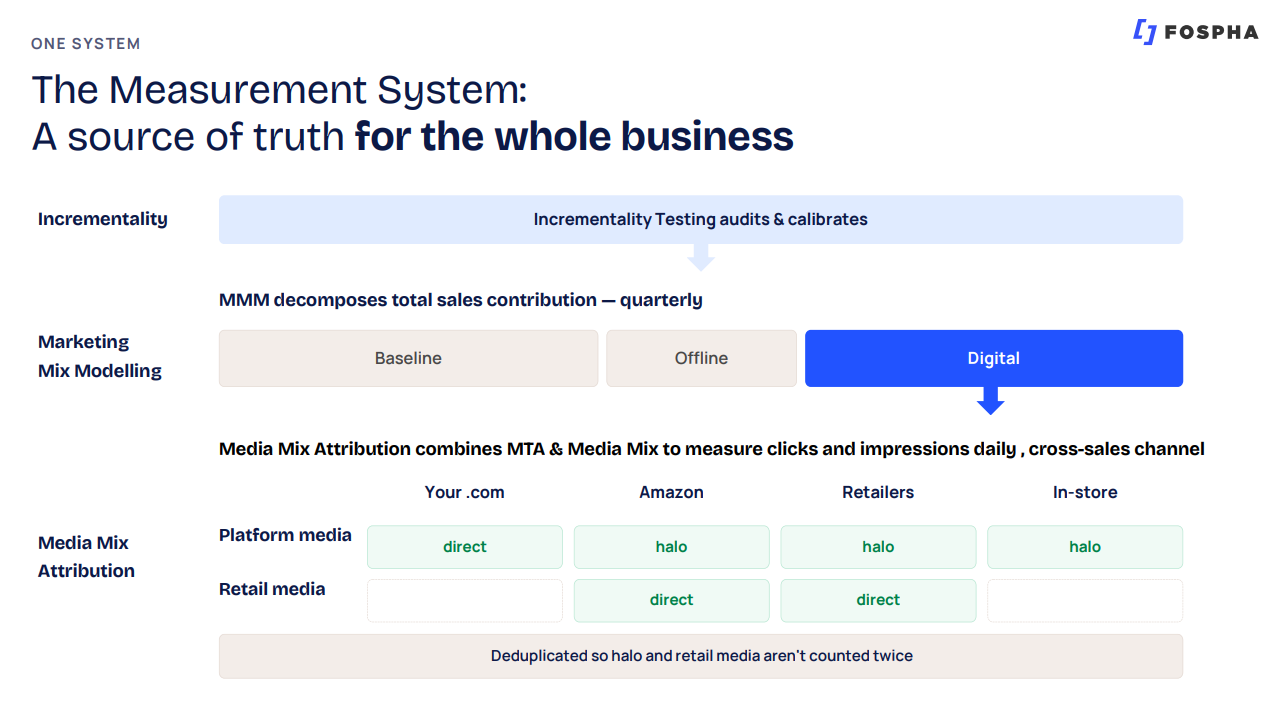
Quarterly MMM and standalone incrementality testing each solve a piece of the problem, but not the whole thing. Quarterly MMM works at channel level and refreshes too slowly for daily decisions. Incrementality tests take too long to run before their findings go stale – many brands are making today’s decisions off a test that was accurate last year and isn’t anymore. Fospha’s model solves for that lag by ingesting lift-test results as they land and using them to continuously recalibrate, so a test’s value compounds instead of expiring the moment the readout is filed. Attribution, meanwhile, is fast and granular, but applied alone it produces what Devlin called “the illusion of precision,” crediting demand it didn’t actually create.
Vanessa Mac’s numbers turned the keynote’s math into a lived example. Before The Ordinary adopted Fospha, she was, in her words, “constantly relying on last click,” and constantly defending media investment she could only tell half the story about.
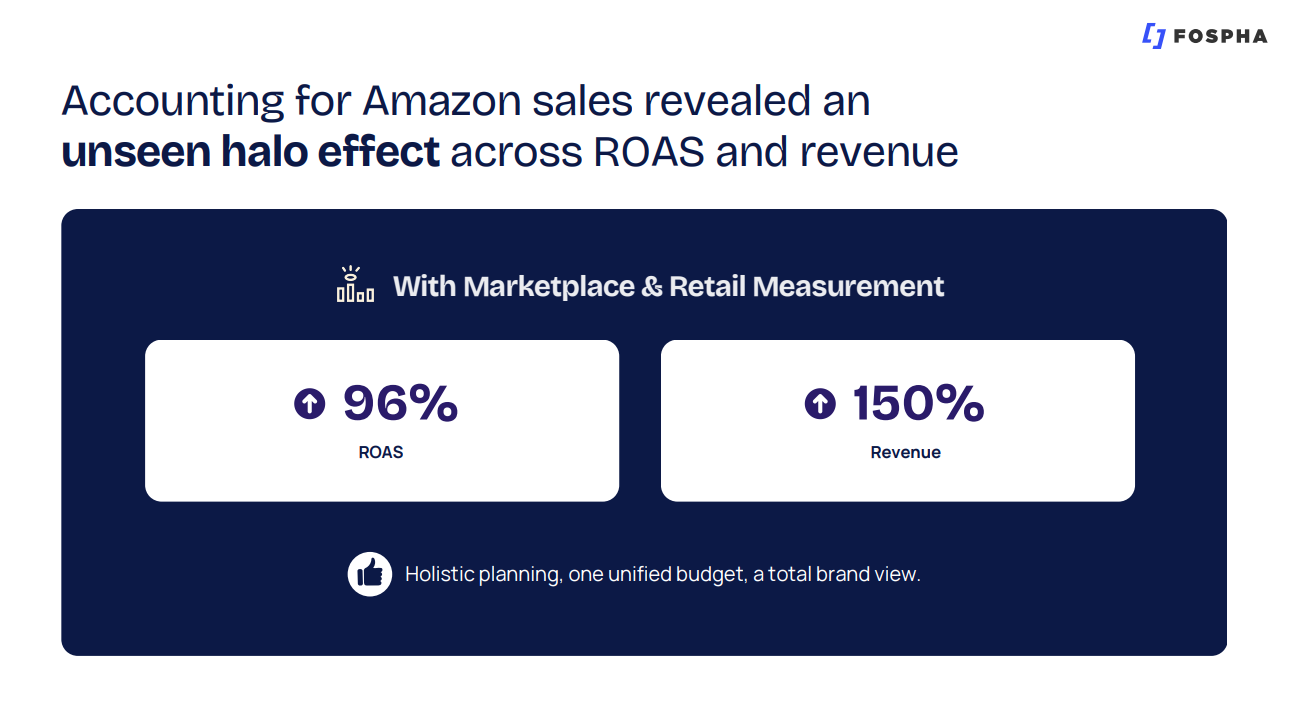
Once that changed, the scale of what last click had been missing became clear. 62% of The Ordinary’s revenue was invisible to last click. Digging further, 90% of that missed revenue traced back to brand-building channels like paid social and video, and 84% of it was showing up not in DTC but in marketplaces such as Amazon. Accounting for the Amazon halo effect produced a 96% lift in ROAS and a 150% lift in revenue. Mac’s team responded by scrapping the separation between Amazon and DTC budgets entirely, moving to one unified budget planned across the full customer journey.
For Mac, the headline stats mattered less than what they unlocked operationally. “The biggest shift really moved from defending decisions to actually being able to make decisions,” she said, describing how her team used to spend budget and then spend just as much energy justifying it after the fact.
Devlin’s closing argument tied that shift back to why quarterly measurement no longer fits how brands sell. Quarterly MMM made sense when media was bought up front and creative changed once a season. It does not make sense when TikTok virality has a 72-hour half-life and creative performance shifts weekly. His point was that the real question is not how confident a brand can be in its numbers, but how many value-creating decisions it can make in a year, which requires full-funnel data refreshed daily rather than quarterly.
The pattern across both halves of this keynote is the same: measurement is upstream of strategy, so a brand can only act on the decisions its data allows. Every new sales channel a brand adds without adding matching visibility becomes growth it cannot defend, plan around, or reallocate against.
The Ordinary’s experience suggests the fix is one system trusted enough that finance, marketing, and leadership stop arguing over which number is real. For a brand that already sells everywhere, seeing everything is the entry price for moving at all.
Leave a Reply
You must be logged in to post a comment.