AI Is Not Making Shoppers Faster. It's Making Them Choosier
Retailers spent a decade optimizing for speed: fewer clicks, faster checkout, shorter funnels. That assumption is broken.
New global research presented at eTail Boston 2026 shows AI is doing the opposite of what most marketers expected. It is not compressing the path to purchase. It is stretching it out, and in the process, rewriting who gets discovered and who gets ignored.
Jaysen Gillespie, VP Global Head of Product Marketing and Analytics at RTB House, opened Day 3 with a fresh cut of the retargeting firm’s global consumer study, split between the U.S. and other high-spending markets like Western Europe and Japan. The headline finding: the way people use AI to shop barely varies by geography. What varies is generation, and that gap is where the real story lives.
Gillespie framed adoption through McKinsey’s agentic AI framework: level zero is no AI at all, level one is AI as assistant, level three is AI assembling a full solution, not just a single product, and the top tier is “authorize,” where a shopper hands AI the credit card outright, with guardrails.
Most consumers are still climbing that ladder. But the climb is happening fast. Nearly 70% of people surveyed have used ChatGPT to research a product. Roughly 45% have started a shopping search on AI rather than Google. A quarter have already gone a step further, asking AI to bundle multiple products into one solution rather than hunting for a single item.
According to Gillespie, shoppers are “literally booting up ChatGPT, Claude to a lesser extent, things like Rock or Gemini, in order to start their search.” That is a real shift from the sequence marketers have watched for two decades: Google, then Amazon and marketplaces, then TikTok and Instagram, and now AI.
Younger cohorts are driving it. Gen Z and millennials told researchers they now start on AI more often than they start on Google. Gillespie’s read is that this matters regardless of who a brand’s current customer is, because behavior that concentrates at the bottom of the age pyramid tends to become how the whole market operates within a few years.
The one number in the session that should stop marketers cold: 62% of boomers said AI discovery actually helps them. That is not a demographic anyone expected to lead on a new discovery channel.
Gillespie’s explanation reframes what “AI adoption” even means. Boomers are not more comfortable with AI in the abstract. They simply have fewer alternative discovery paths. They are not on TikTok the way younger shoppers are, so an AI engine that surfaces products for them fills a gap that platform-native discovery already fills for Gen Z.
That distinction matters for targeting. A brand assuming AI-driven discovery is a young-shopper problem is missing the cohort that may be quietly over-indexing on it.
Discovery is one thing. Gillespie’s second major point is that it is already turning into revenue, and most brands have no visibility into it. Citing data from SimilarWeb, he noted that AI-to-e-commerce sessions run 20 to 30 times higher than what shows up in standard ad tracking, because unless a shopper clicks through, there is no pixel event to capture it. Half of people who discovered a brand through AI went on to visit its site. 41% said they purchased something they found that way.
For marketers, the signal is simple: the absence of tracking data is not the absence of activity. It is a measurement gap, and gaps get filled by whoever has a panel large enough to see through the AI black box.
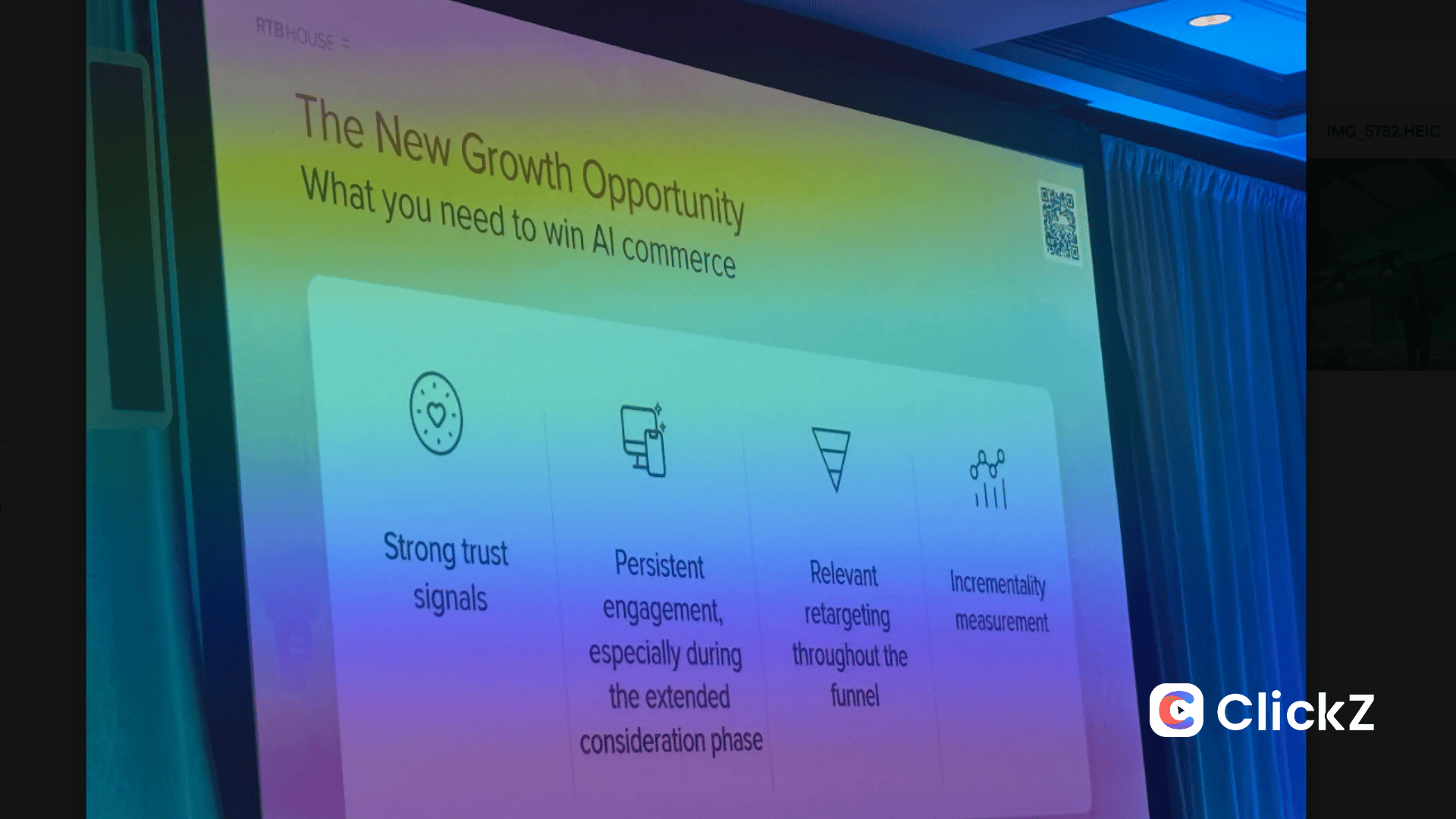
The most counterintuitive finding of the session: AI is lengthening the path to purchase, not shortening it. AI surfaces more alternatives than a shopper would have found manually, and more alternatives mean more consideration before a decision gets made. 42% of respondents said directly that AI has made their research take longer.
That extended window cuts two ways. Brands that do nothing face a longer stretch where a competitor can intercept the sale. But brands that stay present through that window, through retargeting, email, or other persistent outreach, get repeated chances to learn about a shopper and sharpen the next message.
There’s also a competitive opening buried in the data. Smaller brands that could never outspend larger competitors for search relevance can now “productize their way into relevance,” in Gillespie’s words, because AI recommendation is driven by product-market fit, not ad budget. He offered his own example: a search for narrow-fit leather sneakers surfaced a small maker in Colombia he would never have found through conventional search.
Gillespie closed by praising the CEO of Michaels for running a full year-long A/B test, calling it a level of analytical rigor most marketers abandon the moment results wobble. His larger point: the brands that win the AI-lengthened decision window are the ones with the discipline to measure what is actually incremental, not just what is easiest to attribute.
The purchase journey is getting longer, more contested, and more visible to whoever bothers to look closely enough to see it.
Gillespie’s closing point about the disruption in measurement, from the shift off Universal Analytics to the debate between MMM and true incrementality testing, is exactly the territory Fospha‘s positioning centers on: a system that combines attribution, MMM, and incrementality into one daily-refreshed operating model, rather than treating measurement as something bolted on after the fact.

Leave a Reply
You must be logged in to post a comment.