Brand and Performance Were Never Rivals
The brand-versus-performance debate has outlived its usefulness. Marketers keep sorting themselves into camps, brand or performance, as if the split reflects something true about how growth works. It doesn’t. The split says more about how growth gets measured, since most tools built to track performance simply weren’t designed to see what brand spend does.
That was the argument Jamie Bolton, Chief Strategy Officer at Fospha, made opening the Brand track at eTail Boston 2026. Bolton’s premise is that the dichotomy between brand marketers and performance marketers reflects an artifact of measurement, one that has shaped how budgets, teams, and careers get organized for years, rather than any real marketing truth.
Bolton walked through why the split persists. Most measurement in use today is some form of click attribution, and click attribution undervalues nearly everything upper-funnel. Even Google Performance Max, a heavily performance-oriented channel, loses credit under click measurement. Move further from the bottom of the funnel and the gap widens. Snapchat and YouTube, both strong brand-building channels, register almost no attributed value. TV and out-of-home register none at all, since there is no click to track.
The consequence is structural, since a channel invisible to the tool measuring it becomes hard to defend in a budget conversation, regardless of what it is really doing for the business.
Click attribution also misses where revenue lands. Brand advertising drives sales on a company’s own site, but also in physical stores, on marketplaces like Amazon and Sephora, and through its lift on brand search elsewhere. Most code-based measurement never touches any of that.
Bolton pointed to Fospha’s own data showing that once marketplace impact is factored into YouTube measurement, the channel’s attributed value rises by 7 percentage points, a shift significant enough to change how most brands think about YouTube as a brand-building channel.
There is a third blind spot, and it’s the costliest. Standard measurement focuses on the roughly 5% of an audience already in market, since those are the people click attribution can see converting. It has little to say about the other 95%, the future buyers who could be persuaded or built into brand affinity over time, a split popularized by Les Binet and Peter Field in The Long and the Short of It. Chasing only the visible 5% means bidding up the same high-CPA, high-CPM audience quarter after quarter, while ceding the larger pool of future demand to whichever competitor decides to build for it.
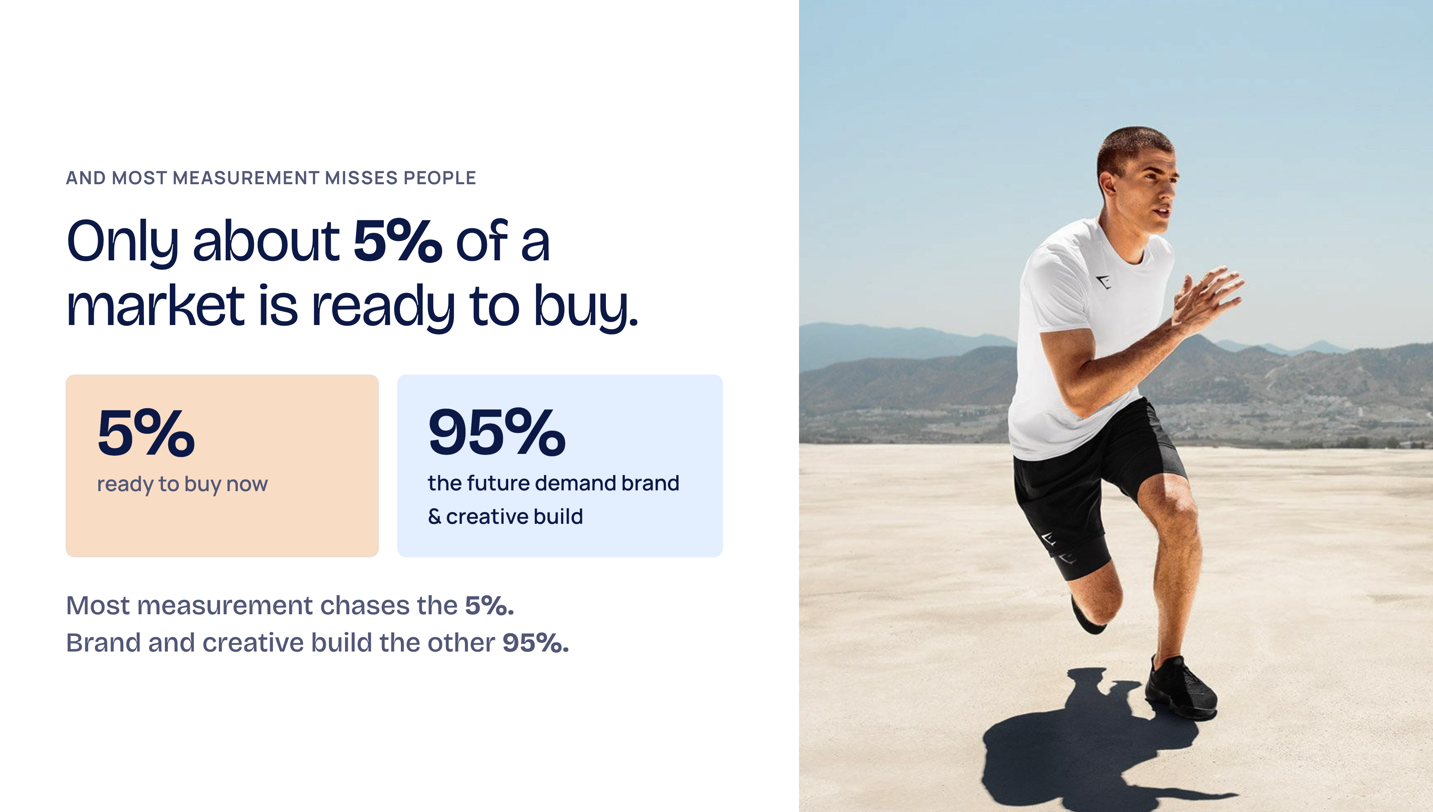
Put those three gaps together and the pattern Bolton described becomes predictable. Brand media gets cut, and brand marketers lose ground to performance marketers in budget conversations, since a channel’s performance doesn’t register in the tool everyone uses to decide, whatever that channel is delivering for the business. For some marketers, a channel’s measured value and its actual value are not the same thing, and the distance between them is currently costing brand budgets across the industry.
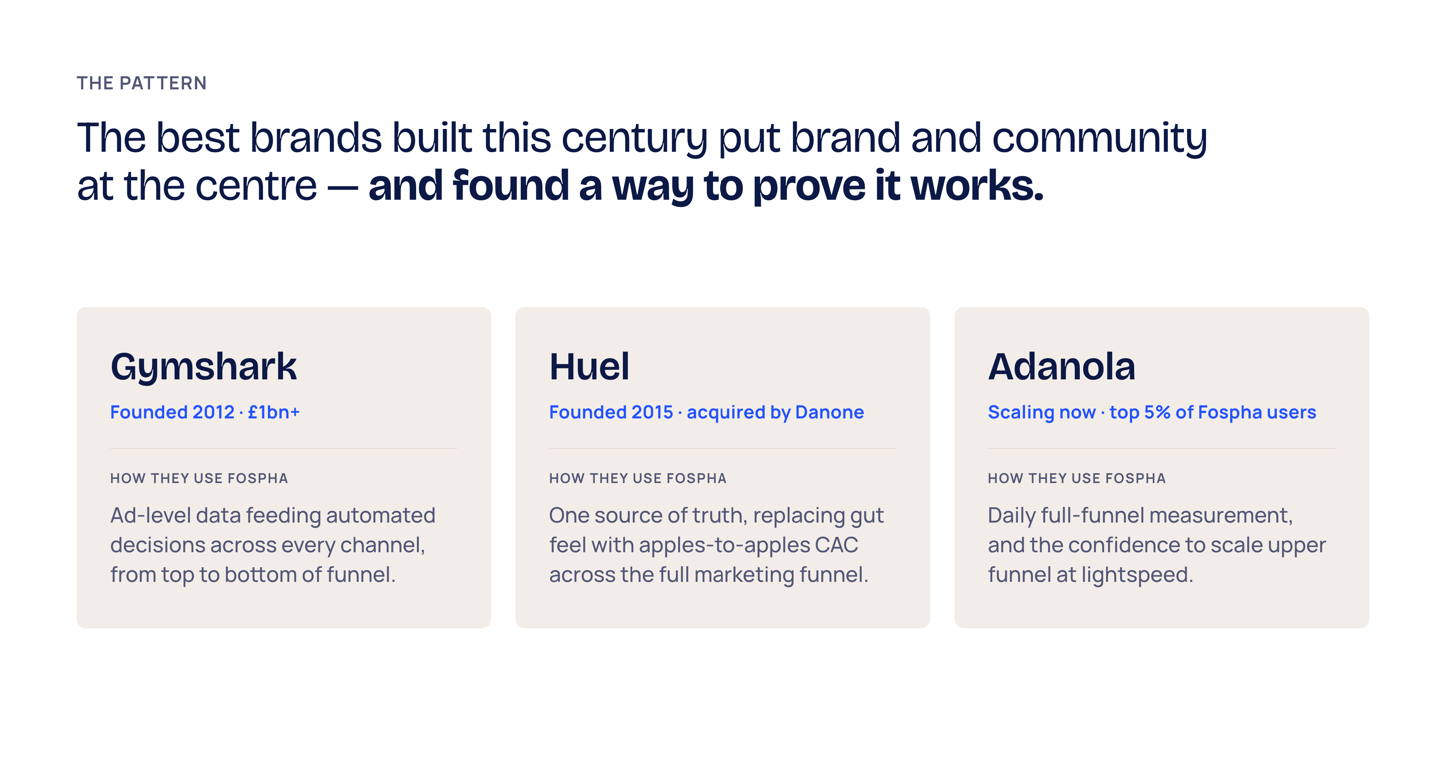
Fospha’s own numbers back the underlying case. Over 11 years, the company has optimized 40 billion dollars in media spend, working with brands from Dyson, Huel to Gymshark, and blends media mix attribution, marketing mix modeling, and incrementality testing, controlled tests that isolate what a channel caused rather than just what it touched, into what Bolton called a calibrated operating system spanning brand and performance.
Bolton’s examples reinforced the point. Gymshark built its identity inside lifting and bodybuilding communities, invested heavily in brand from early on, and became one of Fospha’s highest-usage customers before growing into a British unicorn.
Adanola, which Bolton cited as one of the fastest-growing DTC brands in the room, moved half its Meta budget out of retargeting and remarketing and into awareness and consideration. The result was a doubled revenue growth rate, a doubled return on ad spend, and a halved cost to acquire each customer, all from the same channel most teams treat as pure performance media.
None of this pays off immediately. Bolton was clear that upper-funnel investment typically takes about six months to show returns, and that the conversation with finance gets harder around month three or four, right when patience tends to run out.
Fospha’s research across 70 brands found a causal link between awareness spend and brand search, engaged site visits, and AOV, evidence that can buy a marketer time with a CFO before the longer-term revenue impact shows up. Looking at actual outcomes rather than modelled ones, Fospha’s top-performing brands by spend invest roughly double what the broader market puts into brand media, and they spend it consistently across the year rather than saving it for Q3 and Q4.
The practical takeaway is to demand the same rigor from brand spend that the visible half of the funnel already gets, since the tools most teams use to defend budget were built to see one part of the funnel clearly and the rest barely at all.
Bolton’s closing challenge to the room was to ask, before defending any activity, how to prove it’s working, how to know in advance it’s the right call, and how to make that case to people outside marketing. Measurement that can’t see brand media says more about the measurement’s limits than about whether brand media works, and it’s the measurement that needs to catch up.
Leave a Reply
You must be logged in to post a comment.