Nielsen: Narrower-Targeted Ad Campaigns Perform Better
The number of ad campaigns that reached their intended targets declined across the board, particularly among the Gen X demographic.
The number of ad campaigns that reached their intended targets declined across the board, particularly among the Gen X demographic.
Fifty-nine percent of ad impressions served across all consumer segments reach their intended audience, according to research from Nielsen Online Campaign Rating (OCR). The figure, which is down by 10 percent from 2013, illustrates a decline that correlates with targeted audiences that are narrower and more focused.
Nielsen’s OCR analysis, which included almost double the sample of last year’s study, looked at consumers’ online behaviors and how marketers can appropriately tailor their advertising campaigns to them.
It broke the population into six demographics zones, each representing a targeted segment by age and gender. Demographics one and two represent people with an age span of 30 years, with the latter focused on males or females individually, as opposed to lumped in together.
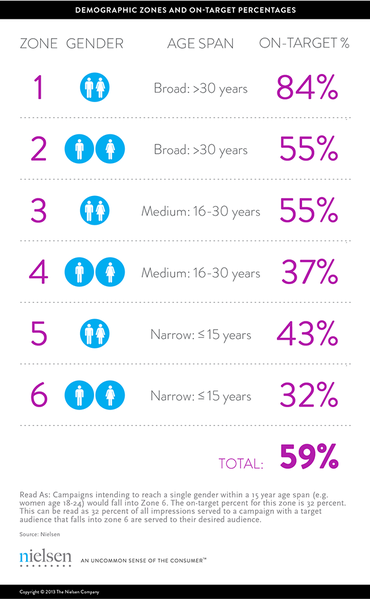
While segments one and two have the breadth to deliver campaign impressions to their intended audiences at higher rates – they represent 36 percent of site observations, a figure that refers to each instance of a website or ad network appearing within a campaign – they saw the sharpest decline, with a 40 percent drop compared to 2013.
Demographic one declined by 6 percent points, while zones five and six, which refer to targeted audiences within a 15-year age gap, performed steadily from year to year.
Nielsen also found a similar decrease (8 percent) among campaigns targeted to a female audience of any age group, particularly 35 to 64. However, the biggest decline of all was the 25 percent drop among campaigns targeting an audience between the ages of 35 and 54.
Because many marketers view Gen X as being affluent, technologically savvy, and brand loyal, the number of campaigns targeted at this demographic quintupled from last year. By comparison, the average number of campaigns aiming to reach other demographic segments only roughly doubled.
“As the industry changes, so does the definition of success,” says Randall Beard, global head of advertiser solutions at Nielsen. “We update these benchmarks around the dynamic media landscape so that media buyers can maximize return on investment by evaluating their partner and placement strategy throughout the campaign cycle, and consider how the changing environment might influence their strategy.”
Leave a Reply
You must be logged in to post a comment.