Nobody at Shoptalk 2026 Could Tell You What's Coming Next and That Was the Best Part
A year ago at Shoptalk, speakers kept making the same joke. Something about not being able to give a presentation without mentioning AI, followed by an eye roll. The audience laughed every time. The feedback afterward was “too much AI, AI fatigue.”
That joke disappeared in 2026.
Not because the topic went away. Because it stopped being funny. As the Shoptalk content team put it in their closing session: “Nobody’s going to tell you what’s going to happen next. The overwhelming feedback through the show is, we don’t know what’s going to happen with AI. But we know we have to invest, because the risk of not investing is greater than the risk of getting it wrong.”
And that honesty turned out to be the thing that made the event actually useful. Speakers were sharing what they’d tried, what had worked, and where they were still figuring it out. The sessions that resonated most had less to do with technology than with the human questions that technology keeps forcing to the surface.
Steve Huffman, Reddit’s CEO, opened Day 1 with a claim that set the tone for everything that followed. “Almost every place you would go for product review information is sanitized and manicured and gamed,” he said. “And you can tell.”
The numbers behind that claim are hard to dismiss. People add the word “Reddit” to Google searches more than 250 times per second. Reddit has sat in Google’s top 10 most-searched words for the past two years, somewhere between “news” and “Trump,” as Huffman noted.
Why does this matter for retail? Because it reveals something about where consumers actually place their trust when making purchase decisions. Huffman pointed out that 40% of all conversations on Reddit are commercial in nature. “The question behind every question is: what should I buy?” People want gear recommendations for a new hobby, honest hotel reviews, real opinions on skincare. And they are actively routing around polished, optimized content to find it.
This creates an uncomfortable reality for brands investing heavily in content production. “At first it was really cool. Everybody can write a blog post with AI,” Huffman said. “But then you realize very quickly that everybody’s writing with this same kind of smug, sanctimonious, performative voice. And now we’re just rejecting it.”
He wasn’t talking about Reddit specifically. He was describing something happening everywhere, a growing consumer instinct to filter out anything that doesn’t feel like it came from a real person.
Reddit’s own response has been to build AI tools that surface human content rather than replace it. Their search product, Reddit Answers, only speaks in verbatim quotes from real users. It literally cannot hallucinate. In a landscape where every other platform is summarizing and synthesizing, Reddit is doubling down on the raw material.
On the same day Huffman made the case for human-generated content, OpenAI announced a new shopping experience inside ChatGPT from the Shoptalk stage. Mahak Sharma, who leads commerce partnerships at OpenAI, shared that more than half of searches on their platform are discovery-based, not transactional. Of those, 70% come with constraints: users want trade-offs, personalized recommendations, context. They are describing problems, not typing product names.
Sephora launched a ChatGPT integration that same morning. Anca Marola, their Chief Digital Officer, was direct about why: “The customer has never had this much opportunity and this much choice. The stake for brands and retailers is, how do you remain that trusted advisor, no matter the channel?”
There is a real tension between what Huffman described and what OpenAI is building, and neither side pretended it was resolved. Huffman acknowledged that “AI tools are very, very powerful and represent a huge part of the future of the internet.” Sharma, for her part, designed a system that routes users to real product data from real merchants rather than generating answers from nothing. Both sides seem to understand that AI and human trust need each other more than either wants to admit.
The Iced Media session earlier that week put a number on this dynamic that the closing panel flagged as one of the most important stats of the event: 60% of shoppers say that when an AI answer engine recommends a product, their next step is to go do more research on their own. Only 18% say they would just buy it. Less than a quarter are ready to transact on an AI recommendation alone.
AI is becoming a powerful front door. But it is not yet a place where people feel comfortable spending money without checking with other humans first.
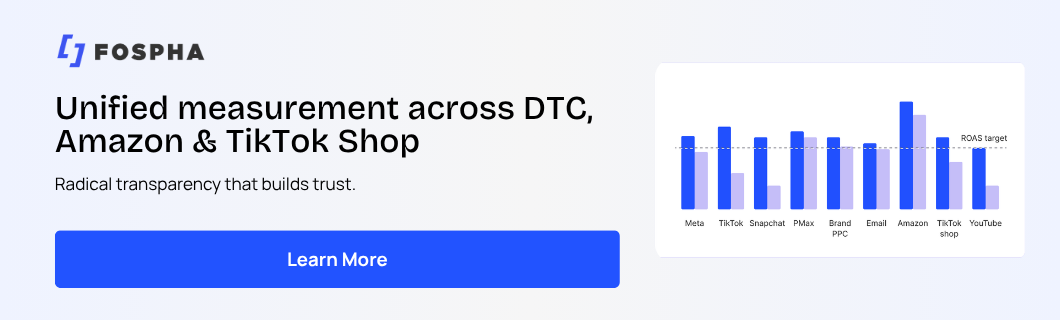
Every session at Shoptalk touched on some version of the same problem: customers are discovering products on TikTok, researching on Reddit, browsing on ChatGPT, comparing on Amazon, and converting in store. The journey is more fragmented than it has ever been, and the measurement tools most brands rely on were built for a simpler world.
Last-click attribution, still the default reporting model for many teams, systematically undervalues the channels that create demand in the first place. When a customer sees a brand on a YouTube creator’s video, discusses it in a Reddit thread, and then searches on Google two weeks later, last-click gives all the credit to that final search. The upper-funnel activity that actually built the intent gets zero recognition. Fospha’s data shows this undervaluation averages over 90% for awareness and consideration channels.
The result is a structural bias that quietly starves the channels responsible for growth. Brands end up over-investing in demand capture at the bottom of the funnel while under-investing in the demand creation that feeds it. The numbers tell the story: brands using Fospha’s full-funnel measurement achieve 30% higher ROAS than the market average. When Amazon halo effects are included, showing how paid social and video drive marketplace sales that siloed tools miss entirely, brands see an average 37% ROAS uplift.
Fospha’s always-on Media Mix Model measures full-funnel impact across every channel, from DTC to Amazon to TikTok Shop and beyond, updated daily at the ad level. In a world where the customer journey looks like the one Shoptalk just spent three days describing, that kind of unified view is the difference between scaling with confidence and scaling on assumption.
Learn more at fospha.com
While the AI conversation dominated hallway discussions, the on-stage sessions that drew the strongest reactions were about something older and less fashionable: knowing exactly who you are and being disciplined about it.
New Balance CEO Joe Preston described a company that grew 180% over five years by getting specific. “We were crystal clear on who that target was,” he said. “A global, independent, 18 to 29 year old. They all had a very similar mindset, and that really codified who we were going to target. It drove our store design, it drove product design, it drove brand activation.”
When asked about holding the line on pricing while competitors discount aggressively, Preston’s answer was simple: control your inventory, price with confidence, and make sure the entire organization believes in the plan. “If your North Star is we’re going to be a premium brand, then it’s not a problem getting people on board. Especially when it’s working.” The brand has spent over $25 million refreshing flagship stores in the past 15 months and plans to open 80 new locations this year.
Coach told a parallel story from a different starting point. Jennifer Yue, SVP of strategy and consumer insights, described a brand that had been “talking to everyone, and because of it, talking to no one.” Their research showed 70% of future category participants would be Gen Z and millennial. The average age of their existing North American customer was outside that group. So they made a choice: go deep on understanding a specific subset of Gen Z consumers they called “the timeless Gen Z,” spending two to three hours in their homes doing in-depth interviews.
What came out of that research reshaped everything: a new positioning around “expressive luxury,” a purpose centered on “the courage to be real,” the elevation of the Tabby bag as an icon, and the redesign of retail stores from intimidating, museum-like spaces to warmer environments called Coach Play.
One of Yue’s most revealing comments was about Amazon. Coach, a premium brand, entered the platform not for sales but for discovery. “The consumer was doing the majority of their first-time research on Amazon. We weren’t playing there, so we were giving up our ability to tell our story in our own voice when they were first discovering us.” Whether purchases happened on Amazon or not was secondary. Owning the discovery layer was the point.
Crocs CMO Carly Gomez described yet another version of the same discipline. The brand has become the number one footwear brand on TikTok Shop by embracing channels before having a full playbook. Their Chief Brand Officer goes on live streams. Dixie D’Amelio does product drops from their office. “You’re going to have some failures along the way,” Gomez said. “But you will learn more from the failures.”
What connects these three stories isn’t a shared strategy. New Balance is investing in premium physical retail. Coach is reshaping its brand identity. Crocs is leaning into social commerce. The common thread is that each made a clear, specific choice about who they serve and then organized everything around it.
For a conference themed around AI, physical retail was surprisingly present.
Macy’s devoted their keynote to the interplay between stores and digital. Max Magni, the Chief Digital Officer, said “stores are our most important asset” on stage, which, coming from the person who runs the digital business, was the kind of line that cut through because it was unexpected. Barbie Cameron, chief of stores, described a prom activation where customers booked appointments with personal stylists, tried on dresses with selfie stations, and worked with on-site makeup artists. “It’s that customer, colleague connection, that building of trust that makes it human,” she said. “That’s really the pivotal point.”
Glossier, in a separate session on stores as venues for connection, described designing try-on tables without mirrors, so that customers have to turn to the stranger next to them and ask how something looks. It’s a tiny detail that manufactures the kind of spontaneous human interaction that no digital experience can replicate.
The Shoptalk closing panel summed up the thread well: Gen Z is showing up in malls and stores at higher rates than expected, not despite being digitally native but alongside it. As Snapchat’s Sid Malhotra put it in the Gen Z session: “It’s not an ‘or.’ It’s an ‘and.’ They’re both digitally native and very heavy physical shoppers.”
YouTube’s closing-day keynote put a number on creator-led commerce that is worth sitting with: 110 million hours of shopping-related content are watched on the platform every single day.
“Creators have basically become the ultimate filter for people’s buying decisions,” Travis Katz from YouTube said. “This is not niche.” YouTube is now using Google Gemini to help brands find the right creator partners at scale, letting them search by audience, category, and creator style with a single prompt.
Jessica Alba, who appeared alongside Travis, offered a practitioner’s perspective from building The Honest Company. Her approach to creator partnerships was to give them no more than three talking points. “More than three and it gets too confusing.” The most successful content, she said, was often the messiest. “Some of our most viral content was, ‘Show your dirty sink.’ Weekend dishes piling up. Laundry from the week I didn’t get to.”
Snapchat’s Sid Malhotra connected this to where Gen Z commerce is heading next. “Where is the next frontier for this generation? It’s chat,” he said. “Conversational commerce, whether or not there’s infrastructure in the platform, is organically happening. If brands don’t embrace chat, it’s going to be the same vertical video story over and over again.” He was referencing 2012, when Snap introduced vertical video and the industry actively mocked it before scrambling to catch up.
Shoptalk’s own content team offered the sharpest framing of the difference between 2025 and 2026. Last year’s theme was “Retail’s New Golden Age,” and the mood was swagger. This year, the organizers said, “it’s kind of like, we don’t know. And just being able to admit that you don’t know, I think there are lots of moments where people in the audience suddenly felt like, oh, maybe we’re not as behind as we think we are.”
The AI conversation has moved past the hype phase and into the harder, slower, less photogenic work of figuring out where it actually helps. The brands pulling ahead are the ones that have not waited for certainty. They are making specific bets, measuring what happens, and staying close to their customers while everything else shifts around them.
The closing session put it simply: “If people don’t have all the answers, it probably means it’s properly hyped. Because otherwise you get people who are completely certain, rushing into behavior they don’t understand.”
After three days in Las Vegas, that felt like the most honest thing anyone said.
Leave a Reply
You must be logged in to post a comment.