Patricia Grundmann on Building OBI's Retail Media Business From Zero
Event Coverage Sponsored by

Eight years ago, retail media inside a DIY retailer had no template. Buying departments had no frame of reference for it. The wrong pitch could make it look like a threat to their budgets rather than a new revenue line. Patricia Grundmann built the function from that starting point. She is Managing Director of OBI Advertising. She launched the business in Austria in 2018 as the first pilot market. Speaking with ClickZ at Shoptalk Europe, she explained what changed inside OBI to make retail media work, what ported from grocery, and why on-site is where she is putting her growth bet for the next two years.
Grundmann’s earliest work was less about advertisers than about her own organization. She had to draw a clear line between what belonged strictly to media and what stayed inside category management negotiations. She also had to align directly with category management, rather than let the new function compete with an existing team for the same budget conversations. “Back then, eight years ago, retail media was nothing you could expect a buying department to have experience in. It could have been a threat for them,” she said. She deliberately positioned the new business as additive, not adjacent, to existing category revenue.
Grocery’s retail media playbook doesn’t transfer wholesale to a DIY footprint. Dwell time and FMCG advertiser demand line up neatly in a grocery store. An OBI store runs closer to 10,000 square meters. Shoppers scatter across distinct journeys the moment they walk in. “We have to really be part of these different journeys, and have much more placements than you probably need in a grocery store,” Grundmann said. She named the garden center, the central hall, and the construction hall as separate entry points. Each needs its own media presence rather than one storewide layer.
OBI’s move to programmatic in-store video through its SSP shifted buying behavior more than format. Advertisers can now pick a specific screen, a specific time window, and a specific department context, instead of buying a blanket package. Grundmann said the demand that unlocked was immediate. “We had thousands of advertisers choosing the right context, the right timing, and also the right budget for the advertisement,” she said. Agencies get the same direct access to the platform.
Grundmann sits on both the BVDW retail media circle in Germany and IAB Europe’s retail media committee. That gives her a direct view into how the two markets diverge. US retailers lean heavily into digital advertising and comparatively little into physical store space. Europe has moved faster on store media itself and is more comfortable running non-endemic advertising. Inside BVDW, the conversation centers on making the full store journey more measurable. Conversations with US counterparts tend to focus on convincing internal stakeholders to fund store media at all.
Asked whether on-site or off-site would drive more growth over the next two years, Grundmann didn’t hedge. Shoppers already treat OBI’s e-commerce shop and app as a planning tool before a store visit. They research and decide there, even when the purchase happens in person. That keeps them engaged with OBI’s owned digital properties longer than the transaction alone would require. She pointed to ROAS as the clearest signal of why that context performs, since the on-site environment is where customers actively make decisions rather than passively encounter an ad. Beyond simple impressions, she named ROAS and incremental ROAS as the metrics that prove a campaign worked. She also named new-to-brand acquisition, which she said retail media’s natural purchase context makes easier to capture than most other channels can manage.
Grundmann named standardization as 2026’s most overused retail media term. Consistency matters, she said, but retailers were never built to be standardized against each other in the first place. Expecting a DIY retailer’s placements to map onto a grocery or beauty retailer’s format misreads what makes each retailer’s context valuable. Waiting for an industry-wide standard before investing further would mean missing the opportunity retail media already offers. On the harder sell, she said non-endemic advertisers take more convincing than endemic ones. That’s less about resistance and more about maturity: the comparable KPIs those brands need to justify budget don’t yet exist in the same depth.
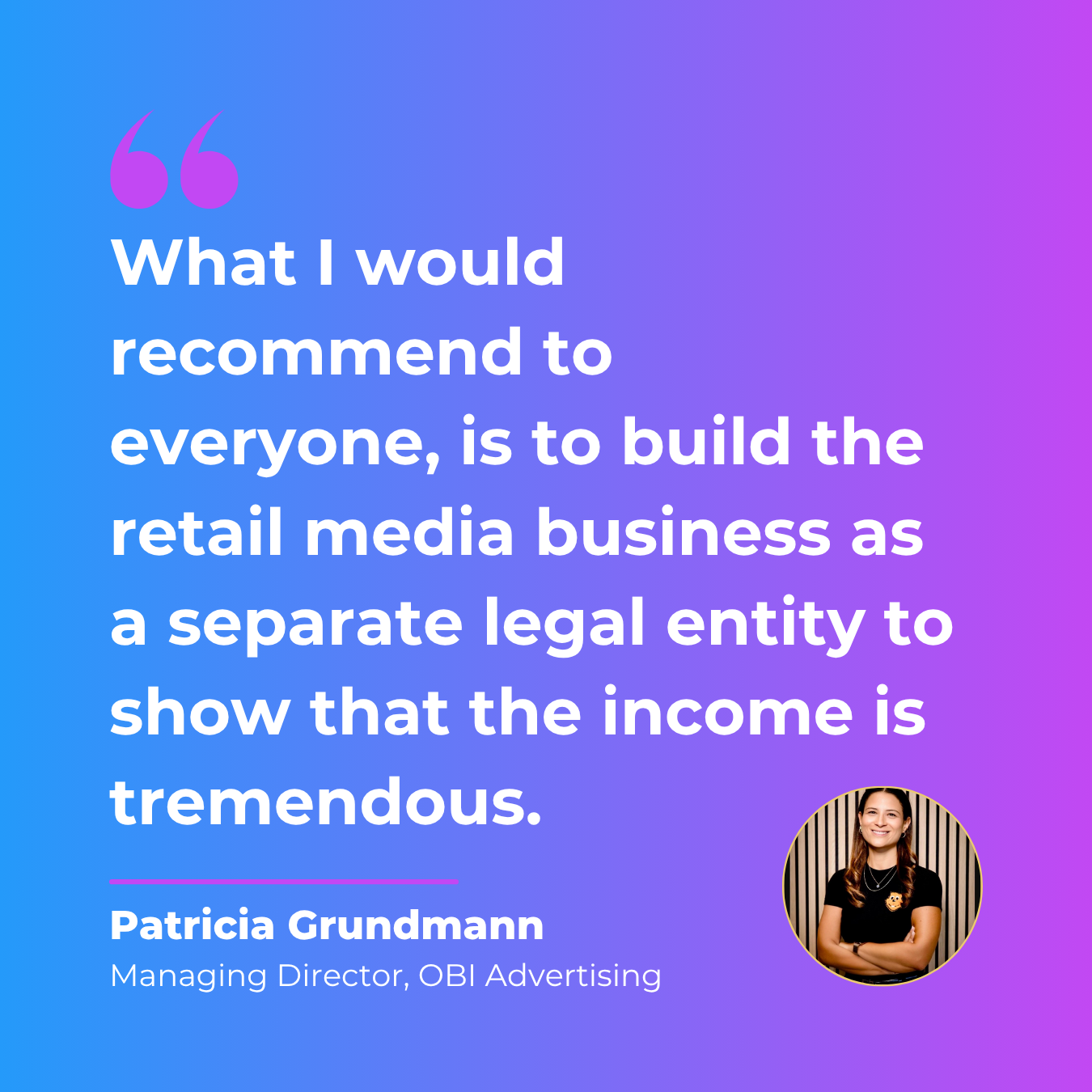
Looking back across eight years of building a business that didn’t exist when she started, Grundmann drew one clear lesson. She set the unit up as its own legal entity, rather than a project team, so nobody could dismiss its revenue as a side effort inside a much larger retailer. Her advice to anyone starting the same build today: spend the fight externally, proving incremental value to the market, rather than internally, defending territory that was never worth defending in the first place.
Leave a Reply
You must be logged in to post a comment.