Product Discovery Now Begins with a Feeling, Says Pinterest's Caroline Orange-Northey
Event Coverage Sponsored by

Product discovery has quietly stopped happening on the shelf, or even in the search bar. Shoppers no longer open with a keyword. They open with a vision of the life they want, an aesthetic, a mood they’re chasing.
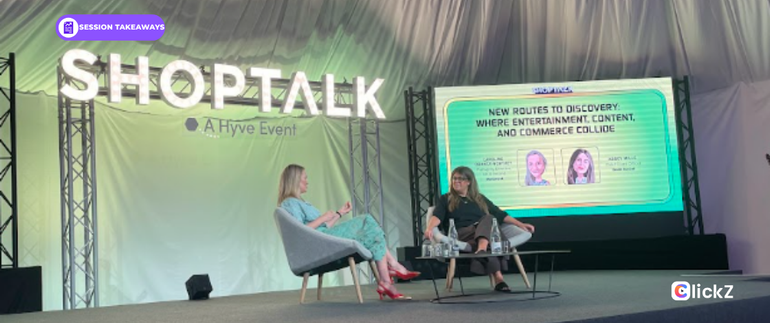
That was the starting point for Caroline Orange-Northey, UK and Ireland Managing Director at Pinterest, at Shoptalk Europe 2026. She joined Abbey Mills, Chief Client Officer at Born Social, for the New Routes to Discovery session. Together they set out to explain why entertainment, content and commerce are colliding, and what that collision means for how brands earn attention.
Orange-Northey’s central claim was straightforward. “Shoppers are humans, typically, and human behaviour doesn’t actually change that much,” she said. What has changed is the format built to serve that behaviour. Visual search rose 44% last year on Pinterest, driven largely by Gen Z, who now make up more than half the platform’s audience. Sixty-nine percent of that cohort say visual results help them more than text when they are close to buying.
Orange-Northey calls this an era defined by intent. Shoppers already know roughly what they want and filter fast toward it, often before they can put it into words.
That intent creates an opening most marketers underuse. “96% of searches on Pinterest are unbranded, so that means there’s a real bit of alchemy or magic, where you can influence brands before preferences are set,” Orange-Northey said. Since the decision has not yet hardened around a name, a brand that shows up early with the right content can shape it before a shortlist ever forms.
Format matters here. Interactive content, collages built like online scrapbooking, earns twice the save rate of any other format on the platform. DFS proved the point with an interior design tool built with WPP and Jungle, gamifying the search for a sofa across six styled worlds. The campaign drove a 5.8 point lift in brand preference and a meaningful lift in purchase intent among the younger audience it targeted.
Pinterest’s forecasting sits behind much of this. Its annual Pinterest Predicts report names around 21 trends a year and has held 88% accuracy over six years, meaning the platform expects 18 or 19 to land. Emma Chamberlain used last year’s fisherman’s aesthetic trend to launch a sea salt toffee coffee, tying both flavour and packaging to the trend. Sales came in more than 200% above expectation on launch day.
Levi’s applied the same logic this year. The brand sponsored Pinterest’s UK summer trend report as searches for women’s denim shorts climbed 430% year on year, and built an off duty denim edit around the data. Its prior baggy season campaign paired video completion goals with Pinterest Performance Plus and trend badging. That combination delivered a 24.7% increase in video completion rate and a 2.6 point lift in brand awareness.
Pinterest has deliberately tuned its algorithm to reward positive content, a choice that runs against the engagement-at-all-costs model most platforms default to. “We’re not chasing content just for a longer dwell time, and actually positivity performs,” Orange-Northey said. Research commissioned with Magna Media Intelligence found that shoppers who perceive a platform as a positive environment show a 94% higher propensity to purchase, with sales rising 24% in that state.
Seventy percent of carts still go unfinished across the industry, and Orange-Northey attributes this less to indecision than to overwhelm, a fear of missing a better option elsewhere. “Curation isn’t just a tool, it is the actual point of the experience,” she said, framing Pinterest’s role as helping shoppers commit faster and with more confidence.
Orange-Northey closed on measurement, and the point cuts against how most teams still report performance. “I don’t think a single source of truth in last click is particularly relevant in today’s complex world,” she said. “I think it oversimplifies things.” A platform’s tracked conversions capture a slice of impact, not the full shape of a decision that started days or weeks earlier as a feeling rather than a search.
That gap is exactly what Fospha’s total commerce measurement is built to close. Rather than crediting the last click a shopper happened to take, Fospha’s approach to The Measurement Operating System for Retail Commerce traces impact across every channel a customer touched on the way to a purchase. It gives marketers a daily, cross-channel view of demand that visual, unbranded discovery like Pinterest’s generates well before a search term ever gets typed.
Leave a Reply
You must be logged in to post a comment.