Why the Smartest Omnichannel Brands Are Thinking in Moments, Not Channels
The modern shopper does not follow a funnel. She watches a TikTok, compares prices on Amazon, checks her Sephora loyalty balance, and buys in store. Sometimes in the span of an hour.
For retailers and brands, this creates a familiar but intensifying pressure: be present everywhere without losing coherence anywhere. The temptation is to treat “omnichannel” as a distribution problem, a checklist of platforms to populate. But the organizations actually winning are treating it as something else entirely: a storytelling discipline anchored to the customer, not the channel.
That distinction was the throughline of a keynote panel at eTail Palm Springs 2026. Moderated by Lauren Livak Gilbert, Executive Director of the Digital Shelf Institute, the session brought together five leaders spanning beauty, home improvement, furniture, apparel, and AI technology: Alexandra Seaman of Furniture.com, Michael McCluskey of Lowe’s, Courtney Miller of Stila Cosmetics, Wayne Liu of Perfect Corp., and David Luba of tentree. Together they mapped the organizational, creative, and data-level decisions required to meet consumers wherever they show up next.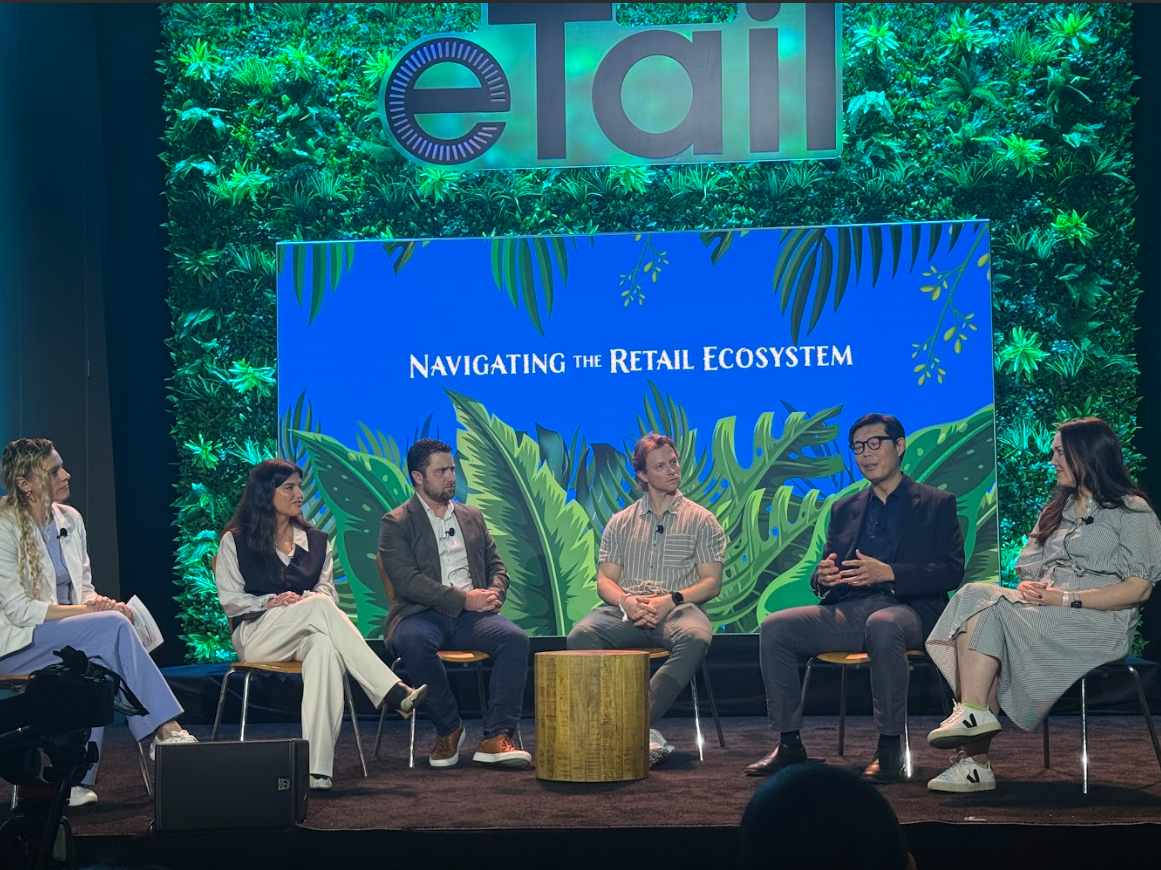
Alexandra Seaman framed the challenge bluntly. The furniture shopper today has a million tabs open, a million influencers to follow, and an expanding set of AI tools, from Perplexity to ChatGPT, reshaping how products get discovered. The real job for Furniture.com is cutting through mid-funnel decision fatigue.
That reframing matters. Seaman argued that owned channels remain the foundation, but their value is increasingly determined by how well they feed into AI-driven discovery. Is your data optimized for LLMs? Is your brand message clear enough to survive extraction by Gemini or ChatGPT? Strong brand equity, she said, “goes a long way” in conversational search.
[Seaman’s point about the gap between upper-funnel awareness and mid-funnel decision fatigue highlights a core measurement challenge. Brands investing in top-of-funnel channels like video and paid social often lack visibility into how those impressions drive downstream action. Fospha, the only full-funnel MMM delivering daily, ad-level insights, is built to quantify the impact of every impression, view, and click, giving teams the data to invest confidently across the full funnel rather than retreating to last-click safety.]
Michael McCluskey brought the perspective of a retailer serving two very different customer states: the break-fix emergency (the washing machine just died) and the dream project (the kitchen remodel you’ve been saving for). Lowe’s framework for keeping both segments in focus is deceptively simple: have it, price it, find it, display it, fulfill it, service it.
The value of that framework is organizational clarity. Each function within McCluskey’s marketplace team knows exactly where it fits. And as agentic commerce begins to surface, those fundamentals become the criteria by which AI agents will choose which retailer to recommend.
McCluskey was also emphatic about the internal collaboration required to present a consistent brand externally. The digital business is often the front door to the enterprise, he noted, and most customers start their purchasing journeys well before they walk into a store. Roadmaps and strategies need to be integrated across brand, marketing, and digital, not just aligned on paper.
Wayne Liu pushed the panel’s logic further. If a customer can start on TikTok, compare on Amazon, and convert through a loyalty program at Ulta, predicting which channel she’ll use to transact is nearly impossible. So Perfect Corp. has stopped trying.
Instead, Liu argued for anchoring everything to the customer and the data associated with her. That data, demographic, behavioral, preference-level, does not change regardless of whether the interaction happens on a retail site, an app, or a social platform. And critically, it is the same data that will power AI chatbots and agentic commerce experiences.
Liu also offered a metaphor the panel returned to more than once. Content and experience do not need to be consistent across channels. But the narrative does. “From Episode 1 to Episode 18, like Stranger Things, you have to be consistent.” Customers grow. The brand needs to grow with them. That means thinking in lifecycles, not campaigns.
Courtney Miller landed the creative counterpart to Liu’s data argument. “I’m not looking to clone my campaign channel to channel,” she said. “I’m looking to have matching luggage.”
The phrase captures a nuance most omnichannel advice misses. The goal is not uniformity. It is coherence. Each channel has a different audience state. Someone in the upper funnel considering a product category is not the same person standing at a gondola in-store trying on eyeliner. Miller’s approach at Stila is to brief with enough clarity that every activation, whether creator-led, affiliate-driven, or in-store, shares the same sales story without sharing the same execution.
She was equally direct about AI’s role in that briefing process. Stila uses AI extensively as a starting point, plugging in seasonal briefs and channel requirements. But Miller pushes back hard on treating AI output as finished work.
“An AI is looking at the average,” she said. “A human being wants highs and lows. And highs and lows are the things that go viral.”
Several panelists made the case that omnichannel success is won or lost inside the org chart.
Seaman described how Furniture.com, a 70-person company, organized its entire team around three stages of the shopper journey: discovery, decision-making, and purchasing. Each group includes business, tech, and ops leads working across marketing, product, and machine learning. The result is that marketing message and site experience stay integrated by design, not by meeting cadence.
David Luba of tentree offered a complementary approach: go narrow and deep. Rather than spreading across too many markets and channels, tentree constrains its presence to stay consistent and measurable. Luba recalled the early days of the brand, spending a million dollars on Facebook in 2011 with extraordinary ROAS. The discipline now is the same: master one channel before expanding to the next.
Miller illustrated the speed this requires with a TikTok Shop story. When Stila’s personalized eyeliner and eyeshadow duos went viral, her team mobilized instantly across email, text, paid Meta, DTC, and in-store field education. “The second they went viral, I had my entire team in a Teams chat being like, okay, let’s execute everything, every channel.” The halo from TikTok Shop expanded because the internal machine was built to move that fast.
[Miller’s description of the “halo” from TikTok Shop virality extending across DTC and in-store channels reflects exactly the cross-channel dynamics that most measurement tools miss. Fospha’s unified measurement captures the impact of paid media on sales across DTC, Amazon, and TikTok Shop, enabling brands to see and invest in these halo effects rather than attributing success to the last click alone.]
The panel’s collective argument reframes omnichannel from a distribution challenge to an organizational and narrative one.
Channels will keep multiplying. Agents will add another layer of fragmentation. The brands that thrive will be the ones that stopped chasing channels and started building around the one thing that does not change: the customer.
EVENT COVERAGE SPONSORED BY FOSPHA

Leave a Reply
You must be logged in to post a comment.