From Dresses to Data: David's Bridal Reinvents Itself as a Platform
Event Coverage Sponsored by

A bride makes over 300 decisions in 18 months. She picks the photographer, the venue, the colors, and the bridesmaids’ dresses. She decides whether she needs teeth whitening before the save-the-date photo. Yet most of those decisions never make it onto a checklist. Instead, they sit in her head, accumulating stress with every passing week.
For 75 years, David’s Bridal was in the business of just one of those decisions: the dress. Now the company is betting that its proximity to the most influential consumer in America gives it permission to be involved in all 300.
Elina Vilk is the president leading that bet. She joined David’s Bridal from a career that ran through PayPal, Meta, and Hootsuite, and she’s overseeing what she describes as a transformation from a 76-year-old retailer into a 76-year-old startup. Speaking exclusively to ClickZ at Shoptalk Spring 2026, Vilk laid out a vision that stretches far beyond the fitting room. It spans retail media, AI-powered wedding planning, original content programming, and a marketplace for more than 2 million wedding vendors.
Vilk’s thesis starts with a reframe. She sees the bride not primarily as a shopper, but as the most valuable media audience available to any brand. The reasoning is quantitative. “90% of all brides in the market will go through the David’s Bridal ecosystem at some point,” she said. “And then you’re looking at someone who is a super influencer, the ultimate influencer.”
Here’s the math as Vilk tells it. Every wedding guest has an average of 200 people in their own social network. So a wedding with 200 guests generates organic exposure to tens of thousands. Meanwhile, the bride controls every visual detail, from the dress to the venue to the aesthetic of the engagement shoot.
After the wedding, though, she becomes something even more commercially valuable. “Married women are household CEOs,” Vilk said. “They make up 85% of all purchase decisions in the United States. I’m talking about the toothpaste that’s in your home, the mattresses, where you live.”
That insight is what drew Vilk to the role. David’s Bridal had this audience and was only selling them dresses.
The company’s AI play centers on Pearl, a wedding planning assistant trained on over 300 tasks that David’s Bridal mapped across the full planning journey. That number matters because, as Vilk explained, the real source of wedding stress is the mental load that never gets written down.
She walked through one example in vivid detail: the engagement photo shoot. On a standard checklist, that’s a single line item. In practice, however, it involves 10 to 20 sub-decisions. Where to shoot, which photographer, what to wear, hair and makeup, whether to whiten your teeth, whether to work out beforehand, when to schedule it. “This is all running through her mind,” Vilk said. “This is one task.”
Pearl’s approach starts with an AI-powered vision quiz. Brides select images rather than answering questions, and the tool generates a personalized vision board. From there, it builds what Vilk called “a knowledge graph about you.” That graph then sequences tasks into a calendar tied to the bride’s wedding date, while also surfacing vendor recommendations, dress options for bridesmaids with an upvoting feature, and even AI-generated wedding websites.
“She, Pearl AI, she understands weddings really well, and she can help you with any task,” Vilk said. “She can help you find vendors. She can help you book things. She can help you curate things.”
Still, Vilk is careful to frame the AI as a tool that accelerates decisions rather than replacing them. “AI can’t marry your husband,” she said. “Not yet, at least.”
When asked why David’s Bridal hadn’t built a retail media network sooner, Vilk didn’t hedge. “That was my first thought,” she said. “First-party data, Gen Z bride, most valuable customer, period. Why wouldn’t you build a retail media network?” As a result, it was the first initiative she launched upon joining.
The media network also connects to a broader customer acquisition strategy that Vilk refined over years at PayPal. There, she ran co-marketing with retailers across verticals from electronics to luxury. Her key takeaway from that experience: “When you mix all the colors, they turn brown.” In other words, treating customers as segments flattens what makes them convert. By contrast, the media network generates early behavioral signals that identify individual preferences. Over time, those signals build a lifecycle journey that doubles as an acquisition engine.
Vilk outlined a three-tier influencer model organized around what she calls the three phases of the customer journey: awareness, relevance, and significance. At the top sit large-scale paid influencers and celebrities, driving awareness. In the middle, mid-tier creators with dedicated followings build relevance. Then at the bottom, David’s Bridal recently launched an ambassador program that enlists store stylists and passionate customers to sell to their own networks on commission.
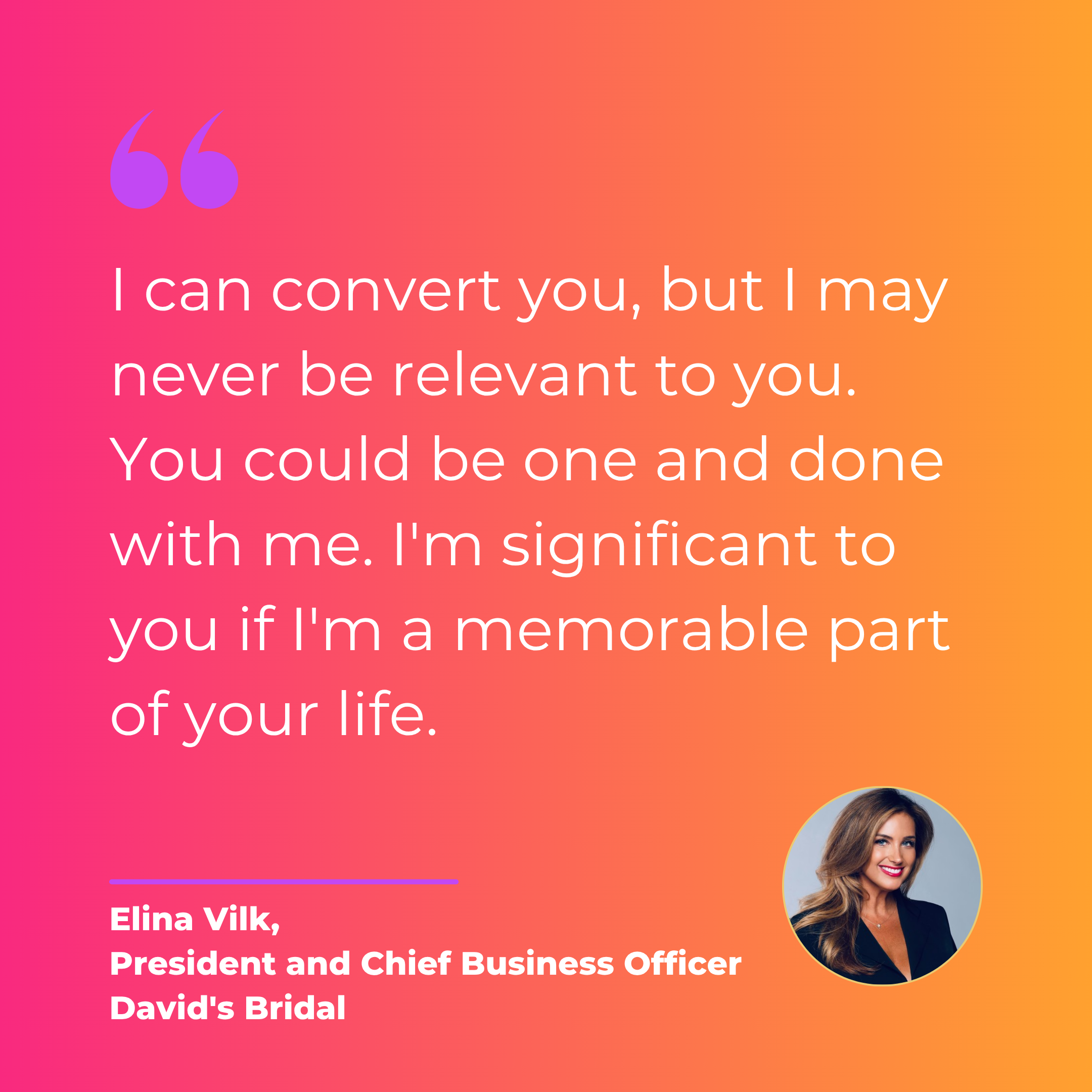
“They could have 10 followers, I don’t care,” Vilk said. “It’s really about that authentic relationship at the bottom layer and the significance layer.” Importantly, she drew a sharp distinction between conversion and significance: “I can convert you, but I may never be relevant to you. You could be one and done with me. I’m significant to you if I’m a memorable part of your life.”
The conversation closed on the topic of trust, and specifically what David’s Bridal learned from its bankruptcy. Vilk pointed out that throughout the process, the company never failed to deliver a single dress. To her, that reflects something fundamental about the brand’s DNA.
But she pushed the definition of trust further. “Your dad walks you down the aisle,” she said, “and so does David’s.” The stress reduction that Vilk keeps returning to, the hundreds of sub-tasks Pearl now handles, is her answer to how you earn that trust going forward. “It’s not just in the big moments, but it’s in the micro moments,” she said. “If we can help you take something off your mind, or something off your list, you can breathe a little bit better that day. That slowly builds the trust.”
Leave a Reply
You must be logged in to post a comment.