When a 39-Year-Old Brand Finally Looks Upstream - Exclusive Q&A with Jennie Kaylie (Travelpro)
Event Coverage Sponsored by

There is a specific kind of brand problem that established companies rarely talk about openly: the moment when your loyal customers are aging out, and the next generation does not know you exist.
For Travelpro, the luggage brand that has been a staple among flight crews and frequent travelers since the late 1980s, that moment arrived quietly. The company had spent years building toward conversion, refining lower-funnel tactics, and serving a customer base that already trusted them. It was working. But the pipeline of new, younger customers was thin – and by the time they were ready to buy luggage, Travelpro was not part of the conversation.
Jennie Kaylie, Head of Marketing and Product at Travelpro, spoke with ClickZ on the ground at Shoptalk Spring 2026 in Las Vegas. The conversation covered how a brand with nearly a century of heritage rethought its marketing architecture from the ground up, and what it took to measure the results honestly.
Travelpro’s identity is tightly bound to superior performance and heritage. The brand originated with pilots who needed luggage that could survive the demands of professional travel, and that practical DNA has always shaped product development. Kaylie described a portfolio built around the world’s most ambitious travelers, proven in the field, competing against other brands in smoothness and strength – with unique features like wheels that glide straight, hands-free.
But the brand’s core demographic had historically skewed older. As Kaylie put it, the product was excellent, the loyalty was real, and the problem was structural:
“By the time they got into being ready to buy a bag, it was too late for them to know our brand.”
A younger audience with different aesthetic preferences and different travel habits was out there. Travelpro was not in their consideration set.
The design evolution Kaylie described – maintaining core functionality while shifting to a more elevated, modern aesthetic – was one response to that gap. The more consequential change was in where and how Travelpro showed up in the market.
The decision to invest in upper-funnel activity is rarely straightforward for a performance-oriented brand. The questions are predictable: What does it cost? How do you measure it? What does leadership need to see? Kaylie was candid about how Travelpro navigated that transition, and the uncertainty that preceded it.
Snapchat became a telling case study. Early into the brand’s presence on the platform, attribution infrastructure was incomplete. The data looked flat, and at one point Kaylie said the team had even considered stopping their investment altogether. The channel looked like it was not working. The problem was that they could not see what it was actually doing.
Once proper measurement was in place, the picture changed entirely.
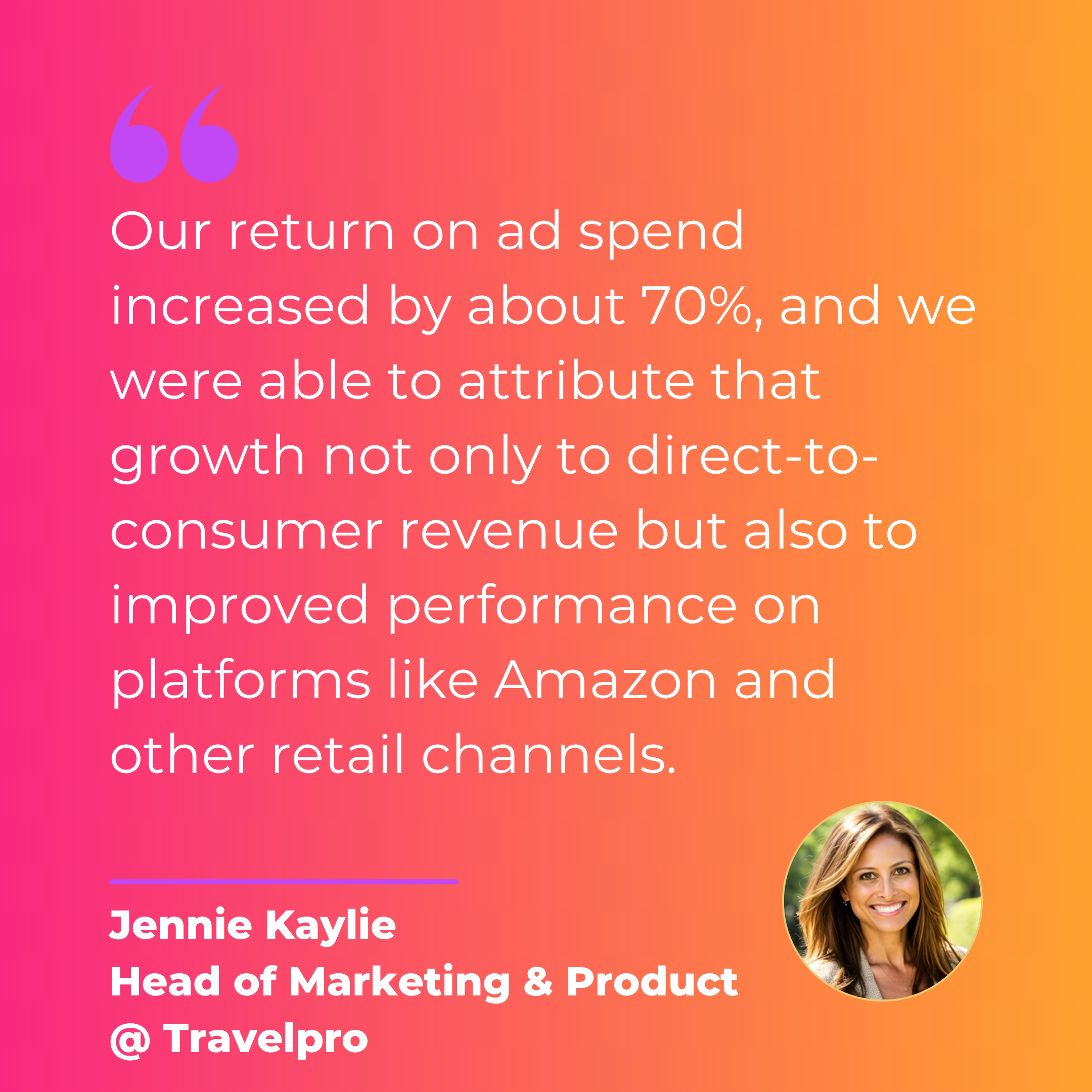
“Our return on ad spend increased by about 70%,” Kaylie said, “and we were able to attribute that growth not only to direct-to-consumer revenue but also to improved performance on platforms like Amazon and other retail channels.”
Travelpro’s measurement work, done in partnership with Fospha, surfaced something performance marketers often miss: paid media’s influence does not stop at the DTC checkout. Incremental lift was showing up in Amazon sales and other eCommerce platforms too, connecting upper-funnel spend to a channel many brands track entirely separately.
Travelpro’s experience reflects a core measurement gap Fospha addresses directly. Last-click attribution systematically undervalues upper-funnel channels like Snapchat, which often drive awareness and intent that converts across multiple touchpoints rather than in a single session. Fospha’s Halo product measures paid media’s impact on marketplace sales including Amazon — which is precisely what Kaylie described: a 70% ROAS uplift only visible once cross-channel incrementality was properly accounted for.
What incrementality testing confirmed was that the new customers coming through Snapchat were genuinely new. “The incrementality showed that we were not just cannibalizing consumers who were already going to convert,” Kaylie said. “That was quite eye-opening. It really changed our philosophy on upper-funnel marketing – realizing that you can actually measure it, and properly attribute return on investment.”
That clarity, she noted, was “incredibly valuable to leadership.” The internal case for upper-funnel investment often stalls not because leadership is opposed in principle, but because no one has shown them numbers they trust.
Beyond the attribution findings, Snapchat itself delivered something Travelpro had not expected: a meaningfully different consumer profile. “We quickly realized we were attracting a completely different type of consumer,” Kaylie said. The content that worked was low-fidelity and easy to produce, which also made it easier to repurpose across other channels.
The audience fit mattered strategically. Younger families represent a demographic Travelpro is actively trying to reach – people whose travel habits are forming, whose purchase decisions are not yet locked in, and who could become long-term customers if the brand shows up early enough. Snapchat, in Travelpro’s experience, was where that audience actually was.
The pendulum question — brand building versus performance — does not have a clean answer for Kaylie. She described a rough 70-30 lean toward performance, reflecting Travelpro’s heritage as a product-led brand. But she was clear that the emotional dimension of the product matters and cannot be optimized away.
“People genuinely care about and love our brand,” she said. “They want to stay connected to it.”
The through-line of Kaylie’s approach is less about any single channel decision and more about sequencing: understand the consumer journey first, then identify where the brand is absent and what it would take to show up meaningfully. Her framing of the team’s current priority:
“Authentically getting our product in the hands of people who are really going to share, rather than top-down.”
For a brand that built its reputation through professional word-of-mouth, that instinct is familiar. The execution, in an era of Snapchat pilots, incrementality models, and full-funnel measurement, looks very different from what it did a decade ago.
A hundred years of brand equity is not a marketing strategy. What Travelpro is building now is the infrastructure to convert that heritage into something the next generation actually encounters before they are standing in an airport, bag in hand, too late to be a new customer.

Leave a Reply
You must be logged in to post a comment.