OBI's Patricia Grundmann Shows How CRM Data Repositioned a Premium Bathroom Brand
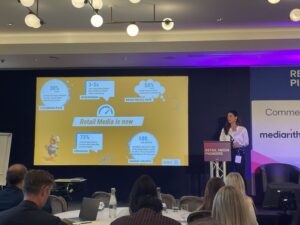
OBI is a European home and garden retailer with a 55-year heritage across 10 countries and 642 stores. Retail media has been one of its four core strategic pillars for the past three years. Patricia Grundmann, Vice President Media & Retail Media at OBI, used her Retail Media Pioneers session to walk through a 2024 campaign for GROHE, one of Europe’s best-known bathroom fixture brands. She framed it as a test of whether first-party CRM data could reposition a product into a premium segment.
Grundmann opened by explaining why home and garden retail media depends so heavily on precise targeting. A lawnmower advertised to a shopper living in a flat without a garden is wasted spend. The product simply isn’t relevant to that customer, however well the creative performs.
To avoid that kind of mismatch across OBI’s more than 9 million loyalty users, the retailer built an AI detection system. It identifies life events behind a customer’s purchases: moving home, based on searches for boxes or a change of address; having a child; renovating a specific room. OBI shares more than 200 of these customer segments with CTV, audio, and display partners through a clean room. It then combines them with personalized creative both onsite and in physical stores.
The GROHE campaign centered on a black-finish shower system, a premium aesthetic upgrade. Grundmann said this kind of upgrade is inherently harder to sell. A customer can’t simply swap one fixture; switching to a black system means replacing every other fixture in the room to match.
The goals were clear: build awareness among DIY and home shoppers, drive purchase intent, and reinforce GROHE’s premium positioning in a crowded, competitive fixtures category.
OBI combined its CRM-derived audiences with a channel strategy spanning onsite, social, and display. The team targeted lookalike audiences built from first-party data alongside shoppers who had already shown intent through retargeting. The campaign ran for six weeks across five countries: Germany, Austria, the Czech Republic, Slovakia, and Hungary. It used OBI’s first-party data, drawn from web consent and the Hey OBI app, to identify relevant customers both on and off OBI’s own platforms. A two-phase media strategy started with high-reach placement across YouTube, the Google Display Network, and Meta, then moved into a performance phase using smart retargeting to reach people who had already shown interest.
The campaign generated 32.9 million gross contacts within the target group. Shoppers spent an average of one minute and nine seconds on the landing page. Product page views rose 237 percent, and sales climbed by up to 196 percent across the markets involved.
Grundmann was direct about the limits of that figure. More than 90 percent of OBI’s sales happen in-store, so the measured sales uplift almost certainly understates the campaign’s true impact once the team factors in-store purchases back in through CRM extrapolation.
She framed the result as a three-way win. Customers received a message relevant to their own context and financial position to make the switch. GROHE trusted OBI with both its brand and performance campaign across five markets, based on the strength of that context and data. OBI, in turn, demonstrated a business model that helps brands communicate more effectively than they could alone. The retailer runs three times the number of campaigns for its partners that it runs for itself, a scale no single brand could replicate on its own.
Grundmann closed with three developments she expects to shape retail media going forward.
The first is self-service measurement. OBI runs thousands of live campaigns at any given time, so an accessible, dashboard-based view of ROI is becoming a core requirement rather than a nice-to-have.
The second is AI. OBI’s customers visit its stores up to eight times a year, generating a volume of data no team could analyze manually. AI also helps produce creative fast enough to stay locally relevant, since a national campaign makes little sense when weather and seasonal conditions vary sharply by region.
The third is the shift away from cookies. Grundmann said this shift is already accelerating the value of CRM data as the industry’s most reliable first-party foundation. “It will change the whole media industry,” she said.
Leave a Reply
You must be logged in to post a comment.