Musely's Jack Jia on Making Medicine the Industry Forgot
The $300 billion skincare industry has a problem it rarely says out loud. Over-the-counter skincare cannot legally change your skin. The moment a topical ingredient does something real, it counts as a drug. So it needs a prescription, a doctor, and a supply chain. Almost no consumer brand wants to build all that.
Most companies route around that wall. Jack Jia walked straight into it.
Jia is the founder and CEO of Musely. It is a telehealth company, and he describes it in clinical terms, not cosmetic ones: medicine for skin, hair, body, menopausal conditions, and longevity. He is also, by his own account, an unlikely person to run it. He is a computer scientist and serial entrepreneur, and he built three internet companies first. Then his wife got melasma. She fought it for more than 20 years. She tried hundreds of creams. She also tried six years of laser treatments, running $1,500 each. Nothing worked. So Jia built a skincare marketplace in 2018 to fix it. It stocked 900 emerging natural and organic brands. But that did not fix it either.
“That forced us to rethink the entire industry,” he said. The conclusion was uncomfortable. The products were never built to work.
What Musely did next is what makes it hard to copy. The company did not source manufactured products. Instead, it built its own compounding pharmacies from scratch. There are two of them, across 80,000 square feet of equipment.
As a result, Musely fills prescriptions in reverse of the usual order. “The doctor writes the prescription, then we start to make the drug, on the fly, freshly made for that patient,” Jia said. He calls it a “pharm to table” model, where the farm is the pharmacy.
He also draws a sharp line between this and the rest of telehealth. Most peers, he argues, are “more drug resellers than actual R&D and manufacturers.” In other words, they scaled on Viagra, acne treatments, and GLP-1s. They did not formulate their own.
Most brands treat AI as a content and operations tool. Inside Musely, though, it sits in the lab. Jia says the R&D team now runs on an agentic model. “We have 30 engineers, and now we have 300 agents writing code. The engineers are conductors now.”
The bigger use is research. Musely runs meta studies, which means it analyzes existing clinical literature. That work used to eat up the time of its chief scientist, its pharmacists, and its medical directors. Now AI lets the team search every study and reach answers faster.
Still, the ingredients stay deliberately unglamorous. Musely favors active pharmaceutical ingredients with 25 to 30 years on the market. Millions of users have proven them safe. In fact, Jia notes, roughly 99% of those APIs have lost patent protection. So no one has a commercial reason to promote them. “They’re the best drugs, but they’re buried,” he said. “The industry has no incentive to let people know about them.”
Musely asks people to put compounded prescriptions on their faces, and sometimes to swallow them. So credibility is the entire business. Jia frames it as a brand problem first, and a clinical one second. “Without trust, people wouldn’t put it on their face,” he said.
His answer is almost stubbornly simple. Build something that works. His wife became Musely’s “patient ze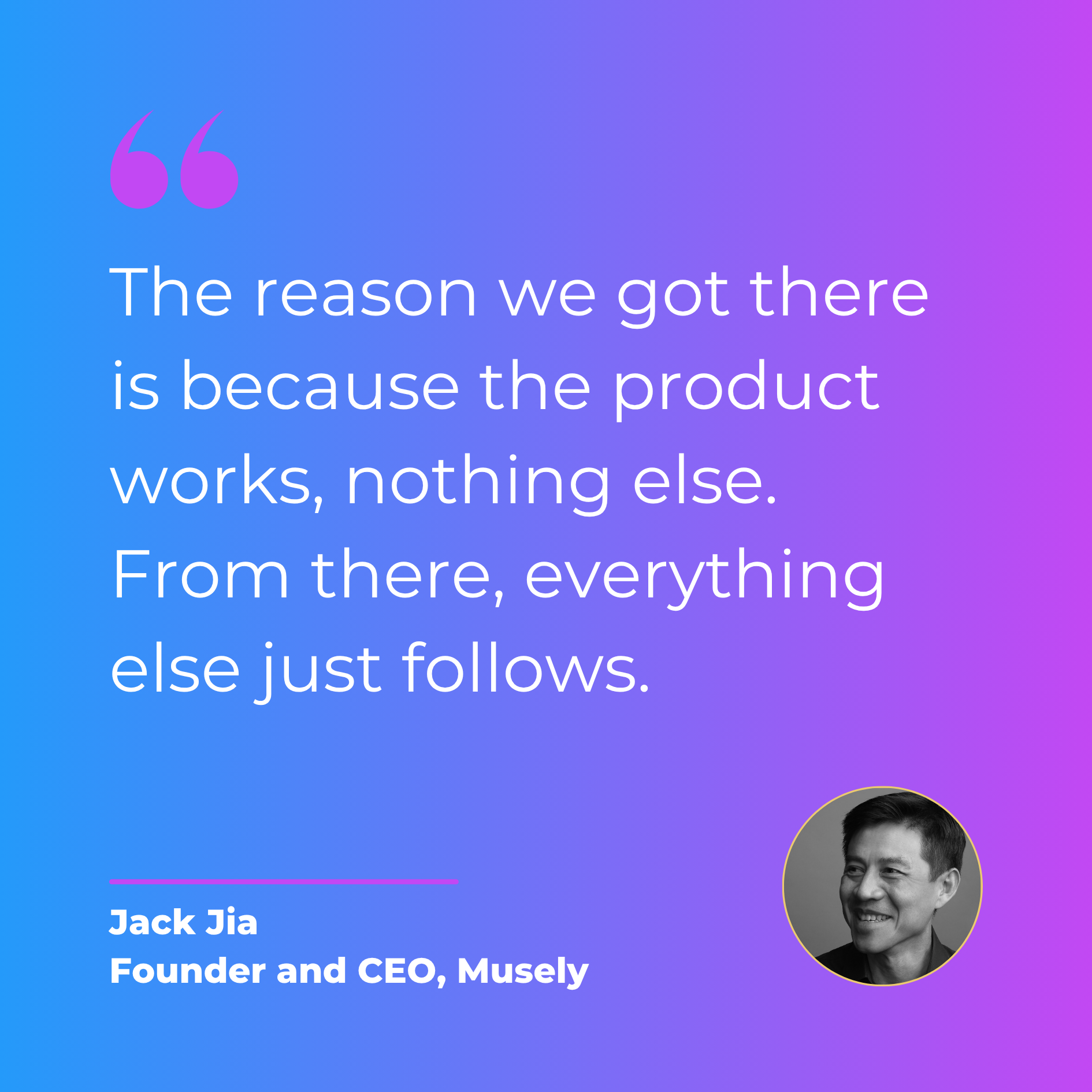 ro,” and her melasma cleared in 30 days after two decades of failure. He says 90 to 95% of customers arrive having tried everything else first.
That outcome then compounds into growth. Half of Musely’s customers come from friends-and-family referral. Because of it, the company built an annual customer campaign, Musely Works, around tens of thousands of before-and-after submissions.
The loyalty numbers back the approach. Jia cites an independent survey, and it found that 27% of people aware of Musely would defend the brand unconditionally. A 2026 USA Today ranking also named it the most trusted telehealth brand, and seventh across all of beauty and health.
Musely started with two products. Now it offers 29 treatments across skin, hair, and hormonal health. That includes HRT for menopausal conditions. Jia entered that category three and a half years ago, when many still treated it as taboo.
His longer thesis reaches past skincare entirely. He argues the body peaks in its chemical production in the mid-to-late 20s, then declines. But bioidentical compounds can help. These are things the body already makes, like estrogen and retinoic acid. Under medical supervision, you can add them back.
He is also blunt that this is medicine, not biohacking. “The current healthcare really should be called sick care,” he said. As he sees it, the system serves the few people who get acutely ill, not the many who just want to stay well.
That reframing is the real ambition behind a company that looks, from the outside, like a skincare brand. Jia built a medical systems business first, then let the products follow. That is also why he resists comparisons to L’Oreal or Estee Lauder. His bet started with one untreatable condition. Now it has grown into a simple argument: medicine belongs in everyday wellness, and Musely wants to get there first.
Jack Jia is a four-time serial entrepreneur and technology investor with experience spanning technology, beauty, health and AI. He has invested with leading venture firms including Rally Ventures, WIN (Winfunding), TSVC, and GSR Ventures, turning startups into unicorn companies collectively valued at over $100 billion.
He is the Founder and CEO of Musely, a telemedicine platform redefining access to prescription treatments across skin, hair, body, menopause/HRT, longevity and more. Since launching in 2019, Musely has served millions of patients and has been recognized by Inc. 5000 as the fastest-growing DTC tele-dermatology company for two consecutive years. In 2026, Musely was also ranked the #7 Most Trusted Brand in Beauty and Health by USA Today among 20,000 brands.
Under Jack’s leadership, Musely integrates clinical rigor with technology and personalized care to make prescription treatments more accessible, effective, and affordable. The company works closely with dermatologists, OB-GYNs, chemists, pharmacists, and other scientists to develop differentiated, evidence-based solutions for cosmetic and wellness conditions that have historically been underserved.
Leave a Reply
You must be logged in to post a comment.