Saatva's CMO on How the LA28 Games Bet Paid Off
While most mattress brands still compete on coil counts and pillow tops, Saatva has spent the last few years competing in the Olympics. For a luxury brand built around a premium product, white glove delivery, and a long consideration cycle, putting national TV and a Team USA sponsorship at the center of the strategy looks like a gamble. Joe McCambley, Saatva’s Chief Marketing Officer, frames it instead as the logical end of a decade-long climb up the funnel.
McCambley spoke with ClickZ at The Lead Summit about how a direct-to-consumer brand justified that spend, how it measured the payoff, and why he believes most marketers ask the wrong question about channels.
The partnership began not as a media buy, but as a problem to solve. During the Paris 2024 Summer Olympics, reports emerged about athletes struggling with their sleeping arrangements. In response, CEO Ron Rudzin emailed Joe McCambley and COO Arthur Melville with a simple question: What could Saatva do to help? The initial answer was, admittedly, not much. The company had no sponsorship rights and no practical way to ship mattresses to Europe on short notice.
Rudzin wasn’t satisfied with that answer. Instead, he turned the question into a mandate, challenging the team to find a path forward. That search ultimately led to conversations with the U.S. Olympic & Paralympic Committee and NBC, resulting in a landmark partnership: Saatva will provide up to 10,000 beds to the athletes’ village at UCLA during the Los Angeles Games. Importantly, those beds will serve every competitor, not just Team USA, reflecting a simple belief that better sleep benefits all athletes and elevates the performance of the Games as a whole.
Saatva had advertised for years as the brand that makes luxury mattresses affordable, but the Team USA sponsorship pushed it toward something more culturally durable. That shift came from the athletes themselves, surfaced through a podcast in which the brand interviewed its partners about how they sleep.
The stories reframed what Saatva stood for. Figure skater Tara Lipinski described practicing at a mall rink at 3:30 in the morning, then sleeping so deeply that her parents carried her to bed. U.S. Cross-country skier Jessie Diggins talked about collapsing at the finish line of her races, and about the anxiety and disordered eating she has navigated over the years. U.S. Paralympians Brenna Huckaby and Jessica Long spoke about rebuilding their lives after losing a limb.
For McCambley, those experiences connect directly to everyone else. “Even for Olympic athletes, they’re humans, and as humans, we all deal with things day to day that we have to recover from,” he said, pointing to the teacher worn down by a roomful of kids or the nurse on her feet all day. The Luxury of Restorative Sleep, the idea the brand eventually built around, applies to all of them.
The confidence to sponsor an event as high-profile as the LA28 Olympic and Paralympic Games came from a pattern Saatva had tested repeatedly. From 2009 to 2017, the brand ran essentially one channel, non-branded search, and grew to roughly $168 million on it. Then, around 250 competitors entered the category, many of them selling cheap boxed foam mattresses, and the cost per click climbed above $20 on holidays like Memorial Day until Saatva lost money that year.
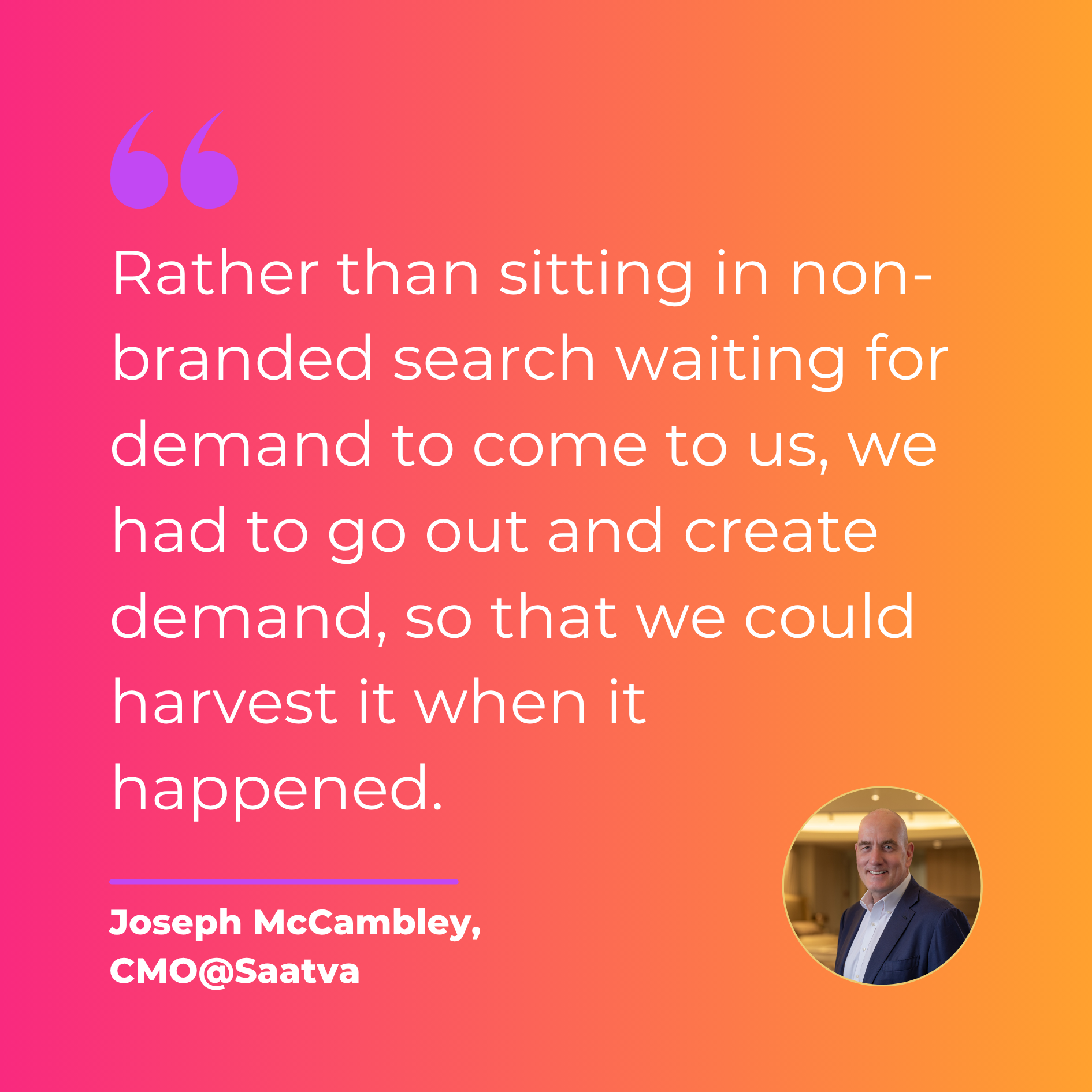
That pressure forced the brand up the funnel, away from waiting for demand in search and toward creating it. McCambley grounds the strategy in research from WARC and the Ehrenberg-Bass Institute, particularly the principle that when a brand’s share of voice exceeds its share of market, market share eventually follows. Market share might take six months to move, but branded search responds almost immediately.
Every step rewarded spending more, which is why the pattern mattered. Radio and podcasting lifted branded search within three weeks, and linear TV at $2.80 CPMs sent it up like a hockey stick. Streaming costs four times as much, so McCambley resisted it until he saw site visits within 30 minutes of a spot come in roughly 10 times higher. Premium sponsorships at $40 CPMs beat even that. “When we looked at our journey from linear to streaming to streaming sponsorships, and where we learned that spending more could be very good for us, that gave us the courage to take a leap into the Olympic sponsorship.”
McCambley accepts that a mattress has to work harder than a sneaker or an energy drink to belong in sports, and he turned that disconnect into the case for owning the space. Footwear matters to some athletes, and energy drinks suit a narrow band of performance, but sleep reaches all of them.
“100% of every Olympic athlete sleeps, and 100% of them rely on sleep for recovery, and for us that was a really big unlock.”
The relevance only holds when a brand commits to a sport rather than buying spots around it. A single ad during a televised football game reads as an ad, whereas a sustained presence across broadcast, rink-board signage, and in-person activation tells fans the brand genuinely belongs there. The athlete partnerships follow the same logic, since an Olympic competitor who trained for years in relative anonymity arrives with both humility and a clear sense that the visibility helps both sides.
McCambley’s north-star metric is branded search, supported by four years of data tying impressions to search, and search in turn to market share. This February, the brand ran far fewer TV impressions than usual and braced for the fallout, yet every associated metric improved, from market share to direct site traffic. “As your branded search rises, every other metric down the chain also goes up at the same time.”
That system’s view drives his sharpest advice. The question he hears most, which single channel he would keep, is the one he refuses to answer. “I’m managing 20 channels, and I have to prove that all of those 20 channels are working together more powerfully.” Before any significant move, Saatva looks for at least three data points that support it, and McCambley argues that the marketers who skip that discipline and rely on instinct are the reason CMOs tend to last only two years.
All of it depends on time, which leads to his most unusual piece of advice: go CEO shopping. Building a brand takes more than two years, longer than most CMOs are given, so he wants a chief executive with the patience to wait, a genuine facility with numbers, the instinct to make a call when the data is ambiguous, and the loyalty to back a CMO through constant second-guessing. Rudzin had all four, including the patience to accept a three-to-four-year timeline. That patience is the thread running through Saatva’s whole approach, a brand that spent more, waited longer, and measured the full system rather than chasing the nearest click.
Joseph McCambley is a digital marketing pioneer with decades of experience driving customer acquisition, brand strategy, and creative direction. He originally joined Saatva in 2017 as Chief Strategy Officer before transitioning to the CMO role in late 2018.
Leave a Reply
You must be logged in to post a comment.