Gen Z Proved the Old Rules Were Wrong
At Shoptalk, Crocs, Coach, and Snapchat made one thing clear: brands still running linear funnels at a non-linear generation are not behind the times. They are behind the consumer.
The awareness-consideration-purchase sequence was a convenience, not a truth. It mapped onto how media worked, not how people worked. Gen Z did not shatter it. They just made it impossible to pretend it was real.
What emerged from the Crocs, Coach, and Snapchat session at Shoptalk Spring 2026 was not a new framework. It was an honest description of how decisions actually happen: a creator video, a group chat, a marketplace search, a pause of weeks, a store visit, a purchase. No single trigger. No predictable sequence. No moment any brand can claim ownership of.
The brands still trying to optimize a path through this are solving the wrong problem.
Gen Z does not discover brands. They research them, often over weeks, entering the purchase moment with more knowledge than many brand teams assume they have.
This changes what marketing has to do. Features do not persuade people who have already read every review. Benefits do not move people who have watched twelve unboxings. What moves them is alignment: does this brand reflect something true about who I am or who I want to be.
Both Coach and Crocs understood this and rebuilt accordingly. Coach moved away from status and aspiration toward self-expression and confidence. Crocs leaned into joy and emotional storytelling rather than product-led messaging. Neither shift was a campaign. Both were repositionings of what the brand stands for.
Amazon is not a retail channel. For Gen Z, it is a search engine. Coach’s decision to invest in the platform was not about incremental sales. It was about not ceding the discovery moment to competitors by absence.
The same logic applies across social platforms, creator content, private group chats, and in-person experiences. Discovery has become radically decentralized. The question is not which channel to own. There is no channel to own. The question is whether you show up consistently across all of them.
Brands that have not rethought their presence map for this generation are invisible in the moments that matter most.
Every session at Shoptalk touched on some version of the same problem: customers are discovering products on TikTok, researching on Reddit, browsing on ChatGPT, comparing on Amazon, and converting in store. The journey is more fragmented than it has ever been, and the measurement tools most brands rely on were built for a simpler world.
Last-click attribution, still the default reporting model for many teams, systematically undervalues the channels that create demand in the first place. When a customer sees a brand on a YouTube creator’s video, discusses it in a Reddit thread, and then searches on Google two weeks later, last-click gives all the credit to that final search. The upper-funnel activity that actually built the intent gets zero recognition. Fospha’s data shows this undervaluation averages over 90% for awareness and consideration channels.
The result is a structural bias that quietly starves the channels responsible for growth. Brands end up over-investing in demand capture at the bottom of the funnel while under-investing in the demand creation that feeds it. The numbers tell the story: brands using Fospha’s full-funnel measurement achieve 30% higher ROAS than the market average. When Amazon halo effects are included, showing how paid social and video drive marketplace sales that siloed tools miss entirely, brands see an average 37% ROAS uplift.
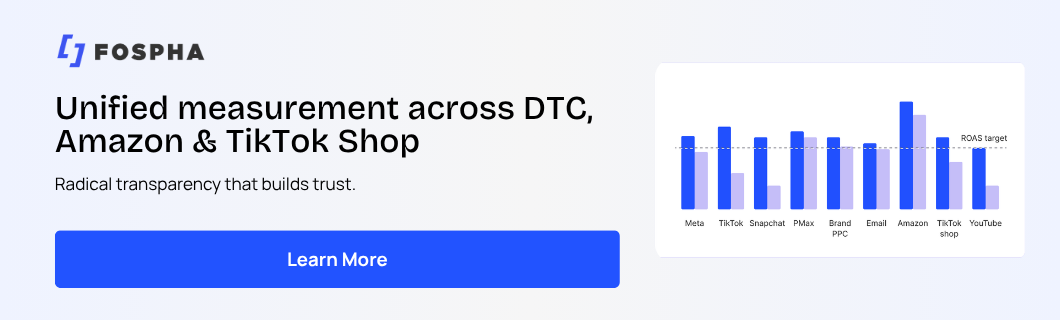
Fospha’s always-on Media Mix Model measures full-funnel impact across every channel, from DTC to Amazon to TikTok Shop and beyond, updated daily at the ad level. In a world where the customer journey looks like the one Shoptalk just spent three days describing, that kind of unified view is the difference between scaling with confidence and scaling on assumption.
Learn more at fospha.com
Two failure modes dominate this space. The first is not knowing the consumer well enough. Assumptions replace insight, messaging disconnects, and the brand talks past the person it is trying to reach.
The second is chasing cultural moments without a stable foundation beneath them. Virality creates spikes, not loyalty. Brands that live trend to trend become, in time, impossible to remember.
The brands winning with this generation are not the fastest to react. They are the most consistent. They know who they are, which means they know what to say yes to and, just as importantly, what to ignore.
In a generation that has seen every playbook, the only thing that still works is being real about what you stand for.
AI is accelerating execution across every part of this: trend identification, content creation, insight generation. Teams that once took months to build a picture of their consumer can now do it in days.
But speed without direction is just noise at scale. Without a clear consumer understanding and a strong strategic foundation, AI amplifies existing weaknesses rather than correcting them. The brands winning here are combining speed with clarity, not substituting one for the other.
Coach shared one of the session’s sharpest strategic insights: as the brand began to resonate with younger consumers, that momentum extended into older demographics as well.
Culture moves in one direction. Younger generations set it, others follow. This is not about multi-generational targeting. It is about understanding where cultural momentum originates and showing up at the point of entry.
Brands that focus on the right entry point do not just win a demographic. They create a ripple that runs through the whole customer base.
The overarching shift from this session is not tactical. It is a change in what marketing is for.
Campaigns that push messages out to consumers are giving way to participation in conversations consumers are already having. That means showing up before purchase intent exists, creating content people actually want rather than content they skip, and accepting that control over the journey is fundamentally gone.
The brands that adapt will remain relevant. The ones that do not will find that being loud is no substitute for being trusted.
Leave a Reply
You must be logged in to post a comment.